
Trigonometric Identities
Trigonometric identities are equations involving trig functions that hold true for every valid value of the variable. You’ll use them constantly, whether you’re simplifying expressions, solving equations, or proving other results. They’re the backbone of trigonometry.
Sine, cosine, and tangent are your primary trig functions. Secant, cosecant, and cotangent round out the set. All six build on each other, and the identities below connect them in ways you need to know cold.
What are Trigonometric Identities?
A trigonometric identity is an equation involving trig functions that’s true for all values of the variable where both sides are defined. This isn’t something you verify with one angle and call it done. It has to work everywhere.
There are many distinct identities, and they involve both the side lengths and angles of a triangle. One thing to keep in mind: most of the basic definitions start with a right-angled triangle. If you need a refresher on how functions behave at their core, check out the notes on function notations and rules.
All trigonometric identities trace back to six ratios: sine, cosine, tangent, cosecant, secant, and cotangent. Each ratio is defined using the sides of a right triangle (adjacent, opposite, and hypotenuse). Once you understand these six, every identity below is just algebra.
Trigonometric Identities
Using a right-angled triangle as your reference, here’s how each trig function is defined.
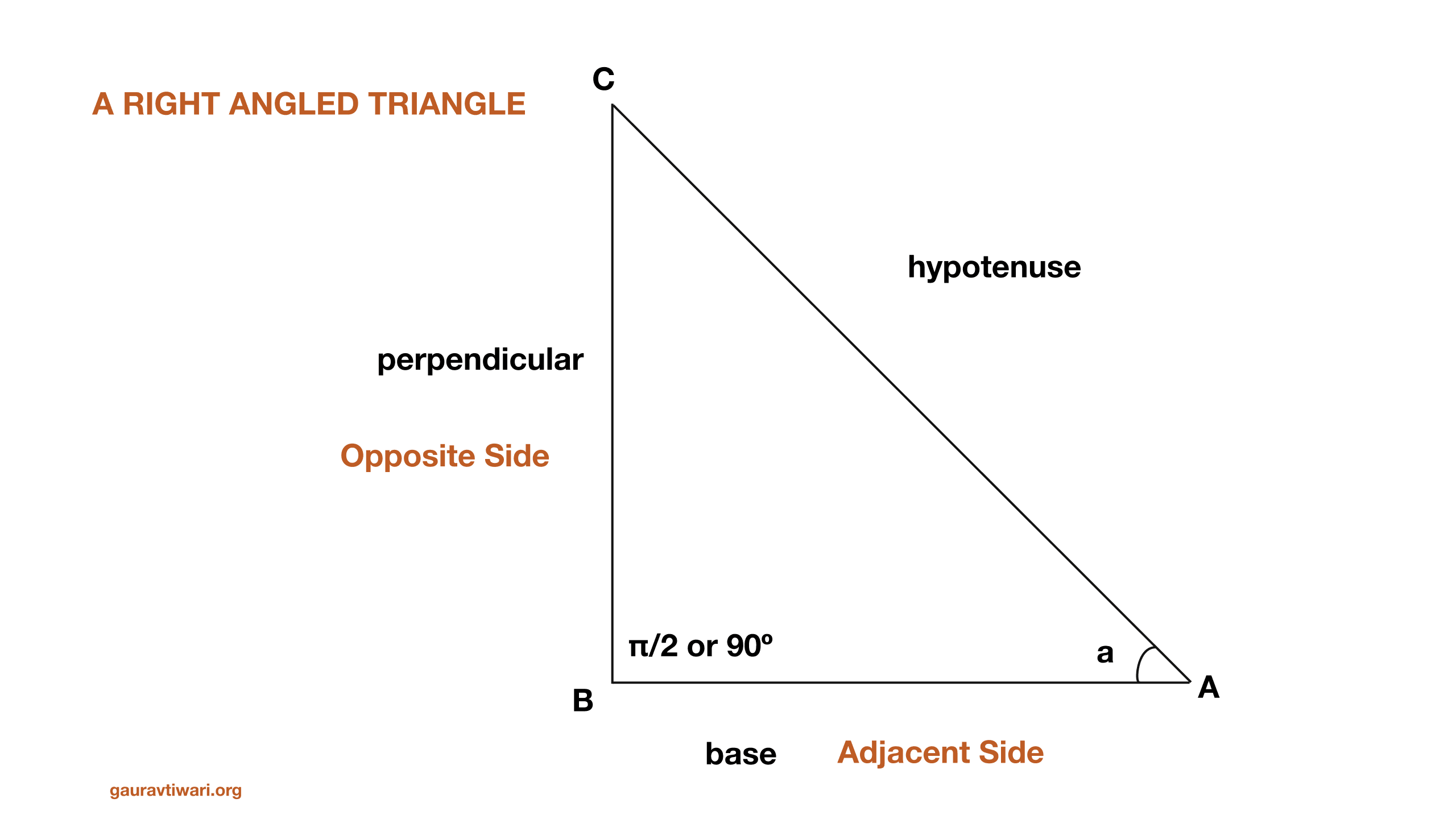
\(\sin \theta = \frac{\mathbf{Opposite \ side \ (Perpendicular)}}{\mathbf{Hypotenuse}}\)
\(\cos \theta = \frac{\mathbf{Adjacent \ side (Base)}}{\mathbf{Hypotenuse}}\)
\(\tan \theta = \frac{\mathbf{Opposite \ side}}{\mathbf{Adjacent \ side}}\)
\(\sec \theta = \frac{\mathbf{Hypotenuse}}{\mathbf{Adjacent \ side}}\)
\( \mathrm{cosec} \ \theta = \frac{\mathbf{Hypotenuse}}{\mathbf{Opposite \ side}}\)
\(\cot \theta = \frac{\mathbf{Adjacent \ side}}{\mathbf{Opposite \ side}}\)
Ratio Trigonometric Identities
These two identities express tangent and cotangent in terms of sine and cosine. You’ll reach for these constantly when simplifying expressions.
\(\tan \theta = \dfrac{\sin \theta}{\cos \theta}\)
\(\cot \theta = \dfrac{\cos \theta}{\sin \theta}\)
Reciprocal Identities
Each trig function has a reciprocal partner. Memorize these pairs and you’ll move through problems much faster.
\( \mathrm{cosec} \ \theta = \dfrac{1}{\sin \theta}\)
\( \sec \ \theta = \dfrac{1}{\cos \theta}\)
\( \cot \ \theta = \dfrac{1}{\tan \theta}\)
\( \sin \ \theta = \dfrac{1}{\mathrm{cosec} \ \theta}\)
\( \cos \ \theta = \dfrac{1}{\sec \theta}\)
\( \tan \ \theta = \dfrac{1}{\cot \theta}\)
All of these come directly from the right-angled triangle definitions. When you know the height and base of a right triangle, you can find every trig value. The reciprocal identities are just the original ratios flipped.
Periodicity Identities (in Radians)
These are also called co-function identities. They let you shift angles by \(\pi/2\), \(\pi\), \(2\pi\), and so on. You’ll find them especially useful when working with the unit circle.
- \(\sin (\pi/2 – A) = \cos A\) and \(\cos (\pi/2 – A) = \sin A\)
- \(\sin (\pi/2 + A) = \cos A\) and \(\cos (\pi/2 + A) = – \sin A\)
- \(\sin (3\pi/2 – A) = – \cos A\) and \(\cos (3\pi/2 – A) = – \sin A\)
- \(\sin (3\pi/2 + A) = – \cos A\) and \(\cos (3\pi/2 + A) = \sin A\)
- \(\sin (\pi – A) = \sin A\) and \(\cos (\pi – A) = – \cos A\)
- \(\sin (\pi + A) = – \sin A\) and \(\cos (\pi + A) = – \cos A\)
- \(\sin (2\pi – A) = – \sin A\) and \(\cos (2\pi – A) = \cos A\)
- \(\sin (2\pi + A) = \sin A\) and \(\cos (2\pi + A) = \cos A\)
All trig functions are cyclic. They repeat after a fixed period. That period differs by function: sine and cosine repeat every \(2\pi\), while tangent and cotangent repeat every \(\pi\).
Cofunction Identities (in Degrees)
If you prefer working in degrees, here are the same co-function relationships. Each pair swaps when you subtract from 90 degrees.
\(\sin(90°−x) =\cos x\)
\(\cos(90°−x) = \sin x\)
\(\tan(90°−x) = \cot x\)
\(\cot(90°−x) = \tan x\)
\(\sec(90°−x) = \mathrm{cosec} x\)
\(\mathrm{cosec}(90°−x) = \sec x\)
Sum and Difference Identities
These let you break apart the trig function of a sum or difference of two angles. You’ll use them heavily in calculus and in proving other identities. If you’re building toward calculus, a solid calculus textbook will show you exactly how these identities power derivative and integral formulas.
\(\sin(x+y) = \sin(x)\cos(y)+\cos(x)\sin(y)\)
\(\cos(x+y) = \cos(x)\cos(y)–\sin(x)\sin(y)\)
\(\tan (x+y) = \dfrac{\tan x + \tan y}{1-\tan x \tan y}\)
\(\sin(x–y) = \sin(x)\cos(y)–\cos(x)\sin(y)\)
\(\cos(x–y) = \cos(x)\cos(y) + \sin(x)\sin(y)\)
\(\tan (x-y) = \dfrac{\tan x – \tan y}{1+\tan x \tan y}\)
The sum and difference identities are the foundation for deriving both double angle and half angle formulas. Master these first, and the rest follow naturally.
Double Angle Identities
Double angle formulas give you the trig values of \(2x\) in terms of \(x\). These show up everywhere, from integration to signal processing.
\(\sin 2x = 2 \sin x \cos x = \dfrac{2 \tan x}{1+\tan^2 x}\)
\(\cos 2x = \cos^2 x – \sin^2 x = \dfrac{1-\tan^2 x}{1 + \tan^2 x}\)
\(\cos(2x) = 2\cos^2(x)−1 = 1–2\sin^2(x)\)
\(\tan 2x = \dfrac{2 \tan x}{1-\tan^2 x}\)
\(\sec 2x = \dfrac{\sec^2x}{2-\sec^2 x}\)
\(\mathrm{cosec} 2x = \frac{1}{2} \sec x \ \mathrm{cosec} x\)
Triple Angle Identities
These express trig functions of \(3x\) in terms of \(x\). They’re less common than double angle formulas but still worth knowing for competitive exams and advanced problem solving.
\(\sin 3x = 3\sin x – 4\sin^3x\)
\(\cos 3x = 4\cos^3x-3\cos x\)
\(\tan 3x = \dfrac{3 \tan x – \tan^3 x}{1-3 \tan^2 x}\)
Half Angle Identities
Half angle identities let you find trig values of \(x/2\) when you know the value at \(x\). The plus-or-minus sign depends on the quadrant where \(x/2\) falls.
\(\sin \dfrac{x}{2} = \pm \sqrt{\dfrac{1-\cos x}{2}}\)
\(\cos \dfrac{x}{2} = \pm \sqrt{\dfrac{1+\cos x}{2}}\)
\(\tan \dfrac{x}{2} = \sqrt{\dfrac{1-\cos x}{1+\cos x}} = \dfrac{1-\cos x}{\sin x}\)
Product Identities
Product-to-sum identities convert a product of two trig functions into a sum. These are particularly handy when you’re integrating products of sines and cosines.
\(\sin x \cos y = \dfrac{\sin (x+y)+ \sin (x-y)}{2}\)
\(\cos x \cos y = \dfrac{\cos (x+y)+ \cos (x-y)}{2}\)
\(\sin x \sin y = \dfrac{\cos (x-y)- \cos (x+y)}{2}\)
Sum to Product Identities
These work the other way: they convert a sum or difference of trig functions into a product. You’ll find them useful for solving equations where you need to factor expressions.
\(\sin x + \sin y = 2 \sin \frac{(x+y)}{2} \cos \frac{(x-y)}{2}\)
\(\sin x – \sin y = 2 \cos \frac{(x+y)}{2} \sin \frac{(x-y)}{2}\)
\(\cos x + \cos y = 2 \cos \frac{(x+y)}{2} \cos \frac{(x-y)}{2}\)
\(\cos x – \cos y = -2 \sin \frac{(x+y)}{2} \sin \frac{(x-y)}{2}\)
Pythagorean Trigonometric Identities
These three identities come directly from the Pythagorean theorem. They’re probably the most used trigonometric identities in all of mathematics, so make sure you know them by heart.
\(\sin^2 a + \cos^2 a = 1\)
\(1+\tan^2 a = \sec^2 a\)
\(\mathrm{cosec}^2 a = 1 + \cot^2 a\)
The Pythagorean identities aren’t separate facts to memorize. If you know sin²a + cos²a = 1, you can derive the other two by dividing both sides by cos²a or sin²a. That’s one identity, not three.
Trigonometric Identities of Opposite Angles
When you negate an angle, some trig functions flip sign and others don’t. Cosine and secant are even functions (they stay the same), while sine, tangent, cotangent, and cosecant are odd functions (they flip sign).
\(\sin (-\theta) = – \sin \theta\)
\(\cos (-\theta) = \cos \theta\)
\(\tan (-\theta) = – \tan \theta\)
\(\cot (-\theta) = – \cot \theta\)
\(\sec (-\theta) = \sec \theta\)
\(\mathrm{cosec} \ (-\theta) = – \mathrm{cosec} \ \theta\)
Understanding even and odd trig functions is essential when you’re evaluating expressions at specific angles. For a deeper look at how functions behave at boundary values, see the notes on zero of a function.
Trigonometric Identities of Complementary Angles
Two angles are complementary when they add up to 90 degrees. The trig function of one equals the co-function of the other. This is actually where the “co” in cosine, cotangent, and cosecant comes from.
\(\sin (90° – \theta) = \cos \theta\)
\(\cos (90 ° – \theta) = \sin \theta\)
\(\tan (90 ° – \theta) = \cot \theta\)
\(\cot (90 °– \theta) = \tan \theta\)
\(\sec (90 °– \theta) = \mathrm{cosec} \ \theta\)
\(\mathrm{cosec} \ (90 ° – \theta) = \sec \theta\)
Trigonometric Identities of Supplementary Angles
Two angles are supplementary when they add up to 180 degrees. Here’s how each trig function behaves when you subtract your angle from 180 degrees.
\(\sin (180°- \theta) = \sin\theta\)
\(\cos (180°- \theta) = -\cos \theta\)
\(\mathrm{cosec} \ (180°- \theta) = \mathrm{cosec} \ \theta\)
\(\sec (180°- \theta)= -\sec \theta\)
\(\tan (180°- \theta) = -\tan \theta\)
\(\cot (180°- \theta) = -\cot \theta\)
Proofs of Trigonometric Identities
Now let’s prove the three Pythagorean identities. These aren’t arbitrary formulas. They follow directly from the Pythagorean theorem applied to a right-angled triangle. Consider a right-angled \(\triangle ABC\), which is right-angled at B.
Applying the Pythagorean theorem to this triangle, you get:
(hypotenuse)2 = (base)2 + (perpendicular)2
\(AC^2 = AB^2+BC^2 \ldots (1)\)
Trigonometric Identity 1
Divide each term of equation (1) by \(AC^2\):
\(\dfrac{AC^2}{AC^2} = \dfrac{AB^2}{AC^2} + \dfrac{BC^2}{AC^2}\)
\(\implies \dfrac{AB^2}{AC^2} + \dfrac{BC^2}{AC^2} =1\)
\(\implies (\dfrac{AB}{AC})^2 + (\dfrac{BC}{AC})^2 = 1 \ldots (2)\)
You know that \( \dfrac{AB}{AC}\) is \(\cos a\) and \(\dfrac{BC}{AC}\) is \(\sin a\).
Substituting into equation \((2)\):
\(\sin^2a + \cos^2a = 1\)
This identity is valid for angles \(0\leq a \leq 90 °\).
Trigonometric Identity 2
Now divide equation \((1)\) by \(AB^2\):
\(\dfrac{AC^2}{AB^2} = \dfrac{AB^2}{AB^2} + \dfrac{BC^2}{AB^2}\)
\(\implies \dfrac{AC^2}{AB^2} =1 + \dfrac{BC^2}{AB^2}\)
\(\implies (\dfrac{AC}{AB})^2 = 1+ (\dfrac{BC}{AB})^2 \ldots (3)\)
Here, \( \dfrac{AC}{AB}\) is the inverse of \(\cos a\), which is \(\sec a\), and \(\dfrac{BC}{AB}\) is \(\tan a\).
Replacing the values in equation \((3)\):
\(1+\tan^2a = \sec^2a \ldots (4)\)
Since \(\tan a\) is not defined for \(a = 90°\), this identity holds true for \(0 \leq a \lt 90°\).
Trigonometric Identity 3
Similarly, dividing equation \((1)\) by \(BC^2\) gives you:
\(\mathrm{cosec}^2 \ a = 1 + \cot^2 a \ldots (5)\)
Since \(\mathrm{cosec} \ a\) and \(\cot a\) are not defined for \(a = 0°\), this identity holds for all values where \(0°\lt a \leq 90°\).
Triangle Identities (Sine, Cosine, and Tangent Rules)
The identities above apply specifically to right-angled triangles. But there are three rules that work for any triangle at all. These are the sine rule, cosine rule, and tangent rule. You’ll find these trigonometric identities essential in any course that covers triangle geometry. For a collection of time-saving mathematics formulas and theorems, including these laws, bookmark that reference.
- Sine law
- Cosine law
- Tangent law
Also see: Triangle Inequality
Sine Law
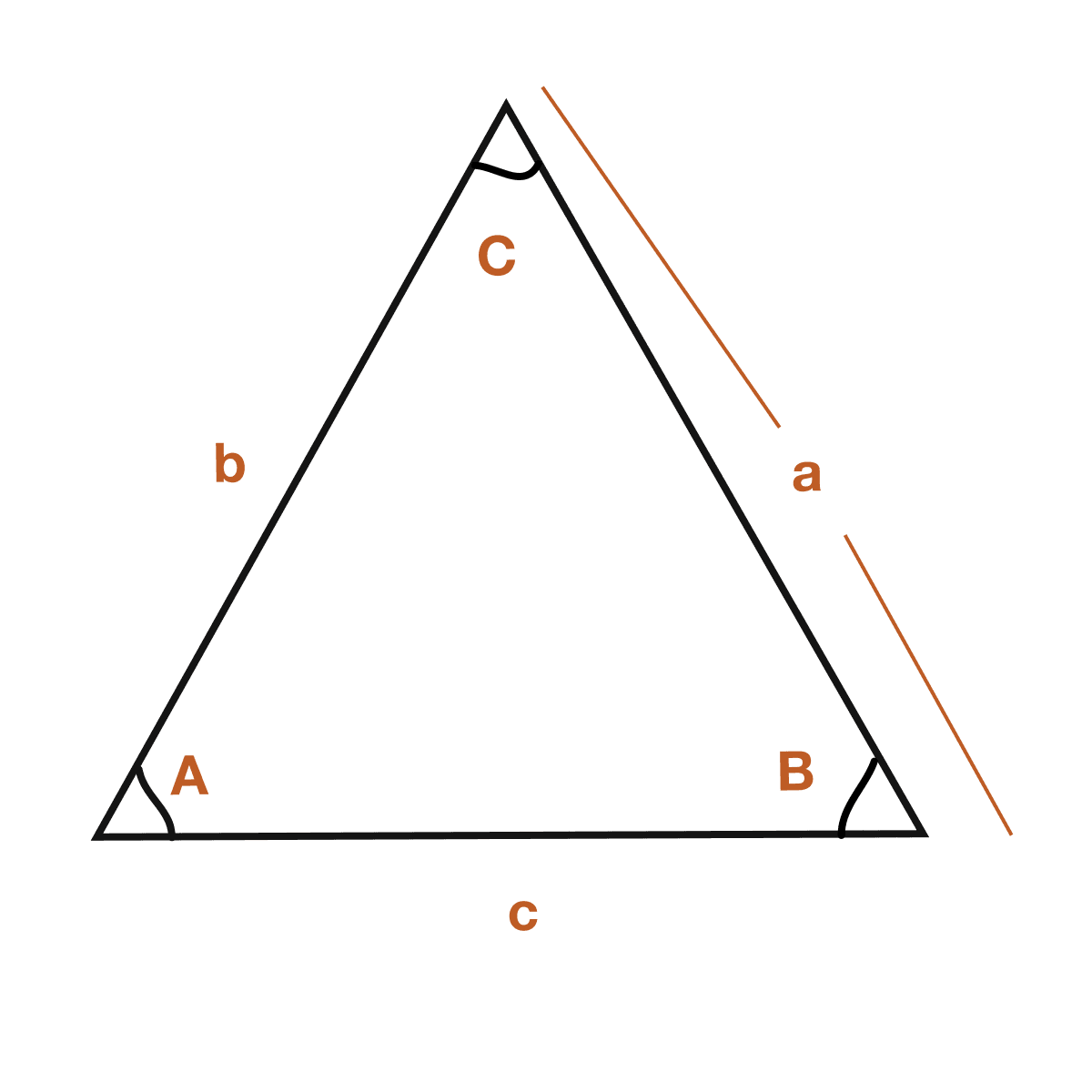
If \(A\), \(B\) and \(C\) are the vertices of a triangle, and \(a\), \(b\) and \(c\) are the opposite sides respectively, the sine rule states:
\(\dfrac{a}{\sin A} = \dfrac{b}{\sin B} = \dfrac{c}{\sin C} \)
or equivalently, \(\dfrac{\sin A}{a} = \dfrac{\sin B}{b} = \dfrac{\sin C}{c} \)
Cosine Law
The cosine rule generalizes the Pythagorean theorem to any triangle. When angle \(C\) is 90 degrees, the \(\cos C\) term drops to zero and you get the standard Pythagorean theorem back.
\(c^2 = a^2 + b^2 – 2ab \cos C\)
or, \(\cos C = \dfrac{a^2 + b^2 – c^2}{2ab}\)
Tangent Law
The tangent rule (also called the law of tangents) relates the sides and angles of any triangle:
\(\dfrac{a-b}{a+b} = \dfrac{\tan \frac{A-B}{2}}{\tan \frac{A+B}{2}}\)