
How to Use Monthly Payments When Financing a Hot Tub?
A hot tub costs anywhere from $500 to $10,000+, and most people don’t have that kind of cash sitting in a savings account. I didn’t either when I started looking into one. But here’s the thing: you don’t need to pay the full amount upfront. Monthly financing makes hot tubs surprisingly affordable if you understand how the math works.
I’ve spent weeks researching hot tub financing options, running the numbers on different payment plans, and comparing what’s actually available on Amazon in 2026. This guide covers everything you need to know about monthly payments, interest rates, what to watch out for, and which hot tubs give you the best value at every budget level. Whether you’re looking at a $575 inflatable spa or a $6,500 hydrotherapy setup, I’ll help you figure out what you can realistically afford.
If you’ve been putting off buying a hot tub because the sticker price scared you, keep reading. The monthly numbers are a lot more manageable than you’d expect.
Why a Hot Tub Is Worth Financing
Hot tubs aren’t just a luxury. They’re one of the few home purchases that actually improve your physical health. Warm water immersion helps with joint pain, muscle recovery, and even blood circulation. The heat causes your blood vessels to dilate, which means nutrients flow more efficiently through your body. There’s real science behind this, not just marketing hype.
Soaking in warm water also triggers endorphin release, which helps manage stress and even mild depression. I’ve talked to readers who use their hot tub daily for chronic back pain, and most of them say it’s the single best investment they’ve made for their wellbeing. When you think about it that way, financing a hot tub isn’t much different from financing a gym membership that you’ll actually use.
The real question isn’t whether a hot tub is worth it. It’s whether you can structure the payments so they fit your budget without stretching yourself thin. Let’s break that down.
How Hot Tub Financing Works
Hot tub financing works like any other installment loan. You agree to pay a fixed amount each month over a set period (usually 36 to 84 months), and the lender charges interest on top of the principal. The total you pay depends on three things: the purchase price, the interest rate (APR), and the loan term.
Here’s a quick breakdown of what monthly payments look like for a $5,000 hot tub at different terms and rates:
- 36 months at 9.99% APR: roughly $161/month (total cost: $5,796)
- 48 months at 9.99% APR: roughly $127/month (total cost: $6,096)
- 60 months at 9.99% APR: roughly $106/month (total cost: $6,360)
- 84 months at 9.99% APR: roughly $83/month (total cost: $6,972)
Notice the tradeoff: longer terms mean lower monthly payments but more total interest. A 36-month plan costs you about $796 in interest, while an 84-month plan costs nearly $2,000. I’d recommend the shortest term you can comfortably afford. You save hundreds of dollars and you’re done paying sooner.
What to Consider Before You Finance
Before you sign any financing agreement, you need to understand the full picture. The sticker price on the hot tub is just the starting point.
Calculate the True Total Cost
The price tag doesn’t include delivery ($200-$500 depending on your location), electrical installation ($500-$2,000 for a dedicated 240V circuit on hardwired models), a concrete pad or reinforced deck if you don’t have one ($500-$3,000), and ongoing costs like chemicals, water, and electricity ($50-$100/month). Add all of these up before you commit to a loan amount. Financing $5,000 when you actually need $7,500 means you’ll either come up short or end up taking a second loan.
Know Your Monthly Budget
A good rule of thumb: your hot tub payment shouldn’t exceed 5% of your monthly take-home pay. If you bring home $4,000/month, keep your payment under $200. This leaves room for the ongoing operating costs without putting pressure on the rest of your budget. If you need help tracking your finances, set up a simple spreadsheet or use a budgeting app before you start shopping.
Understand the Interest Rate
Your APR depends on your credit score. Excellent credit (720+) can get you rates as low as 0% for promotional periods or 6-10% for standard loans. Average credit (620-719) typically lands between 12-20%. Below 620, you’re looking at 20%+ or may need a co-signer. Some dealers offer 0% APR promotions for 12-18 months, which is great if you can pay it off in that window. But if you can’t, the deferred interest kicks in and you’ll owe all the back interest at once.
Financing Options for Hot Tubs
You have several ways to finance a hot tub, and each has its own pros and cons.
Dealer financing is the most common. Most hot tub retailers partner with lenders and offer on-the-spot approval. The advantage is convenience, and you can sometimes negotiate the rate. The downside is that dealer rates aren’t always the best, so compare before you sign.
Personal loans from your bank or credit union often have lower rates than dealer financing, especially if you have an existing relationship. Credit unions in particular tend to offer better terms than big banks.
Home equity loans or HELOCs work if you own your home and have equity. The rates are typically the lowest (5-8%), and the interest may be tax-deductible. But you’re putting your home up as collateral, so this only makes sense for higher-end purchases where the rate savings are significant.
Amazon monthly payments are what I’d recommend for most people buying online. Amazon offers installment plans on many hot tubs, and if you have an Amazon credit card, you can get 0% APR for 6-24 months depending on the purchase amount. It’s straightforward, there’s no separate loan application, and you can combine it with Amazon’s buyer protection. If you’re buying a hot tub from Amazon anyway, this is the easiest path. Just like managing your goals with OKRs, managing your financing is about picking the right framework.
Credit cards should be your last resort. Average credit card APR sits around 22-27% in 2026, which means a $5,000 hot tub could cost you over $7,500 if you only make minimum payments. Only use a credit card if you have a 0% intro APR offer and can pay it off before the promotional period ends.
Best Hot Tubs You Can Finance on Amazon
Here are the hot tubs I’d recommend in 2026, organized from premium to budget. All of these are available on Amazon with monthly payment options, and I’ve included both US and India purchase links.
Strong Spas Select Series (Premium Pick)
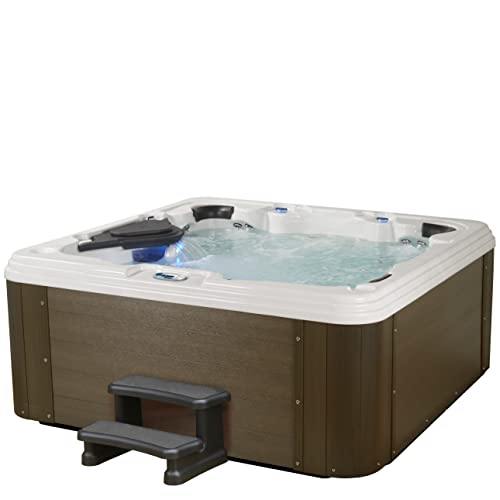
- 100 hydrotherapy jets with adjustable pressure for full-body massage
- Seats 6 adults comfortably with lounger seating configuration
- LED waterfall feature with adjustable lighting controls
- Made in the USA with insulated cover included
At $6,500, this is the top-tier option on this list. The Select Series from Strong Spas packs 100 jets, which is more than most hot tubs in its class. You get a full lounger seat, LED waterfall, and it’s made in the USA, so the build quality is solid. If you finance this over 60 months at 9.99% APR, you’re looking at roughly $138/month. That’s less than most gym memberships for two people.
The 100-jet count matters because it means better water coverage across your back, shoulders, and legs. Cheaper tubs with 20-30 jets leave gaps. This one doesn’t. The cover is included (some brands charge $200-$400 extra), and the LED features make it great for evening use. If you’re buying a hot tub as a long-term health investment and you have the credit to get a good rate, this is the one I’d pick.
Essential Hot Tubs 28-Jet Edgewater
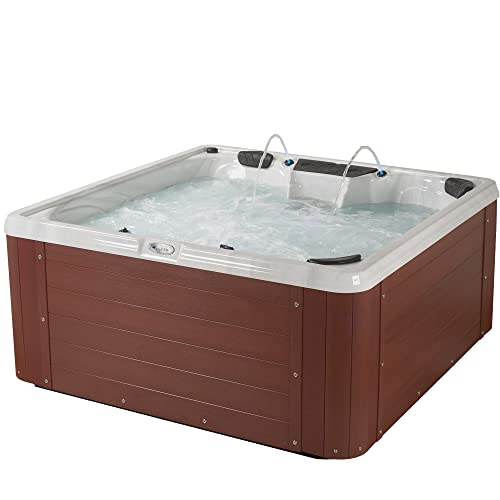
- 28 stainless-steel adjustable jets with passive therapy and massage modes
- Seats 5-6 with lounger configuration for full-body relaxation
- Redwood cabinet finish with durable shell construction
The Edgewater 28-Jet is where I’d point most families. At $4,475, it hits the sweet spot between quality and affordability. You get 28 stainless-steel adjustable jets (enough for a solid hydrotherapy experience), seating for 5-6 people, and a lounger seat for full-body soaking. Financed over 48 months at 9.99% APR, that’s about $113/month.
The passive therapy feature is what sets Essential Hot Tubs apart. You can switch between gentle relaxation and a more aggressive massage at the touch of a button. The redwood finish looks good on a deck, and the build quality is respectable for this price range. It’s not going to compete with the 100-jet Select Series on water pressure, but for most people, 28 jets is plenty. This is the practical choice if you want a real hot tub without the premium price tag.
Outback Hot Tub by Strong Spas
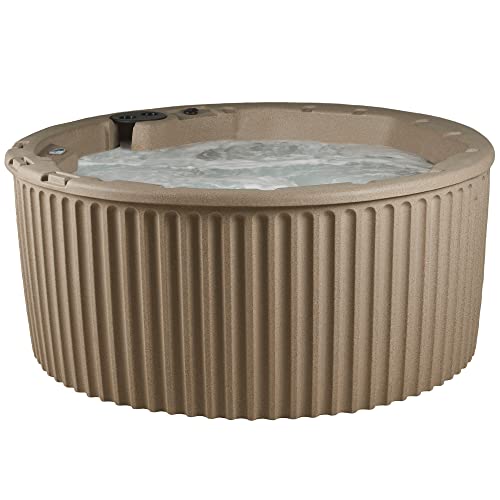
- 20 hydrotherapy massage jets for targeted muscle relief
- Standard 110V outlet compatible, no electrician needed for setup
- Fits 6 people with insulated cover included, made in the USA
The Outback is my pick for the best value in a hardshell hot tub. At $3,018 (down from $3,369), it’s the most affordable full-size option from Strong Spas. The big selling point: it runs on a standard 110V outlet. That means you don’t need to hire an electrician for a dedicated 240V circuit, which saves you $500-$2,000 right off the bat.
With 20 massage jets, it won’t match the hydrotherapy experience of the 100-jet Select Series, but it’s perfectly adequate for daily soaking and muscle relief. It seats 6, comes with a cover, and it’s made in the USA. Financed over 36 months at 9.99% APR, you’re paying about $97/month. That’s very doable for most households. The standard outlet compatibility alone makes this the easiest hot tub to install on this entire list. Just like setting up your perfect home space, the Outback keeps things simple.
Coleman SaluSpa AirJet Inflatable (Budget Pick)
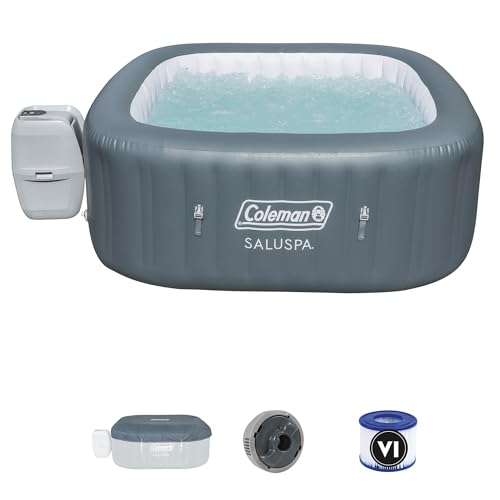
- 114 soothing AirJets with built-in SaluSpa massage system
- Portable inflatable design, sets up in minutes with no tools needed
- Fits 4-6 people with insulated cover and water filtration system included
If $3,000+ isn’t in your budget, the Coleman SaluSpa is the answer. At $574.99, you can pay for this outright or finance it in 5 monthly installments of about $115 with Amazon’s payment plan. No interest, no credit check hassle, no complicated loan paperwork.
Yes, it’s inflatable. No, it won’t feel like a $6,500 hardshell spa. But 114 AirJets create a solid bubble massage experience, and it heats water up to 104 degrees Fahrenheit. You can set it up in 20 minutes without any tools, and you can deflate and store it when the season ends. The built-in filtration system keeps the water clean, and the insulated cover helps retain heat.
I’d recommend the Coleman for anyone who wants to try the hot tub lifestyle without the financial commitment, renters who can’t install permanent fixtures, or anyone with limited deck space who needs something portable. One thing to note: shipping restrictions apply in some US states (CA, OR, RI, MA, NJ, ME), so check availability before ordering.
Monthly Payment Comparison Table
Here’s what your monthly payments look like for each hot tub at different financing terms (assuming 9.99% APR):
| Hot Tub | Price | 36 Months | 48 Months | 60 Months |
|---|---|---|---|---|
| Strong Spas Select Series | $6,500 | $210/mo | $165/mo | $138/mo |
| Essential 28-Jet Edgewater | $4,475 | $144/mo | $113/mo | $95/mo |
| Strong Spas Outback | $3,018 | $97/mo | $77/mo | $64/mo |
| Coleman SaluSpa | $575 | $19/mo | $15/mo | $12/mo |
These numbers show you the real story. Even the premium Select Series comes out to less than $5 a day on a 60-month plan. And the Outback at $64/month is less than a streaming service bundle. When you break it down this way, hot tub ownership is more accessible than most people think.
Tips to Save Money When Financing a Hot Tub
After researching dozens of financing options, here are the strategies that actually save you money:
- Make a larger down payment. Even $500-$1,000 down reduces your monthly payment and total interest significantly. On a $5,000 tub, putting $1,000 down saves you about $200 in interest over 48 months.
- Choose the shortest term you can afford. I know I keep saying this, but it’s the single biggest money-saver. A 36-month term costs hundreds less in interest than a 60-month term.
- Shop during holiday sales. Amazon runs hot tub deals during Prime Day (July), Black Friday, and end-of-summer sales. You can often save $200-$500 on the purchase price itself.
- Look for 0% APR promotions. Many dealers and credit cards offer promotional periods. If you can pay off the balance before the promo ends, you pay zero interest.
- Compare at least 3 lenders. Don’t take the first rate you’re offered. Check your bank, credit union, and Amazon’s payment plan before committing.
- Skip unnecessary add-ons. Dealers love to upsell steps, chemical kits, and fancy covers. Buy the basics and get accessories separately on Amazon for less.
Running Costs to Factor Into Your Budget
Your monthly payment isn’t the only recurring cost. Here’s what to budget for on top of the financing:
- Electricity: $20-$50/month for a well-insulated hardshell tub, $30-$75/month for inflatable models (they lose heat faster)
- Water and chemicals: $15-$30/month for chlorine or bromine, pH balancers, and occasional water changes
- Filters: $20-$50 every 3-6 months for replacement cartridges
- Insurance: Some homeowners policies cover hot tubs, but you may need a rider ($50-$100/year)
All in, expect to spend $50-$100/month on operating costs in addition to your financing payment. So if your tub payment is $100/month, your true monthly cost is closer to $150-$200. Factor this in before you commit. If you work from home and you’re already optimizing your home office setup, think of the hot tub as part of your wellness infrastructure.
Should You Finance or Save Up?
This depends on your situation. Finance if you can get a low interest rate (under 10%), you need the hot tub for health reasons (chronic pain, recovery), and you have stable income to cover the payments plus operating costs.
Save up if your credit score won’t get you a decent rate, you don’t have an immediate need, or you’re already carrying significant debt. Adding a hot tub payment on top of existing debt is a recipe for stress, which defeats the whole purpose of buying one.
My honest advice: if you’re looking at the Coleman SaluSpa ($575), just save for a couple of months and buy it outright. Financing makes more sense for the $3,000+ models where the upfront cost would require significant savings depletion.
Frequently Asked Questions
What credit score do I need to finance a hot tub?
Most lenders require a minimum credit score of 580-620 for hot tub financing. However, you’ll get much better rates with a score of 720 or higher. If your score is below 620, consider a co-signer, a secured personal loan, or saving up for a larger down payment to improve your approval odds. Amazon’s monthly payment plans may have different requirements and are generally easier to qualify for.
How much does it cost to run a hot tub per month?
Expect to spend $50 to $100 per month on electricity, water treatment chemicals, and filter replacements. Well-insulated hardshell tubs run closer to $50/month, while inflatable models cost more to heat because they lose warmth faster. Your actual cost depends on how often you use it, your local electricity rates, and whether you keep the cover on when not in use.
Can I finance a hot tub with bad credit?
Yes, but your options will be limited and the interest rates will be higher (20% or more). Some dealer financing programs work with subprime borrowers, and rent-to-own programs don’t always require credit checks. However, I’d recommend improving your credit score first or saving up for a larger down payment. A higher rate means you could end up paying 40-50% more than the sticker price over the life of the loan.
Is it better to finance through a dealer or a bank?
Compare both. Dealer financing is convenient and sometimes comes with 0% APR promotions, but standard dealer rates can be higher than what your bank or credit union offers. Credit unions in particular tend to offer the best rates on personal loans. Get pre-approved at your bank first, then see if the dealer can beat that rate. Amazon’s built-in payment plans are another solid option with straightforward terms.
How long should I finance a hot tub for?
The sweet spot is 36 to 48 months. This keeps your monthly payments manageable while minimizing total interest paid. Avoid going beyond 60 months unless absolutely necessary, because a hot tub’s useful life is typically 10-15 years, and you don’t want to still be paying for it when it needs major repairs. The shorter the term, the less you pay overall.
Do I need a special electrical outlet for a hot tub?
It depends on the model. Entry-level hot tubs like the Strong Spas Outback and inflatable models like the Coleman SaluSpa run on a standard 110V/120V outlet. Larger, more powerful tubs (like the Select Series) typically require a dedicated 240V circuit, which means hiring a licensed electrician. This installation can cost $500 to $2,000 depending on the distance from your electrical panel to the tub location.
Are inflatable hot tubs worth financing?
At $500 to $800, inflatable hot tubs are cheap enough that financing isn’t really necessary. I’d recommend saving up and buying one outright. If you do use Amazon’s payment plan, you can split it into 5 interest-free installments, which makes sense. But taking out a loan with interest for a $575 inflatable tub doesn’t add up financially. Save the financing for hardshell models where the upfront cost justifies it.
What hidden costs should I budget for when buying a hot tub?
Beyond the purchase price, budget for delivery ($200-$500), electrical installation if needed ($500-$2,000), a concrete pad or reinforced surface ($500-$3,000 if you don’t have one), monthly chemicals and water ($15-$30), electricity ($20-$75/month), and replacement filters ($20-$50 every 3-6 months). The total first-year cost can be 30-50% more than the sticker price when you account for everything.
Final Thoughts
Financing a hot tub isn’t complicated once you understand the numbers. Figure out your total budget (purchase price plus installation plus operating costs), shop for the best interest rate, and pick the shortest loan term you can comfortably afford. That’s really all there is to it.
If I had to recommend just one hot tub from this list, it would be the Strong Spas Outback at $3,018. It runs on a standard outlet (saving you installation costs), seats 6 people, it’s made in the USA, and the monthly payment on a 36-month plan is under $100. For most people, that’s the right balance of quality, convenience, and affordability.
Whatever you choose, don’t let the sticker price scare you off. Break it down into monthly payments, compare it to what you already spend on things like gym memberships or streaming subscriptions, and you’ll realize a hot tub is more affordable than it looks. Your body will thank you for it.