
5 Tips to Find a Marketing Agency for SEO around you
Picking the wrong SEO agency doesn’t just waste money. It wastes 6 to 12 months of momentum while your competitors climb the rankings you should own. I’ve helped businesses recover from agency relationships where the “SEO work” amounted to spammy backlinks, recycled blog posts, and a monthly PDF that nobody read. The recovery alone took another 4 to 6 months.
You can avoid that trap entirely. Whether you’re searching for a local SEO agency near your city or a remote team specializing in your niche, the evaluation process follows the same playbook. You need to understand what you actually need, know the signs that it’s time to hire, verify their track record with real data, and set expectations that protect your investment. Here’s the complete guide.
The 2026 SEO Agency Landscape
The SEO services market has fractured into four distinct categories in 2026, and understanding which one fits your business saves you from expensive mismatches. Each option comes with different trade-offs in cost, expertise depth, and bandwidth.
Freelance SEO consultants are individual specialists who typically focus on one or two areas: technical SEO, content strategy, or link building. You get deep expertise in their specialty, direct communication with no middleman, and lower overhead costs. The downside is limited bandwidth. One person can only do so much, and if they get sick or take on too many clients, your project slows down. Freelancers work best for businesses with focused, well-defined SEO needs and budgets under $3,000 per month.
Boutique SEO agencies run teams of 5 to 20 people. They assign a dedicated account manager, provide regular reporting, and can handle technical SEO, content, and link building simultaneously. This is the sweet spot for most small and mid-size businesses. You get a team without enterprise pricing. Boutique agencies typically charge $2,000 to $5,000 per month and offer the best combination of personal attention and multi-skill coverage.
Full-service mid-size agencies have specialized departments for technical SEO, content marketing, paid search, and analytics. They bring established playbooks, professional tools, and cross-industry experience. These agencies work well for businesses spending $5,000 to $15,000 per month who need a comprehensive SEO program with advanced reporting. The trade-off is that you’re one of many clients, so the personal touch can fade.
Enterprise agencies handle complex, multi-site, multi-market SEO for large organizations. They deploy dedicated teams, build custom tools, and operate at $10,000 to $50,000+ per month. If you don’t have a website generating seven figures in annual revenue, you don’t need an enterprise agency.
There’s also a fifth option that didn’t exist three years ago: AI-powered SEO tools combined with DIY effort. Tools like Semrush now automate site audits, keyword research, content optimization, and rank tracking at a fraction of agency costs. I’ll cover the DIY vs. agency decision later in this guide.
SEO Agency Pricing: What’s Actually Normal in 2026
Pricing is the most confusing part of hiring an SEO agency because the range is enormous. A freelancer might charge $500 per month while an enterprise agency quotes $50,000 for similar-sounding services. Here are the real benchmarks based on what businesses actually pay.
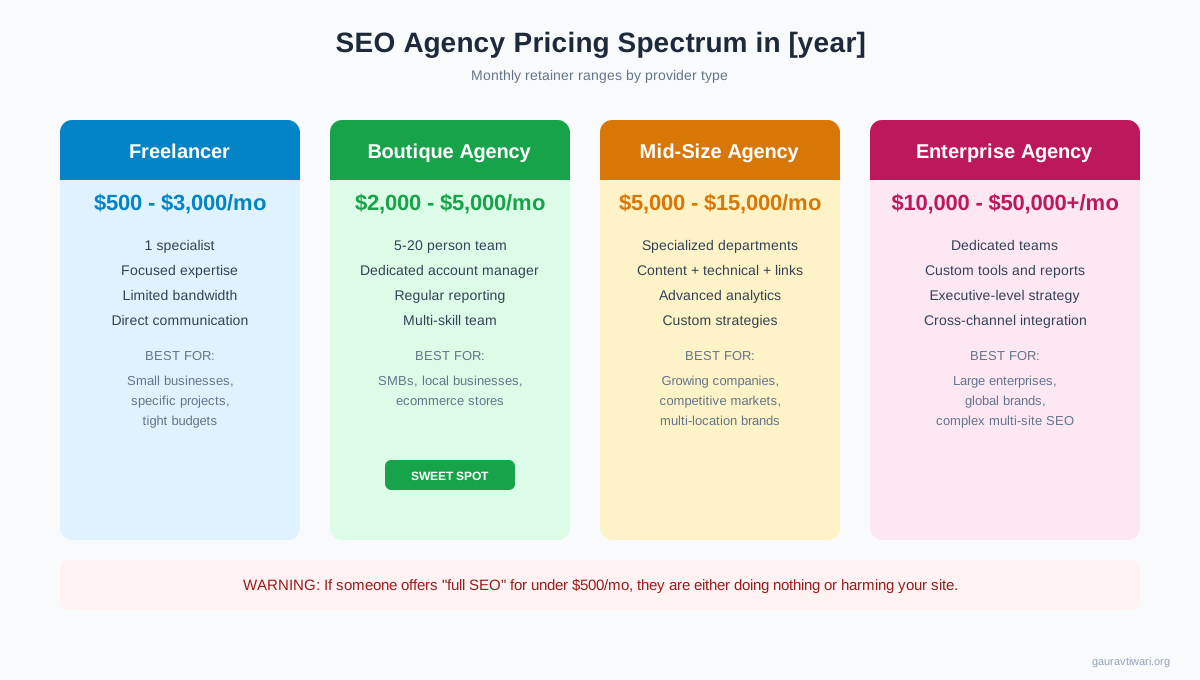
Freelance SEO consultant: $500 to $3,000 per month. You get one person’s expertise, typically 10 to 20 hours of work per month at the lower end and 30 to 40 hours at the higher end. Best for businesses with specific, focused needs like a technical SEO audit, content optimization for existing pages, or local SEO setup.
Boutique agency: $2,000 to $5,000 per month. This buys you a small team (account manager, SEO strategist, content writer, sometimes a developer for technical fixes). You get monthly reporting, a defined strategy, and coordinated execution across multiple SEO channels. This is where most SMBs should start.
Mid-size agency: $5,000 to $15,000 per month. Larger teams with specialized departments. You get dedicated resources for technical SEO, content production, link building, and analytics. Good for businesses with established websites in competitive markets that need 20+ pieces of content per month and aggressive link building campaigns.
Enterprise agency: $10,000 to $50,000+ per month. Full-service operations with dedicated teams, custom reporting dashboards, executive strategy sessions, and cross-channel integration. Appropriate for businesses with complex multi-site architectures and international SEO needs.
The 20-Question Agency Vetting Checklist
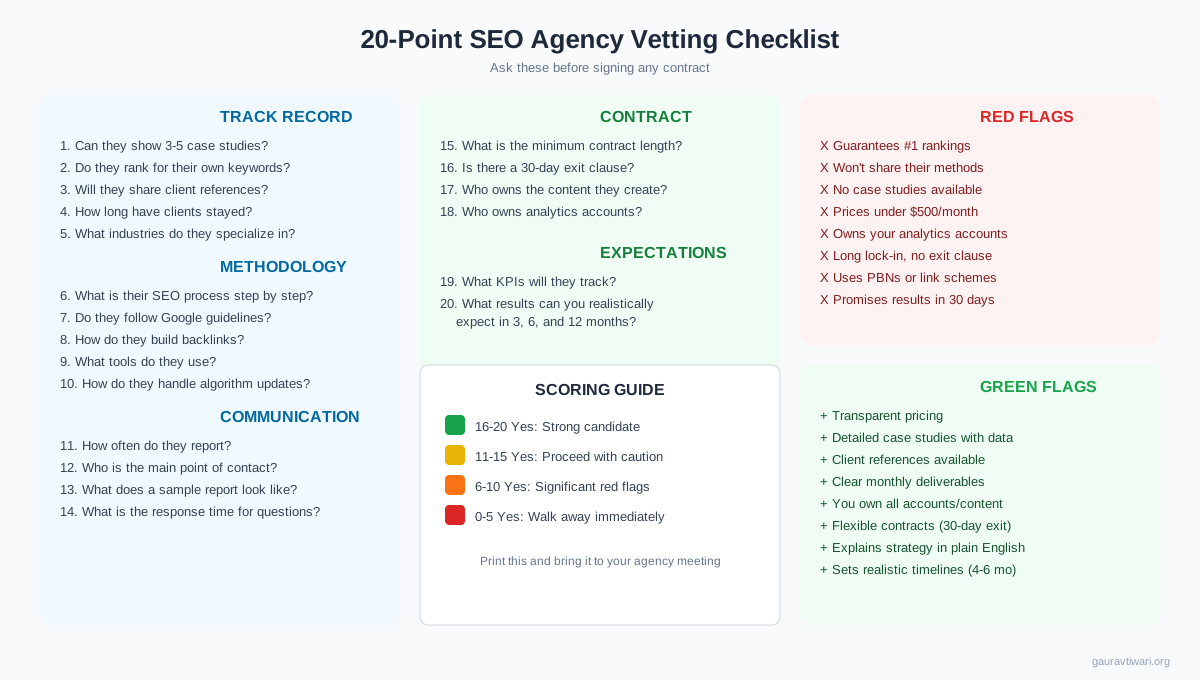
I’ve distilled the evaluation process into 20 questions that separate legitimate agencies from time-wasters. Print this list and bring it to your discovery call. Any agency worth hiring will answer all of these without hesitation.
Track Record (Questions 1 to 5)
These questions verify whether the agency actually delivers results or just talks about them.
- Can you show me 3 to 5 case studies with specific metrics? Look for: starting traffic, ending traffic, keyword improvements, revenue impact, and timeframe. “We improved their SEO” tells you nothing.
- Do you rank for your own target keywords? Search for “SEO agency [their city]” and see if they appear. An agency that can’t rank itself raises questions.
- Can I talk to 2 to 3 current clients? Prepare questions: “What results have you seen?”, “How’s communication?”, “Would you recommend them to a competitor?”
- What’s your average client retention? Good agencies keep clients for 12+ months. High churn means clients aren’t seeing value.
- What industries do you specialize in? An agency that claims to be great at everything is great at nothing. Look for relevant experience in your vertical.
Methodology (Questions 6 to 10)
These questions reveal whether the agency has a real process or just wings it.
- Walk me through your SEO process step by step. They should describe: audit, strategy, implementation, monitoring, and optimization. If the answer is vague, they don’t have a process.
- Do you follow Google’s Search Essentials guidelines? If they dodge this question, hedge, or say “we use proprietary methods,” walk away. Black-hat SEO can get your entire site penalized.
- How do you build backlinks? Acceptable answers: digital PR, guest posting on relevant sites, broken link building, content-driven outreach. Red flag answers: “We have a network of sites,” PBNs, or anything involving buying links.
- What tools do you use? Legitimate agencies use professional tools: Semrush, Ahrefs, Screaming Frog, Google Search Console, GA4. If they can’t name specific tools, they’re not doing serious work.
- How do you handle Google algorithm updates? Good answer: “We monitor updates, assess impact, adjust strategy, and communicate changes to you.” Bad answer: “Our methods are update-proof.” Nothing is update-proof.
Communication (Questions 11 to 14)
Poor communication is the number one complaint businesses have about their SEO agencies. Set expectations upfront.
- How often will you report, and what’s included? Monthly at minimum. Reports should cover: organic traffic (month-over-month and year-over-year), keyword rankings, backlinks acquired, content published, technical issues fixed, and next month’s plan.
- Who is my main point of contact? You should have one dedicated person, not a rotating cast of account managers.
- Can I see a sample report? If it’s just a data dump with no insights or recommendations, the reports won’t help you make decisions.
- What’s your typical response time? Same-day for urgent issues, 24 to 48 hours for standard questions. If they take a week to respond during the sales process, it won’t improve after you sign.
Contract and Ownership (Questions 15 to 18)
These questions protect your business if the relationship doesn’t work out.
- What’s the minimum contract length? 3 to 6 months is reasonable since SEO takes time. But anything over 12 months with no exit clause is a trap.
- Is there a 30-day exit clause? After the initial commitment period, you should be able to leave with 30 days notice. No cancellation fees.
- Who owns the content they create? You do. Always. Get this in writing.
- Who owns the analytics accounts and logins? You do. The agency should work within your Google Analytics, Search Console, and Semrush accounts. Never let an agency set up accounts under their ownership.
Expectations (Questions 19 to 20)
These final questions separate realistic agencies from those selling fantasies.
- What KPIs will you track and report on? They should suggest: organic traffic, keyword rankings by position band, organic conversions, and backlink growth. If they only talk about rankings, they’re missing the bigger picture.
- What results can I realistically expect in 3, 6, and 12 months? An honest agency will say: “Month 3, you’ll see some ranking movement. Month 6, noticeable traffic growth. Month 12, significant revenue impact.” Anyone promising page-one rankings in 30 days is lying.
Red Flags That Should Make You Walk Away
Some warning signs are so serious that you should end the conversation immediately. I’ve seen every one of these in the wild, and they always end badly for the client.
“We guarantee #1 rankings.” Nobody can guarantee specific positions in Google. Google’s own guidelines say this. Any agency making this promise is either lying or planning to rank you for zero-competition keywords nobody searches for. I once audited a site where the previous agency “achieved” 50 first-page rankings. Every single keyword had fewer than 10 monthly searches.
“We can’t share our methods, they’re proprietary.” This is code for “we use tactics that violate Google’s guidelines.” Legitimate SEO isn’t secret. The strategies are well-documented. What separates good agencies from bad ones is execution quality, not hidden techniques.
They own your accounts and content. Some agencies set up Google Analytics, Search Console, and hosting under their own accounts. This gives them leverage if you try to leave. You lose access to your own data. Always insist on owning everything.
Long contracts with no exit clause. A 24-month contract with steep early termination fees is designed to lock you in, not to serve you. Good agencies don’t need contractual handcuffs because their results keep clients around.
They use Private Blog Networks (PBNs). PBNs are networks of low-quality websites created solely for link building. Google has gotten extremely good at detecting and penalizing PBN links. If an agency mentions PBNs or “our network of sites,” that’s your exit cue.
They promise results in 30 days. SEO is inherently slow. Google needs to crawl, index, and evaluate your content changes. Even the fastest legitimate wins (technical fixes, optimizing existing content) take 4 to 8 weeks to show up in rankings. Meaningful results take 4 to 6 months.
They send you an unsolicited “SEO audit.” Cold emails claiming “we found critical issues with your site” are almost always automated spam. The “audit” is generic, the issues are fabricated, and the agency is a churn-and-burn operation that relies on fear to close deals.
Green Flags That Indicate a Good Agency
Just as important as knowing the red flags is recognizing what good looks like. Here’s what separates agencies that deliver from those that don’t.
They ask about your business goals first. A good agency starts by understanding your revenue targets, customer acquisition costs, and business model. They don’t jump straight into keyword volumes. SEO is a business growth tool, and an agency that treats it that way will align their work with your actual goals.
They show detailed case studies with timelines. Real case studies include: starting point (traffic, rankings, revenue), specific strategies used, monthly progression, and final results with timeframes. “We grew their traffic 340% in 11 months” is infinitely more useful than “we helped them rank higher.”
They set realistic timelines. An honest agency says “expect meaningful results in 4 to 6 months.” They explain that Month 1 is audit and strategy, Months 2 to 3 are foundation work, and Months 4 to 6 are when the growth becomes visible. That honesty is a green flag.
They explain everything in plain English. SEO is technical, but a good agency translates it into business outcomes. “We’ll improve your Core Web Vitals” means nothing to most business owners. “We’ll make your site load in under 2 seconds so visitors don’t leave before it finishes loading” is how good agencies communicate.
They insist you own everything. Good agencies set up tools and accounts under your name. They give you access to all reports, data, and content. If you part ways, nothing is lost.
Local vs. Remote SEO Agencies
The “hire local” instinct is strong, but it’s not always the right call. The decision depends entirely on your business type and SEO needs.
Choose a local agency when your business is location-dependent and you need someone who understands your local market intimately. A restaurant in Austin benefits from an agency that knows the Austin dining scene, local publications, and community influencers. Local agencies can also help with in-person strategy sessions and existing relationships with local media for PR link building. If local SEO is your primary need (Google Maps, “near me” queries, Google Business Profile optimization), a local agency with proven local results has an edge.
Choose a remote agency when your business serves a national or international audience, or when the best agency for your specific niche isn’t in your city. Remote agencies often bring more diverse experience across markets. The vast majority of SEO work, from keyword research to content creation to link building to technical fixes, doesn’t require physical proximity. A video call works just as well as a conference room.
Here’s my honest take: the quality of the agency matters infinitely more than their location. A mediocre agency down the street will always lose to an excellent remote agency with proven results in your industry. Choose skill over geography.
Contract Considerations That Protect You
The contract is where many businesses get burned. I’ve reviewed agency contracts that were essentially designed to extract maximum revenue with minimum accountability. Here’s what to watch for.
Contract length. A 3 to 6 month initial commitment is reasonable because SEO genuinely needs that runway. But after the initial period, the contract should convert to month-to-month with a 30-day cancellation notice. Avoid 12 to 24 month lock-ins unless the agency offers significant discounts for longer commitments and includes performance-based exit clauses.
Scope of work. The contract should clearly define what’s included each month: number of content pieces, technical audits frequency, link building targets, reporting cadence. “SEO services” is too vague. You need specifics. If they deliver 2 blog posts per month and you expected 8, a vague contract gives you no recourse.
Performance benchmarks. Some agencies offer performance-based pricing or include KPI benchmarks in the contract. This isn’t common, but it’s a strong indicator of confidence. At minimum, the contract should include a quarterly review clause where both sides assess progress against agreed-upon metrics.
Intellectual property. All content, designs, code, and creative assets produced for your business should be your property. Some agencies retain IP rights until the contract ends or include clauses that let them repurpose your content. Read the fine print.
Termination terms. Understand what happens when you cancel. Do they finish in-progress work? Is there a transition period? Do they hand over all accounts, logins, and data? Get this in writing before you sign.
DIY SEO vs. Agency: The Decision Matrix
Not every business needs an agency. Sometimes the smarter move is handling SEO yourself with the right tools. Here’s how to decide.
DIY SEO makes sense when: you have 5 to 10 hours per week to dedicate to SEO, your competition is moderate (not trying to outrank Forbes or Amazon), you’re willing to learn, and your budget is under $2,000 per month. A tool like Semrush ($130 per month for the Pro plan) handles site audits, keyword research, rank tracking, content optimization, and competitive analysis. Combine that with Rank Math for on-page SEO and internal linking, and you’ve got a solid foundation for under $200 per month total.
An agency makes sense when: you don’t have the time or inclination to learn SEO, your market is highly competitive, you need link building (the hardest part to DIY), or your website has complex technical issues that require specialized knowledge. An agency also makes sense when your time is worth more than the agency fee. If you bill at $200 per hour and SEO takes 10 hours per week, that’s $8,000 per month in opportunity cost vs. a $3,000 per month agency.
The hybrid approach works best for many businesses. Handle on-page SEO yourself with Rank Math and Semrush, but outsource link building and technical SEO to an agency or freelancer. This keeps costs around $1,500 to $2,500 per month total while covering the areas where professional help makes the biggest difference.
- All-in-one SEO toolkit for DIY site audits and keyword research
- Track rankings across 100+ countries with daily updates
- Content optimization scoring with real-time suggestions
- Competitive analysis showing exactly what rivals rank for
- Plans start at $129.95/month (Pro) with 14-day free trial
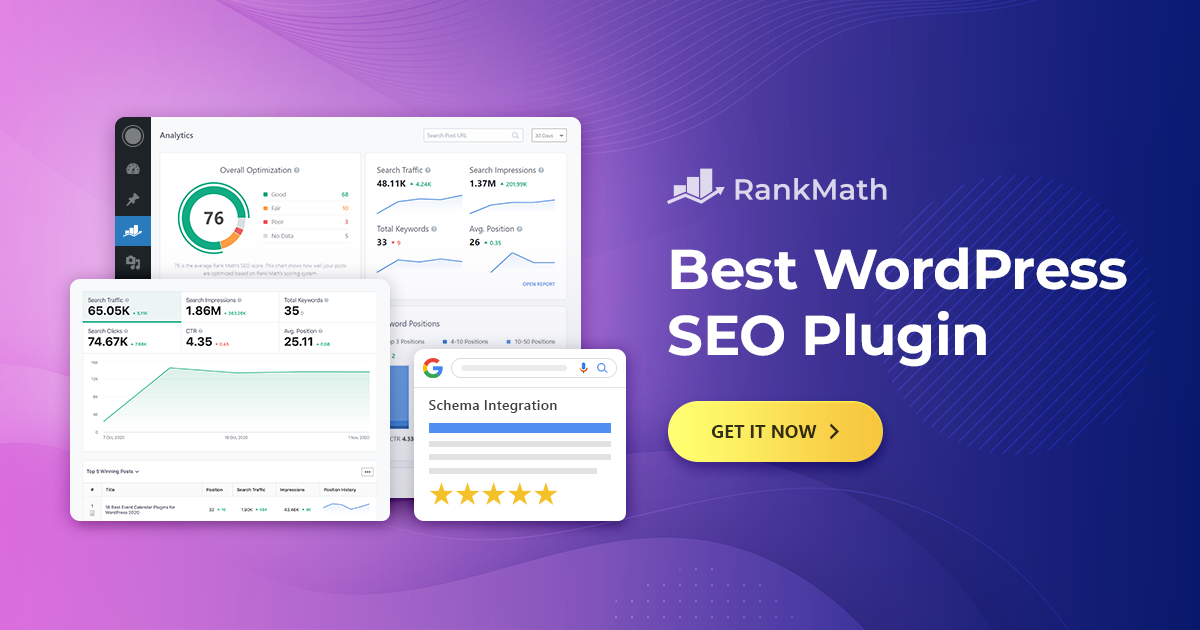
- Advanced on-page SEO with real-time content analysis
- Built-in internal linking suggestions for WordPress
- Schema markup generator for rich snippets
- Google Search Console integration in your dashboard
- Free version covers most needs. Pro starts at $6.99/month
What to Expect Month by Month
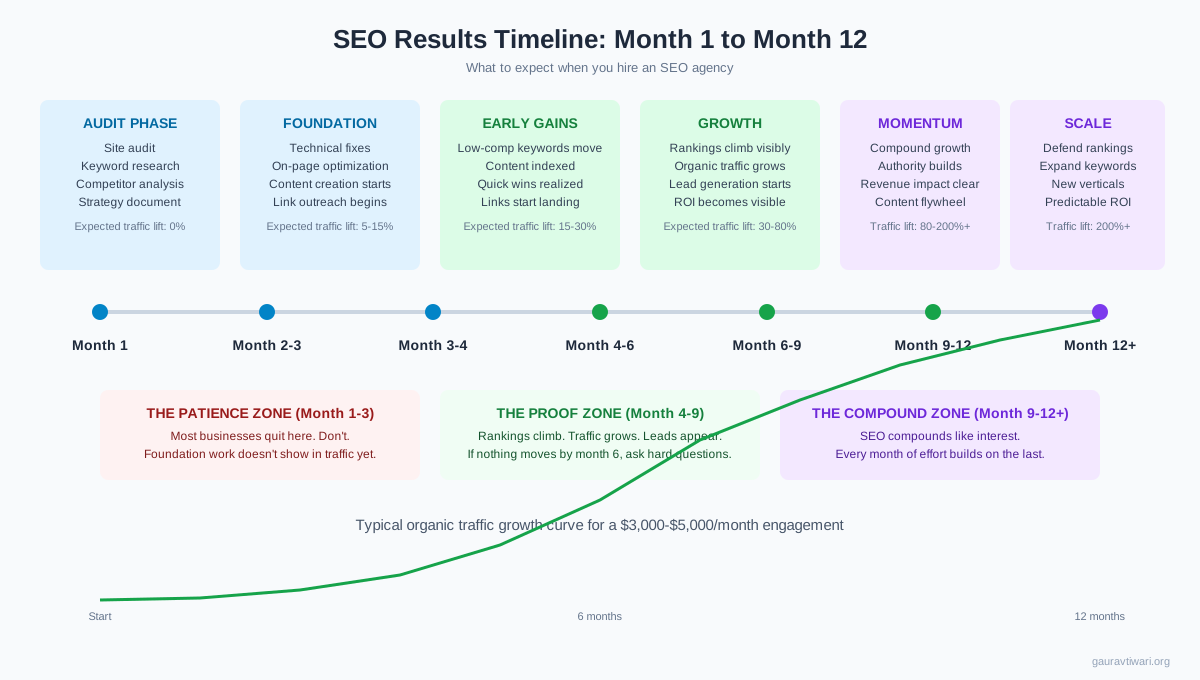
Setting the right expectations prevents the most common reason businesses fire their SEO agency: impatience. SEO compounds like interest, but the early months feel painfully slow. Here’s the realistic timeline for a typical $3,000 to $5,000 per month engagement.
Month 1: Audit and strategy. The agency audits your website (technical issues, content gaps, backlink profile), researches keywords, analyzes competitors, and creates a strategy document. No ranking improvements yet. This month is about diagnosis and planning. You should receive a comprehensive audit report and a 6-month roadmap.
Months 2 to 3: Foundation work. Technical fixes get implemented (site speed, URL structure, crawl errors, mobile optimization). On-page optimization begins for existing high-potential pages. Content creation starts with 4 to 8 new pieces targeting strategic keywords. Initial link building outreach goes out. You might see some early movement for low-competition keywords, but don’t expect dramatic changes. Most businesses see 5% to 15% traffic improvement here.
Months 4 to 6: Early growth phase. The content strategy hits its stride. Published content starts ranking for target keywords. Link building gains momentum with 5 to 15 quality backlinks per month landing. Rankings climb visibly for medium-competition keywords. Monthly reports should show clear progress against the original benchmarks. This is where you should start seeing 15% to 30% organic traffic growth.
Months 6 to 9: Acceleration. The compound effect kicks in. Earlier content matures in Google’s index, new content builds on established topical authority, and your backlink profile strengthens. Organic traffic grows 30% to 80% compared to pre-agency baseline. Leads and conversions from organic search become measurable. This is the proof zone.
Months 9 to 12: Compound growth. Every month of past effort now contributes to current results. You’re ranking for more keywords, attracting more backlinks naturally, and your site’s authority is meaningfully higher. Revenue impact from SEO should be clearly attributable. Most businesses see 80% to 200%+ traffic growth by month 12.
How to Measure If Your SEO Agency Is Working
Don’t rely on the agency’s reports alone. You need to verify their work independently. Here’s what to check and where to find the data.
Google Search Console (free). Check total impressions (how often your site appears in search results), total clicks (how often people click through), and average position for your target keywords. Compare month-over-month and year-over-year. Impressions should trend up steadily. Clicks should follow 2 to 4 weeks later.
GA4 organic traffic. In Google Analytics 4, go to Acquisition > Traffic acquisition > filter by “Organic Search.” Track total sessions, engaged sessions, engagement rate, and conversions from organic. If the agency is doing good work, organic should become a growing percentage of your total traffic.
Keyword position tracking. Use Semrush Position Tracking to monitor your target keywords independently. Categorize keywords by position bands: Top 3 (money positions), Top 10 (first page), Top 20 (striking distance), Top 100 (visibility). The number of keywords in each band should improve over time.
Backlink quality. Check Semrush’s Backlink Analytics monthly. New backlinks should come from relevant, authoritative websites. If you see links from random directories, foreign-language sites, or PBN-looking domains, raise the issue immediately. Quality matters more than quantity. 5 links from relevant DR 40+ sites beat 50 links from DR 5 spam sites.
Revenue attribution. The ultimate measure: is SEO generating revenue? Set up conversion tracking in GA4 for your key actions (form submissions, purchases, signups). Track “content-assisted conversions” to see which organic landing pages contribute to sales. If organic revenue isn’t growing after 6 months, the SEO investment isn’t working regardless of what the ranking reports say. Understanding correlation vs. causation in SEO data helps you avoid misreading the numbers.
Have you ever hired an SEO agency?
When It’s Time to Move On
Sometimes the relationship isn’t working despite everyone’s best efforts. Here are the clear signals that it’s time to find a new agency.
Six months with no measurable progress. SEO takes time, but six months of work should produce something: improved technical health scores, keyword movement, new content indexed, backlinks acquired. If all metrics are flat, the agency either isn’t doing the work or is doing it poorly.
Communication has degraded. They take longer to respond. Reports arrive late or contain the same templated language every month. Your account manager changes without explanation. These are signs that your account has been deprioritized, usually because they’ve taken on too many clients.
They can’t explain what they’re doing. If you ask “what did you work on this month?” and the answer is vague or defensive, there’s a problem. Good agencies are eager to show their work because they’re proud of it.
Your site got penalized. A manual action from Google or a dramatic traffic drop after a link-building campaign means the agency used risky tactics. This is grounds for immediate termination and potentially a demand for remediation work. Understanding when to prune problematic content becomes critical in recovery situations.
When you do decide to switch, give the required notice, request a complete handover of all work, data, and credentials, and have the new agency start with a fresh audit. Don’t carry the old agency’s strategy forward without validating it first.
Frequently Asked Questions
How much should a small business spend on SEO each month?
For a small business with a local focus, expect to invest $1,000 to $3,000 per month on quality SEO. For businesses targeting national keywords in competitive industries, $3,000 to $8,000 per month is typical. The budget should reflect your market’s competitiveness and revenue goals. If SEO generates $10,000 in monthly revenue for a $2,000 investment, that’s a 5x return worth maintaining. Start with the boutique agency tier ($2,000 to $5,000 per month) and adjust based on results after 6 months.
How quickly will I see results from an SEO agency?
Expect initial ranking movements within 2 to 3 months. Meaningful organic traffic growth typically appears at 4 to 6 months. Significant revenue impact from SEO usually shows at 6 to 12 months. Quick wins exist (fixing technical issues, optimizing underperforming pages), but sustainable growth takes time. If an agency promises results faster than this for competitive keywords, they’re setting unrealistic expectations.
What’s the difference between local SEO and national SEO?
Local SEO focuses on ranking in Google Maps and local search results for queries like ‘plumber near me’ or ‘best restaurant in Austin.’ It involves Google Business Profile optimization, local citations, review management, and location-specific content. National SEO targets standard organic results for keywords without geographic modifiers. Most local businesses need both, but local SEO is the priority for foot-traffic-dependent businesses. The strategies, tools, and pricing differ significantly between the two.
Can I do SEO myself instead of hiring an agency?
Yes, but it depends on your available time, willingness to learn, and competition level. Basic SEO (keyword-optimized content, Google Business Profile, on-page optimization with Rank Math) can be handled by a motivated business owner spending 5 to 10 hours per week. Tools like Semrush ($130 per month) automate much of the research and monitoring. However, competitive link building and advanced technical SEO require specialized skills that take years to develop. If your competitors are hiring agencies, doing everything yourself puts you at a disadvantage in competitive markets.
Should I choose a local or remote SEO agency?
Choose local when your business depends on local customers and you need an agency that understands your specific market. Choose remote when you serve a national audience or the best agency for your niche isn’t in your city. The quality of the agency matters far more than proximity. Over 90% of SEO work (keyword research, content creation, link building, technical fixes) doesn’t require in-person meetings. Video calls work just as well.
What should I do if my SEO agency isn’t delivering results?
First, make sure you’ve given them enough time (at least 4 to 6 months for organic SEO). Then review their monthly reports against the KPIs you agreed on at the start. If metrics are flat or declining after 6 months, schedule a direct conversation. Ask what’s not working, what they plan to change, and what the revised timeline looks like. If the answers are vague or they blame external factors without a clear adjustment plan, give your 30-day notice and start interviewing replacements. Before switching, verify the data independently using Google Search Console and Semrush.
How do I know if an SEO agency is using black-hat techniques?
Check three things. First, look at their backlink reports. If new links come from irrelevant, low-quality, or foreign-language sites, that’s a red flag. Second, ask them directly how they build links. Evasive answers or mentions of ‘our network of sites’ suggest PBNs. Third, check Google Search Console for manual actions. If Google has flagged your site for unnatural links or thin content after hiring the agency, they’re using risky tactics. Run a Semrush Backlink Audit monthly to catch problems early.
Finding the right SEO agency takes real effort upfront. But the payoff is enormous when you find a partner who delivers transparent, measurable results. Define your needs clearly, run them through the 20-question checklist, protect yourself with a flexible contract, and verify their work independently every month. The best agencies don’t just improve your rankings. They become a genuine extension of your marketing team, bringing expertise and accountability that grows your business month after month. Start by identifying whether you need a content refresh, a technical overhaul, or a full SEO program, and let that guide your search.
Disclaimer: This site is reader-supported. If you buy through some links, I may earn a small commission at no extra cost to you. I only recommend tools I trust and would use myself. Your support helps keep gauravtiwari.org free and focused on real-world advice. Thanks. - Gaurav Tiwari