
Dedekind’s Theory of Real Numbers
Most math students encounter real numbers without ever seeing how they’re actually constructed. You use \( \pi \) and \( \sqrt{2} \) throughout calculus, but nobody explains what these objects really are. They just… exist.
This gap bothered Richard Dedekind in the 1850s. He was teaching calculus at Zürich and realized he couldn’t give a rigorous definition of continuity without first defining real numbers properly. His solution, published in 1872, remains one of the most elegant constructions in mathematics.
I’ve taught this material to undergraduate and graduate students for years. The concept clicks once you see it properly, but most textbooks bury the intuition under notation. This guide fixes that. We’ll build real numbers from scratch using nothing but rationals, and you’ll understand exactly why irrational numbers must exist.
Why Rational Numbers Aren’t Enough
Let \( \mathbf{Q} \) be the set of rational numbers. This set is an ordered field equipped with a “less than” relation. You can add, subtract, multiply, and divide (by non-zero elements) and stay within \( \mathbf{Q} \).
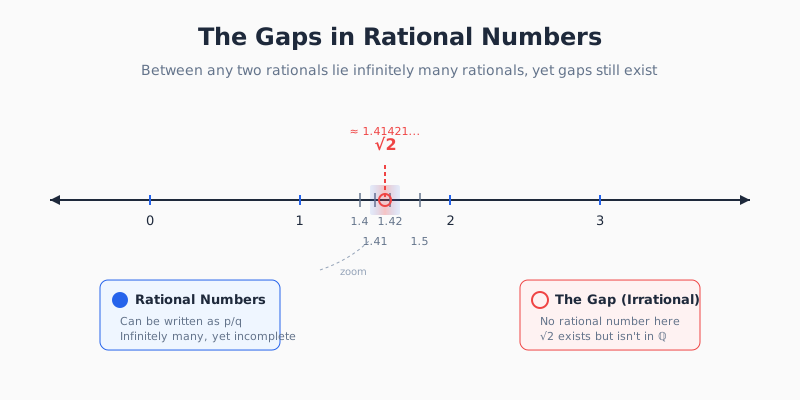
Between any two rational numbers, infinitely many other rationals exist. Pick \( \frac{1}{2} \) and \( \frac{3}{4} \). Their average \( \frac{5}{8} \) lies between them. Average again to get \( \frac{9}{16} \). You can continue forever.
This density property makes \( \mathbf{Q} \) appear complete. No gaps, right?
Wrong. The rationals are riddled with holes. Numbers like \( \sqrt{2} \), \( \sqrt{3} \), and \( \pi \) occupy positions on the number line where no rational number sits. These gaps break calculus. You can’t define limits properly when your number line has holes.
The Classic Proof That \( \sqrt{2} \) Is Irrational
Before constructing real numbers, let’s prove these gaps actually exist. We’ll show no rational number squares to give 2.
Assume \( \sqrt{2} \) is rational. Then we can write \( \sqrt{2} = \frac{p}{q} \) where \( p \) and \( q \) are integers with no common factors. This “lowest terms” requirement is crucial.
Squaring both sides:
$$\left(\sqrt{2}\right)^2 = \frac{p^2}{q^2}$$
$$2 = \frac{p^2}{q^2}$$
$$p^2 = 2q^2$$
Since \( p^2 = 2q^2 \), the number \( p^2 \) is even. Here’s the key insight: the square of an odd number is always odd. (Check it: \( 3^2 = 9 \), \( 5^2 = 25 \), \( 7^2 = 49 \).) So if \( p^2 \) is even, \( p \) must be even.
Write \( p = 2m \) for some integer \( m \). Substituting back:
$$(2m)^2 = 2q^2$$
$$4m^2 = 2q^2$$
$$q^2 = 2m^2$$
By identical reasoning, \( q \) must also be even.
Now we have a contradiction. Both \( p \) and \( q \) are even, meaning they share 2 as a common factor. But we assumed they had no common factors. This contradiction proves our assumption was false. No rational number squares to give 2.
The same proof structure works for \( \sqrt{3} \), \( \sqrt{5} \), and any \( \sqrt{n} \) where \( n \) isn’t a perfect square. The rational numbers have infinitely many gaps.
What This Means Geometrically
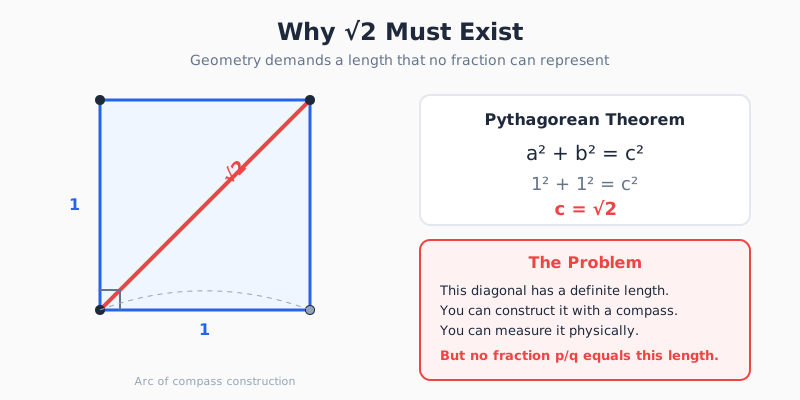
Draw a square with side length 1. The diagonal has length \( \sqrt{2} \) by the Pythagorean theorem. This length exists geometrically. You can construct it with a compass and straightedge. But no fraction represents it exactly.
The ancient Greeks discovered this around 500 BCE and reportedly found it so disturbing they tried to keep it secret. Hippasus, who allegedly revealed the proof, was (according to legend) drowned at sea for his trouble.
We need a number system without these gaps. Dedekind’s construction provides exactly that.
Foundational Definitions
Before building Dedekind cuts, we need precise language for several concepts. These definitions might seem pedantic, but precision matters when constructing new mathematical objects.
Rational Numbers (Formal Definition)
A rational number is any number expressible as \( \frac{p}{q} \) where:
- \( p \in \mathbf{Z} \) (the numerator is an integer)
- \( q \in \mathbf{Z} \setminus {0} \) (the denominator is a non-zero integer)
- \( \gcd(p, q) = 1 \) (the fraction is in lowest terms)
The set of all rational numbers is denoted \( \mathbf{Q} \). This notation comes from “quotient” since every rational is a quotient of integers.
Ordered Fields
An ordered field is an algebraic structure supporting four operations (addition, subtraction, multiplication, division by non-zero elements) along with a total ordering compatible with those operations.
The compatibility means:
- If \( a < b \), then \( a + c < b + c \) for any \( c \)
- If \( a < b \) and \( c > 0 \), then \( ac < bc \)
The rationals \( \mathbf{Q} \) form an ordered field. So do the reals \( \mathbf{R} \) (once we construct them). The complex numbers \( \mathbf{C} \) do not. You can’t sensibly ask whether \( 3 + 2i \) is greater than \( 1 + 4i \).
Least Elements and Greatest Elements
These concepts are essential for understanding Dedekind cuts.
Least Element: Let \( A \subseteq \mathbf{Q} \) and \( a \in \mathbf{Q} \). The element \( a \) is the least (or smallest, or minimum) element of \( A \) if:
- \( a \in A \) (a belongs to the set)
- \( a \le x \) for every \( x \in A \) (a is less than or equal to everything else in the set)
Greatest Element: Let \( A \subseteq \mathbf{Q} \) and \( b \in \mathbf{Q} \). The element \( b \) is the greatest (or largest, or maximum) element of \( A \) if:
- \( b \in A \) (b belongs to the set)
- \( x \le b \) for every \( x \in A \) (everything in the set is less than or equal to b)
Not every set has a least or greatest element. The open interval \( (0, 1) \) in \( \mathbf{Q} \) has neither. No rational in this interval is smallest (you can always halve it) or largest (you can always average it with 1).
Bounds and the Completeness Problem
Upper Bound: A rational \( u \) is an upper bound for set \( A \subseteq \mathbf{Q} \) if \( x \le u \) for all \( x \in A \). The bound doesn’t need to belong to \( A \).
Lower Bound: A rational \( l \) is a lower bound for set \( A \subseteq \mathbf{Q} \) if \( l \le x \) for all \( x \in A \).
Least Upper Bound (Supremum): The smallest upper bound of a set, if it exists.
Here’s where \( \mathbf{Q} \) fails. Consider the set:
$$S = {x \in \mathbf{Q} : x^2 < 2}$$
This set has plenty of upper bounds in \( \mathbf{Q} \). The number 2 works. So does 1.5. So does 1.42. But the least upper bound would be \( \sqrt{2} \), and that’s not in \( \mathbf{Q} \).
The rationals lack the least upper bound property. This is precisely the “gap” that Dedekind cuts fill.
Dedekind Cuts: The Core Construction
Now we build real numbers from rationals. The idea is beautiful: instead of trying to describe an irrational number directly, we describe all the rationals less than it.
The Geometric Intuition
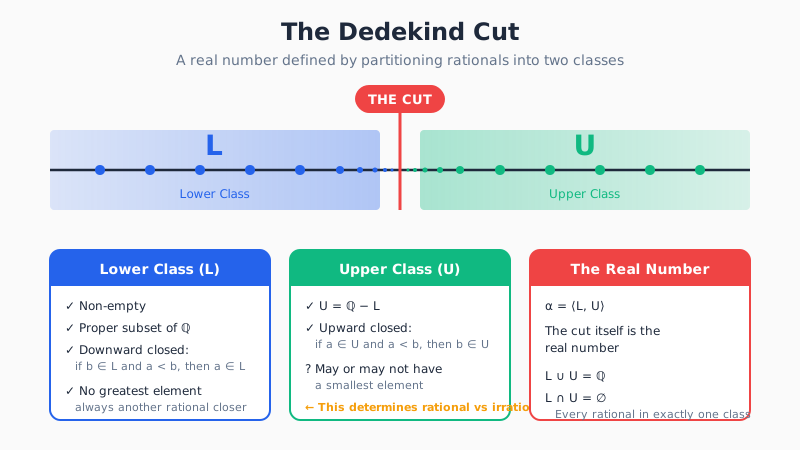
Picture the rational numbers arranged on a line from left to right. Take a knife and cut the line at some point \( P \). This divides the rationals into two classes:
- \( L \) (lower class): all rationals to the left of \( P \)
- \( U \) (upper class): all rationals to the right of \( P \)
If \( P \) corresponds to a rational number, that rational goes into \( U \) by convention.
If \( P \) corresponds to an irrational (like \( \sqrt{2} \)), then every rational falls into exactly one class. The cut itself, the division point, represents the irrational number.
This is the key insight. We define \( \sqrt{2} \) not by what it is, but by where it sits among the rationals. It’s the boundary between rationals whose squares are less than 2 and rationals whose squares exceed 2.
Formal Definition of a Dedekind Cut
A Dedekind cut is a subset \( L \subset \mathbf{Q} \) satisfying three conditions:
Condition 1 (Non-triviality): \( L \) is a non-empty proper subset of \( \mathbf{Q} \).
This means \( L \) contains at least one rational, and \( \mathbf{Q} \) contains at least one rational not in \( L \). We’re not allowing the trivial cases of “everything” or “nothing.”
Condition 2 (Downward closure): If \( a, b \in \mathbf{Q} \), \( a < b \), and \( b \in L \), then \( a \in L \).
In plain English: if a rational is in the lower class, every smaller rational is also in the lower class. There are no “holes” in \( L \) going downward.
Condition 3 (No maximum): \( L \) has no greatest element.
This condition is subtle but essential. It ensures the cut represents a single point, not an interval. If \( L \) had a greatest element \( r \), we wouldn’t know whether our cut is “at” \( r \) or “just above” \( r \).
Given such an \( L \), we define \( U = \mathbf{Q} – L \) (everything not in the lower class). The ordered pair \( \langle L, U \rangle \) is the Dedekind section (or cut).
Real Numbers as Dedekind Cuts
Here’s the definition that makes everything work:
A real number is a Dedekind cut of the rational numbers.
The set of all real numbers is denoted \( \mathbf{R} \). Individual real numbers are typically written as Greek letters: \( \alpha, \beta, \gamma \), etc.
For a real number \( \alpha = \langle L, U \rangle \):
- \( L \) is called the lower class of \( \alpha \), written \( L(\alpha) \)
- \( U \) is called the upper class of \( \alpha \), written \( U(\alpha) \)
Since \( L \cup U = \mathbf{Q} \) and \( L \cap U = \emptyset \), a real number is completely determined by its lower class alone. Specify \( L \), and \( U \) follows automatically.
Types of Real Numbers
Dedekind cuts naturally divide into two categories based on whether the upper class has a smallest element.
Rational Real Numbers
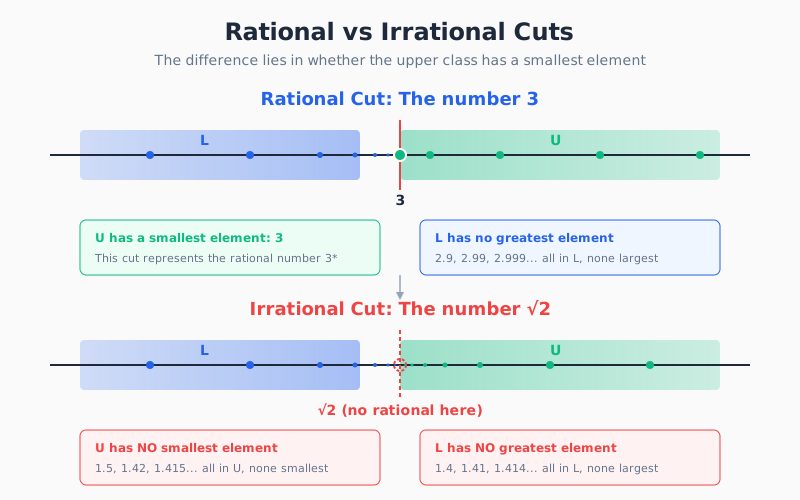
A real number \( \alpha = \langle L, U \rangle \) is a rational real number if \( U \) has a smallest element.
Suppose that smallest element is \( r \). Then the cut represents the rational number \( r \), and we write \( \alpha = r^* \). The asterisk distinguishes the real number \( r^* \) (a Dedekind cut) from the rational number \( r \) (an element of \( \mathbf{Q} \)).
For example, the cut for \( 3^* \) has:
- \( L = {x \in \mathbf{Q} : x < 3} \)
- \( U = {x \in \mathbf{Q} : x \ge 3} \)
The upper class \( U \) has smallest element 3, confirming this is a rational real.
Irrational Numbers
A real number \( \alpha = \langle L, U \rangle \) is irrational if \( U \) has no smallest element.
When \( U \) lacks a minimum, the cut sits at a “gap” in the rationals. No rational number occupies that position. This is precisely where irrational numbers live.
The number \( \sqrt{2} \) is the cut where:
- \( L = {x \in \mathbf{Q} : x \le 0} \cup {x \in \mathbf{Q} : x > 0 \text{ and } x^2 < 2} \)
- \( U = {x \in \mathbf{Q} : x > 0 \text{ and } x^2 > 2} \)
Neither class contains a rational whose square equals exactly 2 (we proved that’s impossible). The lower class has no maximum. The upper class has no minimum. The cut floats in the gap between them.
Detailed Example: Constructing \( \sqrt{2} \)
Let’s rigorously verify that the cut described above satisfies all three conditions for a Dedekind cut.
Define:
$$L = {x \in \mathbf{Q} : x \le 0} \cup {x \in \mathbf{Q} : x > 0 \text{ and } x^2 < 2}$$
Verifying Condition 1 (Non-triviality)
We need \( L \) to be non-empty and proper.
Non-empty: The number 0 satisfies \( 0 \le 0 \), so \( 0 \in L \). Also, \( 1 > 0 \) and \( 1^2 = 1 < 2 \), so \( 1 \in L \). The set is non-empty.
Proper subset: Consider \( 2 \in \mathbf{Q} \). We have \( 2 > 0 \) and \( 2^2 = 4 > 2 \), so \( 2 \notin L \). Thus \( L \neq \mathbf{Q} \).
Condition 1 is satisfied.
Verifying Condition 2 (Downward Closure)
We need: if \( a, b \in \mathbf{Q} \), \( a < b \), and \( b \in L \), then \( a \in L \).
Take any such \( a \) and \( b \).
Case 1: If \( a \le 0 \), then \( a \in L \) by definition (all non-positive rationals are in \( L \)).
Case 2: If \( a > 0 \), then since \( a < b \) and \( b \in L \) with \( b > 0 \), we know \( b^2 < 2 \). Since \( 0 < a < b \), we have \( a^2 < b^2 < 2 \). Therefore \( a \in L \).
Both cases give \( a \in L \). Condition 2 is satisfied.
Verifying Condition 3 (No Maximum)
We need to show \( L \) has no greatest element. This is the tricky part.
Take any \( a \in L \) with \( a > 0 \). We’ll construct a rational \( b \) with \( a < b \) and \( b \in L \).
Since \( a \in L \) and \( a > 0 \), we have \( a^2 < 2 \). We need to find \( b > a \) with \( b^2 < 2 \).
Here’s a clever construction. Let:
$$b = \frac{2a + 2}{a + 2}$$
First, let’s verify \( b > a \):
$$b – a = \frac{2a + 2}{a + 2} – a = \frac{2a + 2 – a(a + 2)}{a + 2} = \frac{2a + 2 – a^2 – 2a}{a + 2} = \frac{2 – a^2}{a + 2}$$
Since \( a^2 < 2 \) and \( a > 0 \), we have \( 2 – a^2 > 0 \) and \( a + 2 > 0 \). Therefore \( b – a > 0 \), meaning \( b > a \).
Now let’s verify \( b^2 < 2 \):
$$b^2 = \left(\frac{2a + 2}{a + 2}\right)^2 = \frac{(2a + 2)^2}{(a + 2)^2} = \frac{4a^2 + 8a + 4}{a^2 + 4a + 4}$$
We want \( b^2 < 2 \), which means:
$$\frac{4a^2 + 8a + 4}{a^2 + 4a + 4} < 2$$
$$4a^2 + 8a + 4 < 2a^2 + 8a + 8$$
$$2a^2 < 4$$
$$a^2 < 2$$
This is exactly our assumption about \( a \). So \( b^2 < 2 \), meaning \( b \in L \).
We’ve shown: for any positive \( a \in L \), there exists \( b \in L \) with \( b > a \). Therefore \( L \) has no greatest element.
For non-positive elements, the argument is simpler. If \( a \le 0 \) and \( a \in L \), then \( 1 \in L \) and \( 1 > a \). So non-positive elements can’t be the maximum either.
Condition 3 is satisfied. The set \( L \) defines a valid Dedekind cut representing \( \sqrt{2} \).
Why the Upper Class Has No Minimum
The upper class is:
$$U = {x \in \mathbf{Q} : x > 0 \text{ and } x^2 > 2}$$
By a symmetric argument, for any \( a \in U \), we can find \( b \in U \) with \( b < a \). Try:
$$b = \frac{2a + 2}{a + 2}$$
Working through similar algebra shows \( b < a \) and \( b^2 > 2 \) whenever \( a^2 > 2 \).
Since \( U \) has no minimum and \( L \) has no maximum, no rational number sits at the cut. This cut represents a genuinely new number: \( \sqrt{2} \).
Arithmetic with Dedekind Cuts
Defining real numbers is only half the job. We also need to add, subtract, multiply, and divide them. Here’s how arithmetic works with cuts.
Addition of Real Numbers
Let \( \alpha = \langle L_\alpha, U_\alpha \rangle \) and \( \beta = \langle L_\beta, U_\beta \rangle \) be real numbers.
Define \( \alpha + \beta = \langle L, U \rangle \) where:
$$L = {a + b : a \in L_\alpha \text{ and } b \in L_\beta}$$
In words: the lower class of the sum consists of all sums of elements from the respective lower classes.
This definition requires verification (we must check \( L \) satisfies all three conditions), but the intuition is clear. If \( a \) is “less than” \( \alpha \) and \( b \) is “less than” \( \beta \), then \( a + b \) should be “less than” \( \alpha + \beta \).
Multiplication of Real Numbers
Multiplication is more delicate because we need to handle signs. For positive reals \( \alpha, \beta > 0 \):
Define \( \alpha \cdot \beta = \langle L, U \rangle \) where:
$$L = {x \in \mathbf{Q} : x \le 0} \cup {ab : a \in L_\alpha, b \in L_\beta, a > 0, b > 0}$$
For negative numbers, we use the rule \( (-\alpha) \cdot \beta = -(\alpha \cdot \beta) \) and similar identities.
Order on Real Numbers
The ordering is natural. For real numbers \( \alpha = \langle L_\alpha, U_\alpha \rangle \) and \( \beta = \langle L_\beta, U_\beta \rangle \):
$$\alpha < \beta \iff L_\alpha \subsetneq L_\beta$$
A real number is “smaller” when its lower class is a proper subset of another’s lower class. This matches our intuition: \( \sqrt{2} < 2 \) because everything less than \( \sqrt{2} \) is also less than 2, but not vice versa.
The Completeness Theorem
Here’s the payoff for all this construction work.
Theorem (Completeness of \( \mathbf{R} \)): Every non-empty subset of \( \mathbf{R} \) that is bounded above has a least upper bound in \( \mathbf{R} \).
This is the property \( \mathbf{Q} \) lacks. The rationals have bounded sets without least upper bounds (like \( {x \in \mathbf{Q} : x^2 < 2} \)). The reals don’t have this problem.
The proof uses the cut construction directly. Given a bounded set \( S \subseteq \mathbf{R} \), define:
$$L = \bigcup_{\alpha \in S} L(\alpha)$$
This union of lower classes forms the lower class of \( \sup S \). The details require checking the three conditions, but the construction is straightforward.
Completeness is why calculus works. Limits exist. Continuous functions on closed intervals achieve maxima and minima. The intermediate value theorem holds. All of real analysis rests on this foundation.
Key Properties of Dedekind Cuts
Here are the fundamental results about cuts. Each is worth understanding and remembering.
Property 1: Upper Class is Non-Trivial
If \( \langle L, U \rangle \) is a Dedekind cut, then \( U \) is a non-empty proper subset of \( \mathbf{Q} \).
Proof: Since \( L \) is a proper subset of \( \mathbf{Q} \) (Condition 1), some rational \( r \) exists with \( r \notin L \). This \( r \) must be in \( U = \mathbf{Q} – L \), so \( U \) is non-empty. Since \( L \) is non-empty, \( U \neq \mathbf{Q} \).
Property 2: Upper Class is Upward Closed
If \( a, b \in \mathbf{Q} \), \( a < b \), and \( a \in U \), then \( b \in U \).
Proof: Suppose \( b \notin U \). Then \( b \in L \). By downward closure of \( L \) (Condition 2), since \( a < b \) and \( b \in L \), we get \( a \in L \). But \( a \in U \) and \( L \cap U = \emptyset \). Contradiction.
Property 3: Lower Class Elements Are Smaller
If \( a \in L \) and \( b \in U \), then \( a < b \).
Proof: We can’t have \( a = b \) (they’re in disjoint sets). Suppose \( a > b \). Then since \( a \in L \) and \( b < a \), downward closure gives \( b \in L \). But \( b \in U \). Contradiction. So \( a < b \).
Property 4: Arbitrarily Close Representatives
For any positive rational \( k \), there exist \( x \in L \) and \( y \in U \) with \( y – x = k \).
This says we can find elements of \( L \) and \( U \) that are arbitrarily close. The cut can be “pinpointed” to any desired precision using rationals.
Proof sketch: Use the Archimedean property. For any \( k > 0 \), the rationals \( \ldots, -2k, -k, 0, k, 2k, 3k, \ldots \) partition \( \mathbf{Q} \) into intervals of length \( k \). At least one interval contains elements from both \( L \) and \( U \).
Property 5: Ratio Representatives
If \( L \) contains positive rationals and \( k > 1 \), there exist \( x \in L \) and \( y \in U \) with \( \frac{y}{x} = k \).
This is the multiplicative version of Property 4. We can find representatives whose ratio is any specified value greater than 1.
Alternative Constructions
Dedekind cuts aren’t the only way to build real numbers. Two other approaches are historically important.
Cantor’s Construction (Cauchy Sequences)
Georg Cantor (around the same time as Dedekind) defined real numbers as equivalence classes of Cauchy sequences of rationals.
A Cauchy sequence is a sequence \( (a_n) \) where terms eventually get arbitrarily close: for any \( \epsilon > 0 \), there exists \( N \) such that \( |a_m – a_n| < \epsilon \) whenever \( m, n > N \).
Two Cauchy sequences are equivalent if their difference converges to zero. A real number is an equivalence class of such sequences.
For example, \( \sqrt{2} \) is the equivalence class containing:
$$1, 1.4, 1.41, 1.414, 1.4142, \ldots$$
This construction feels more computational (it’s essentially decimal approximation made rigorous) but requires more machinery to set up properly.
Decimal Representation
We can also define reals as infinite decimal expansions, with rules handling the \( 0.999\ldots = 1.000\ldots \) ambiguity.
This approach is intuitive but technically messy. Proving arithmetic properties requires careful handling of carrying and borrowing across infinite digit strings.
Why Dedekind Cuts Are Elegant
Dedekind’s approach has a conceptual advantage. It defines each real number as a single object (a set of rationals) rather than an equivalence class of sequences. The definition is purely set-theoretic with no limiting processes.
The arithmetic and order are also more transparent with cuts. Adding cuts means adding their lower classes. Comparing cuts means comparing lower classes by inclusion. Everything stays within naive set theory.
Historical Context
Richard Dedekind (1831-1916) developed his cut theory while preparing calculus lectures in 1858. He published it 14 years later in “Stetigkeit und irrationale Zahlen” (Continuity and Irrational Numbers) in 1872.
The delay wasn’t procrastination. Dedekind refined his ideas carefully and waited until Cantor independently published his Cauchy sequence construction. The two approaches appeared almost simultaneously, providing independent confirmation that rigorous foundations for real numbers were possible.
Before these constructions, mathematicians used real numbers intuitively. They “knew” \( \sqrt{2} \) existed but couldn’t say precisely what it was. Dedekind and Cantor transformed real analysis from intuition into rigorous mathematics.
This matters beyond pure mathematics. Every time you use a calculator, numerical software, or any computational tool handling real numbers, you’re benefiting from foundations laid in 1872. The IEEE floating-point standard, computer algebra systems, and numerical analysis all trace back to these ideas.
Common Misconceptions
A few points often confuse students first encountering this material.
Misconception 1: “Real numbers are defined as decimals.”
Decimals are a representation of real numbers, not a definition. The definition via Dedekind cuts is purely set-theoretic. Decimal representation is a consequence, not a foundation.
Misconception 2: “The cut ‘is’ the irrational number.”
More precisely, the cut defines what we mean by the irrational number. Before Dedekind, \( \sqrt{2} \) was an intuitive notion. After Dedekind, it’s a specific mathematical object: the set of all rationals whose squares are less than 2 (plus all non-positive rationals).
Misconception 3: “This is needlessly complicated.”
The construction is unavoidable if you want rigorous foundations. Working mathematicians rarely think explicitly about cuts, just as programmers rarely think about transistors. But the foundations must be solid for the higher-level work to be trustworthy.
Misconception 4: “Condition 3 (no maximum in L) is arbitrary.”
Without Condition 3, cuts wouldn’t uniquely represent numbers. The rational \( 1 \) could be represented by:
- \( L_1 = {x \in \mathbf{Q} : x < 1} \) (no maximum)
- \( L_2 = {x \in \mathbf{Q} : x \le 1} \) (maximum is 1)
Condition 3 eliminates this ambiguity by requiring cuts to use the first form.
Summary
Dedekind cuts provide a rigorous construction of real numbers from rationals. The key ideas:
- Rational numbers have “gaps” where irrationals should live
- A Dedekind cut partitions rationals into lower and upper classes
- The cut itself represents a real number
- Cuts with no minimum in the upper class represent irrationals
- Cuts where the upper class has a minimum represent rationals
- Arithmetic and order extend naturally to cuts
- The resulting system is complete (every bounded set has a least upper bound)
This construction puts real analysis on solid foundations. Every theorem about limits, continuity, derivatives, and integrals ultimately relies on the completeness property that Dedekind cuts guarantee.
The beauty of this approach is its simplicity. We build an uncountably infinite set (the reals) from a countably infinite set (the rationals) using only basic set theory. No infinite processes, no hand-waving, no appeals to geometric intuition. Just sets and their properties.
That’s the power of Dedekind’s insight: to define what we cannot directly describe, we instead describe everything around it.
Show that the system of rational numbers is complete with respect to Dedekind’s cut.
as