
Best Microscopes for Students
My first microscope was a disaster. Smudged lens, stiff focus knob, and I couldn’t tell an amoeba from a speck of dust. But it got me hooked on biology, and that’s what matters. A student microscope doesn’t need to cost a fortune. It needs to work well enough to spark curiosity and hold up through a semester of lab sessions.
I’ve tested and recommended microscopes to students, parents, and teachers for over a decade. I’ve seen kids lose interest because their $20 toy microscope showed nothing but blur. I’ve also seen college students overspend on lab-grade gear they didn’t need yet. The sweet spot exists, and I’ll show you exactly where it is.
This guide covers compound, stereo, and digital microscopes for every student level, from elementary school science fairs to medical school lab work. I’ve picked models that balance price, build quality, and optical clarity so you don’t waste money or time.
Table of Contents
What to Look for When Buying a Microscope

Don’t cheap out too much. I know you’re on a student budget, but a $15 microscope from a random brand will show you nothing but frustration. The slides slip, the focus drifts, and everything looks like a smear. You need at least 400x magnification to see cell walls, nuclei, and the stuff that actually makes biology interesting. Anything below that and you’re squinting at blobs.
You also need to decide between a compound or stereo microscope. Compound microscopes are the standard biology lab type. They’re built for thin specimens on glass slides, like tissue samples, blood smears, and onion cells. Stereo microscopes show larger objects in 3D, think insects, rocks, or plant parts. If you’re studying biology, go compound. If you’re into geology, botany, or dissection, a stereo microscope is the better pick.
LED lighting is non-negotiable in 2026. Older microscopes used mirrors to bounce ambient light through the specimen. I used one of those in school, and on cloudy days, I was basically staring at nothing. LED-lit models give you consistent brightness, don’t heat up your slides, and run for thousands of hours. Every microscope I recommend here has LED illumination.
Check if the microscope comes with prepared slides. I’ve seen too many students unbox a new microscope, get excited, and then realize they have nothing to look at. Kits with pre-made slides of onion cells, algae, or blood cells let you start observing right away. Making your own slides is a skill you’ll build over time, but having samples ready on day one keeps the momentum going.
And keep a microfiber cloth nearby. Smudged lenses are the number one reason students think their microscope is broken. It’s usually just fingerprints. Clean the eyepiece and objectives before every session, and you’ll get sharp, clear images every time.
Tips for Buying a Microscope
I always tell parents and students the same thing: match the microscope to the coursework, not to ambition. A high school student doing AP Biology doesn’t need a $500 trinocular lab microscope. And a pre-med student shouldn’t buy a $30 beginner kit and expect it to last through four years of coursework.
For brands, I trust AmScope and OMAX the most. AmScope dominates the student microscope market for good reason. Their models are sturdy, well-priced, and backed by decent customer support. OMAX costs a bit more but gives you better optics and a more solid build. You get what you pay for with microscopes, and both brands deliver on value.
One thing I wish more students knew: simplicity beats features when you’re starting out. I’ve seen friends buy microscopes loaded with accessories they never used, while struggling with a stiff focus knob. Get a model with smooth coarse and fine focus adjustments, clear instructions, and a solid metal frame. You can always add accessories later.
If you’re looking for more STEM gear for students, I’ve covered that separately. And if you’re a parent shopping for a younger kid, a telescope paired with a microscope makes a killer combo for building scientific curiosity.
Types of Microscopes
There are three main types you’ll run into when shopping: compound, stereo, and digital. Each one serves a different purpose, and picking the wrong type is the most common mistake I see students make.
Compound Microscopes

- A sleek, multi-purpose compound microscope for viewing tiny details of specimen slides; built for clinicians, high school and…
- Six widefield magnification settings: 40X, 100X, 200X, 400X, 500X and 2000X,Professional 30 degree inclined 360 degree…
Compound microscopes are the workhorses of biology education. They use an objective lens and an eyepiece together to produce magnified images of thin specimens on glass slides. This is the type you’ve seen in every school lab, and it’s the type you’ll use most if you’re studying cell biology, histology, or microbiology.
They typically offer magnification from 40x to 2000x, which covers everything from plant cells to bacteria. The trade-off? You can only view thin, translucent specimens, so you need prepared or hand-made slides. For medical students and serious biology coursework, compound microscopes are the only option I’d recommend.
Stereomicroscopes

AmScope Kids SE100Y Portable Stereo Microscope 20X & 30X
- 20X & 30X wide field binocular stereo magnification power
- Optical Glass Lenses offers sharp images
Stereo microscopes use two separate optical paths, one for each eye, which gives you a 3D view of your specimen. You don’t need slides. You just place the object on the stage and look. They’re perfect for examining rocks, insects, circuit boards, coins, or plant structures.
The magnification is lower (usually 10x to 90x), but the depth of field is much better. For elementary and middle school students, I actually prefer stereo microscopes over compound ones. Kids can examine things they find in the backyard, and that hands-on experience sticks. For high school and college, you’ll likely need a compound microscope for coursework, but a stereo scope is still a great addition for hobby work.
Digital Microscopes

Digital microscopes project the image onto a built-in screen or your computer monitor. You don’t squint through an eyepiece. You just look at the display. This makes them perfect for group viewing, taking photos of specimens, and sharing results in class presentations.
They’re usually the most affordable option and the easiest to use. I recommend digital microscopes for hobbyists, coin collectors, and younger students who find traditional eyepieces uncomfortable. But if you need precise magnification for lab-grade work, stick with a compound microscope. Digital scopes are more about convenience than optical precision.
Differences Between Various Microscopes
I get asked about microscope comparisons all the time. Here’s how I break it down for students who aren’t sure which type to pick.
Compound vs. Stereo Microscopes
Compound microscopes give you high magnification (40x to 2000x+) and are built for viewing thin, transparent specimens on glass slides. You’ll find these in every school and university lab. The higher the magnification, the higher the price. A decent compound scope for high school starts around $60-80, while medical-grade models run $200+.
Stereo microscopes have lower magnification power (10x to 90x) but let you view larger, opaque objects in three dimensions. They’re used professionally in electronics repair, gem sorting, and forensic analysis. For students, they’re great for examining anything you can pick up: rocks, leaves, insects, coins. I’d say stereo scopes are more fun for younger kids, while compound scopes are more useful for coursework.
Monocular vs. Binocular Microscopes
Monocular microscopes have a single eyepiece. Most school microscopes fall into this category. They max out around 1000x magnification and are cheaper, lighter, and easier to transport. If your student is in middle or high school, monocular is fine.
Binocular microscopes have two eyepieces, which reduces eye strain during long lab sessions and gives a more comfortable viewing experience. If your student plans to spend hours at the scope (like pre-med or nursing students do), binocular is worth the extra cost. Some binocular models are also designed with wider tubes for younger kids, making it easier for small faces to position correctly.
Traditional vs. Digital Microscopes
Traditional (optical) microscopes use your eye looking through a lens to view the specimen. This gives you the purest optical experience, and it’s what you’ll use in any lab setting. You learn to adjust focus, lighting, and slide positioning by feel, which is a real skill.
Digital microscopes project the image onto a screen using a built-in camera. They’re faster to set up, easier to share with a group, and great for documenting your work with photos and video. But the image quality depends heavily on the camera sensor, and cheaper digital scopes can produce grainy results at higher magnifications. I see digital scopes as a supplement, not a replacement, for traditional optical microscopes.
Why Buy a Professional Microscope?
Student-grade microscopes get the job done for coursework. But if you’re serious about a career in medicine, research, or lab science, investing in a professional microscope pays off. The difference is immediately obvious when you look through one.
Professional models use higher-quality glass optics, full-metal construction with enamel coatings, and precision-machined mechanical stages. The image is sharper, the focus is smoother, and everything feels solid in your hands. They also tend to have dual-source LED illumination (light-emitting diodes) with adjustable intensity and color filters on a rotating disc, giving you much more control over how your specimens look.
Are they expensive? Yes. A professional compound microscope runs $300 to $800+. But they last decades with proper care. If you’re a med student or a serious biology major, I’d consider a professional scope a one-time investment that follows you through school and into your career. Cheaper plastic-and-metal microscopes with low-quality glass will get you through a semester, but they won’t last.
Best Microscopes for Students in 2026
After comparing dozens of models, these are the microscopes I’d buy for students at every level. I’ve sorted them from beginner-friendly to advanced, so you can jump to the one that fits your needs.
AmScope 120X-1200X: Best for Beginners and Kids
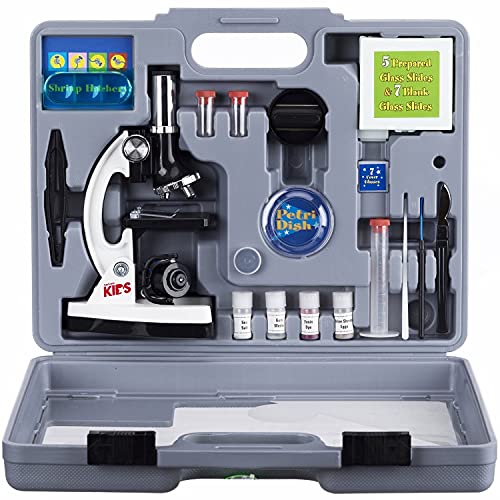
- Explore Microscopy: The AmScope M30 Series 52-Piece STEM Microscope Kit for Kids is a complete set that introduces the fascinating…
- Magnification: Equipped with six magnification settings from 120X to 1200X, this compound microscope enables young scientists to…
This is my top pick for kids and absolute beginners. The AmScope M30 series comes as a complete 52-piece STEM kit with a metal-body microscope, prepared slides, LED illumination, a mirror, a built-in color filter wheel, and a carrying box. Six magnification settings (120x to 1200x) give young students enough range to see everything from fabric fibers to plant cells.
The metal body surprised me at this price point. Most beginner microscopes are all plastic, which means they wobble and break within months. This one feels solid. It’s not lab-grade, but for a 10-year-old doing their first science project, it’s perfect. I’d buy this for any kid who shows interest in science. The carrying box alone makes it worth it because kids will actually take it places.
BEBANG 100X-2000X: Best Budget Compound Microscope
The BEBANG 100X-2000X is the microscope I recommend for high school students who need real magnification without spending a lot. It uses a WF25X eyepiece with a 2X lens combined with 4x, 10x, and 40x objective lenses to deliver 6 magnification levels up to 2000x. The solid metal frame and coarse/fine focus knobs give you the precision you need for lab work.
It comes with dual LED illumination (top and bottom), a phone adapter for capturing images, and a set of 15 prepared slides. The phone adapter is a nice touch. Students can photograph what they see and include it in their lab reports without buying a separate camera. For the price, this one punches well above its weight.
OMAX 40X-2000X LED Binocular: Best for College Students

- Magnification: The OMAX microscope boasts 4 achromatic DIN objectives and offers 8 levels of high-resolution magnification from…
- Advanced Illumination: Equipped with variable intensity LED light, this compound microscope ensures clear visualization of…
This is where things get serious. The OMAX M82E is a binocular compound microscope with 8 magnification levels up to 2000x, 4 achromatic DIN objectives, and WF10X/WF20X eyepieces. The 45-degree inclined binocular head swivels 360 degrees, which means multiple students can share it in a lab setting without moving the whole unit.
Full metal construction makes this feel like a real lab instrument, not a toy. It comes with 100 blank slides and cover slips, so you can start making your own preparations right away. The variable-intensity LED light is a big step up from fixed-brightness models. I recommend this for biology majors, pre-med students, and anyone who’s going to spend serious hours at the microscope. The binocular setup alone saves your eyes during long lab sessions. It’s worth every dollar.
Amazon Basics Biological Compound Microscope: Best Value Pick
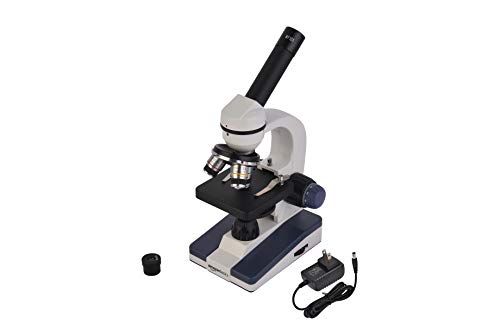
Amazon Basics All-Metal Optical Glass Lenses Cordless LED Student Biological Compound Microscope
- Biological compound microscope ideal for students, learning environments, and hobbyists
- Durably built with an aluminum frame construction, coated glass lenses, and ABS bottom; epoxy resin finish
If you just need a basic, reliable microscope for homework and simple lab work, the Amazon Basics compound microscope is hard to beat on value. It has an aluminum frame, coated glass lenses, and an epoxy resin finish that holds up well. At just 3.3 pounds, it’s light enough for a student to carry between home and school.
It runs on batteries or an AC adapter, so you can use it anywhere, even outdoors for a field observation. The magnification isn’t as high as the OMAX or BEBANG models, but for basic biology notes and general observation, it gets the job done. I’d pick this for middle school students or parents who want to test their kid’s interest before investing in a pricier model.
OMAX 40X-2500X Trinocular: Best for Medical and Research Students
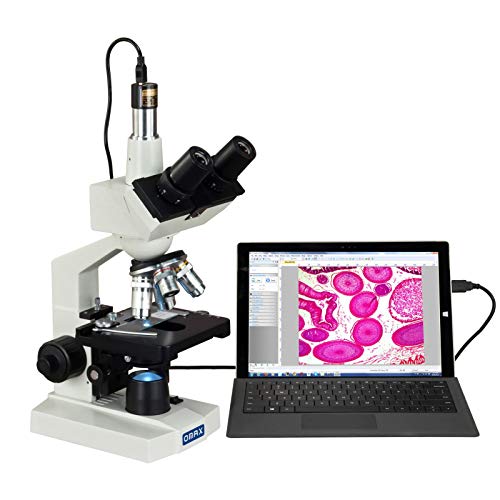
- High Magnification Range: The OMAX M83EZ-C02 microscope offers 40X to 2500X magnification, ideal for diverse lab applications
- Trinocular Design: Our compound microscope features a trinocular head with camera port for better functionality
The OMAX M83EZ-C02 is the most advanced microscope on this list, and the one I’d recommend for medical students, lab researchers, and serious science majors. It delivers up to 2500x magnification with WF10X and WF25X eyepieces, and the trinocular head has a camera port so you can connect a USB digital camera (included) to capture images at 640×480 pixels directly to your computer.
The 45-degree inclined trinocular head swivels 360 degrees, and the double-layer mechanical stage gives you precise slide positioning. It’s compatible with Windows and macOS, so you can document everything digitally. This is a microscope you’ll use through medical school and beyond. If you’re preparing for NEET or studying for pre-med, this is the one I’d pick. It’s priced higher, but the build quality and feature set justify every rupee or dollar.
Which Microscope Should You Buy?
If you’re buying for a kid under 12, get the AmScope 120X-1200X kit. It’s complete, portable, and built to survive a curious child. For high school students doing real lab work, the BEBANG 100X-2000X gives you the best magnification per dollar. College students should go straight to the OMAX 40X-2000X binocular because your eyes will thank you after three-hour lab sessions.
For medical and research students who need documentation capability, the OMAX 40X-2500X trinocular with the USB camera is the right investment. And if you’re testing the waters or need a no-fuss backup scope, the Amazon Basics compound microscope is a safe, affordable choice.
The right microscope isn’t the most expensive one. It’s the one that matches your coursework, fits your budget, and works well enough that you actually want to use it. Get that part right, and you’ll have a tool that makes science feel real instead of abstract.
Frequently Asked Questions
What magnification do I need for a student microscope?
For most high school and college biology courses, you need at least 400x magnification to see cell structures clearly. A 40x-1000x range covers standard lab work. Medical students and researchers should look for 40x-2000x or higher. For younger kids (under 12), a 120x-1200x range is enough to spark interest without overwhelming them.
Should I get a compound or stereo microscope as a student?
It depends on what you’re studying. Compound microscopes are built for viewing thin specimens on slides, like cells, bacteria, and tissue samples. They’re what you’ll use in biology and medical labs. Stereo microscopes show larger objects in 3D, like rocks, insects, or circuit boards. Most biology students need a compound microscope. If you’re into geology, botany, or electronics, go stereo.
How much should I spend on a student microscope?
For kids and beginners, $30-60 gets you a solid starter kit. High school students should budget $60-120 for a compound microscope with good magnification and LED lighting. College and medical students should invest $150-350 for a binocular or trinocular model that’ll last through their entire program. Anything under $25 is usually too cheaply made to be useful.
Is a digital microscope good enough for school coursework?
Digital microscopes are great for hobbyists, presentations, and group viewing. But most school labs expect students to use traditional optical microscopes. If your coursework requires hands-on microscopy skills, like focusing, adjusting lighting, and preparing slides, a digital scope won’t teach you those techniques. I recommend digital as a fun supplement, not a primary tool for school.
What brand of microscope is best for students?
AmScope and OMAX are the two brands I trust most for student microscopes. AmScope offers the widest range of affordable models with solid build quality. OMAX costs a bit more but gives you better optics and durability. Amazon Basics is also a good option for budget buyers who want a simple, reliable scope without extra features.
How do I maintain my microscope so it lasts longer?
Clean the lenses with a microfiber cloth after every use. Never touch the glass with your fingers. Store it with a dust cover in a dry place. Keep the mechanical stage and focus knobs free of debris. If you’re using oil immersion objectives, clean off the oil immediately after each session. A well-maintained microscope can last 10-20 years, even a student-grade one.