
Einstein Field Equations
The Einstein field equations (EFE) are a set of 16 coupled, hyperbolic-elliptic, nonlinear partial differential equations at the heart of general relativity. They describe how mass and energy curve the fabric of spacetime, and that curvature is what you experience as gravity. Published by Albert Einstein in November 1915, the Einstein field equations replaced Newton’s law of universal gravitation with a geometric framework that’s still our best description of gravity at macroscopic scales.
At a high level, the EFE relate the geometry of spacetime (the left side of the equation) to the distribution of matter and energy within it (the right side). Because the Einstein tensor Gμν and the stress-energy tensor Tμν are both symmetric, the 16 equations reduce to 10 independent ones. Apply the four Bianchi identities and you’re left with six truly independent equations, giving the metric four gauge-fixing degrees of freedom.
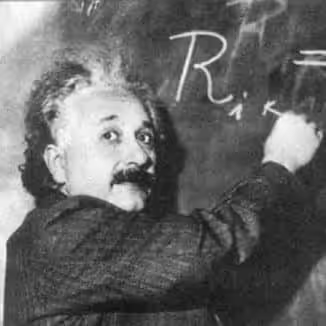
Albert Einstein first published these equations in 1915 as a tensor equation connecting local spacetime curvature (the Einstein tensor) with the stress, momentum, and energy present in that region (the stress-energy tensor). In practical terms, the Einstein field equations determine the metric tensor of spacetime for a given arrangement of stress-energy-momentum. Think of it as the gravitational analog of Maxwell’s equations, which relate electromagnetic fields to the distribution of charges and currents. This connection between geometry and physics is what makes special relativity a limiting case of the broader theory.
Because the Einstein tensor depends on the metric tensor, you can rewrite the EFE as a set of nonlinear partial differential equations whose solutions are the components of the metric tensor itself. Once you have the metric, you can trace out the paths that particles and light follow through curved spacetime using the geodesic equation. Gravity, in this picture, isn’t a force at all. It’s the natural consequence of objects following the straightest possible paths through curved geometry, a concept that connects directly to the four fundamental forces of nature.
Geometric interpretation of the Einstein field equations
The deepest insight behind the Einstein field equations is that gravity isn’t a force pulling objects together. It’s the curvature of spacetime itself. Imagine placing a heavy bowling ball on a stretched rubber sheet. The ball creates a dip, and smaller marbles rolling nearby curve toward it, not because the bowling ball “pulls” them, but because the surface they’re rolling on is curved.
That analogy, while imperfect, captures something essential. In general relativity, massive objects like stars and planets warp the four-dimensional fabric of spacetime around them. The Ricci curvature tensor Rμν measures how much a small volume of spacetime shrinks or expands compared to flat space. The scalar curvature R gives you a single number summarizing the overall curvature at a point. Together, they form the Einstein tensor Gμν, which encodes all the geometric information the field equations need.
The metric tensor gμν is the central object in this whole framework. It tells you how to measure distances and time intervals in curved spacetime. In flat spacetime (no gravity), the metric is just the Minkowski metric from special relativity. Near a massive object, the metric components change, stretching time and compressing space. That’s why clocks tick slower near Earth’s surface than in orbit, a prediction confirmed to extraordinary precision by atomic clocks on GPS satellites.
The Einstein field equations can be summarized in one sentence: matter and energy tell spacetime how to curve, and curved spacetime tells matter how to move. The left side of the equation (geometry) equals the right side (matter-energy), making gravity a purely geometric phenomenon.
Mathematical form of the Einstein field equations
The Einstein field equations are written as:
Gμν + Λgμν = κTμν
Here, Gμν is the Einstein tensor, Λ is the cosmological constant, gμν is the metric tensor, κ is the Einstein gravitational constant, and Tμν is the stress-energy tensor. Each symbol carries precise geometric or physical meaning, and understanding what they represent is the key to reading these equations.
You can expand the Einstein tensor as:
Gμν = Rμν – ½Rgμν
Here, Rμν is the Ricci curvature tensor and R is the scalar curvature. The Einstein tensor is a symmetric second-rank tensor that depends only on the metric tensor and its first and second derivatives. That constraint is what makes it the natural geometric object to appear on the left side of the field equations.
The Einstein gravitational constant is defined as:
κ = 8πG/c4 ≈ 2.077 × 10-43 N-1
Here, G is the Newtonian constant of gravitation and c is the speed of light in vacuum. Notice how tiny κ is. That’s why you need enormous amounts of mass-energy to produce any noticeable curvature of spacetime.
Substituting the definition of Gμν, the full expanded form reads:
Rμν – ½Rgμν + Λgμν = κTμν
Every term on the left side has units of 1/length2. The left side encodes the curvature of spacetime as determined by the metric, while the right side represents the stress-energy-momentum content. You can read the equation as a precise statement: “matter tells spacetime how to curve.”
Together with the geodesic equation, the EFE form the mathematical backbone of general relativity. Each side of the equation is a symmetric 4×4 tensor with 10 independent components. After applying the four Bianchi identities, six independent equations remain, leaving the metric with four gauge-fixing degrees of freedom.
Although Einstein originally wrote these equations in four dimensions, theorists have explored their consequences in arbitrary n dimensions. When you write the equations out in full component form, you see that they are a system of 10 coupled, nonlinear, hyperbolic-elliptic partial differential equations. That complexity is exactly why finding exact solutions is so challenging. For a deeper dive into the mathematical foundations, some of the best general relativity books walk through tensor calculus step by step.
Equivalent formulations
If you take the trace of both sides of the EFE with respect to the metric, you get:
R – R + DΛ = κT
Here, D is the spacetime dimension. Solving for R and substituting back into the original EFE gives you the “trace-reversed” form:
Rμν – Λgμν = κ(Tμν – Tμν)
In D = 4 dimensions, this simplifies to:
Rμν – Λgμν = κ(Tμν – ½Tgμν)
You can reverse the trace again to recover the original EFE. In certain problems, the trace-reversed form turns out to be far more convenient to work with, particularly when you want to isolate the Ricci tensor on one side.
Linearized form
The nonlinearity of the EFE makes finding exact solutions difficult, but you can simplify things with an approximation. Far from a source of gravitating matter, the gravitational field becomes extremely weak and spacetime closely resembles flat Minkowski space.
In this regime, you write the metric as the sum of the Minkowski metric and a small perturbation term, then drop higher-order powers of the perturbation. This process of linearization is exactly how physicists study gravitational radiation, the ripples in spacetime that LIGO and Virgo have now famously detected.
Polynomial form
The standard EFE contain the inverse of the metric tensor, but you can rearrange them into a purely polynomial form. To do this, first express the determinant of the metric in four dimensions using the Levi-Civita symbol:
det(g) = εαβγδεκλμνgακgβλgγμgδν
Then the inverse metric can be written as:
gακ = (εαβγδεκλμνgακgβλgγμgδν) / det(g)
Substitute this into the field equations and multiply both sides by a suitable power of det(g) to clear the denominator. What you get is a set of polynomial equations in the metric tensor and its first and second derivatives. You can also rewrite the Einstein-Hilbert action in polynomial form using appropriate field redefinitions.
The cosmological constant and dark energy
The term Λgμν in the EFE wasn’t part of Einstein’s original 1915 publication. He added the cosmological constant Λ later to allow for a static universe, one that neither expands nor contracts. That attempt failed for two reasons:
- The static solution it produces is unstable. Any small perturbation causes the universe to expand or collapse.
- Edwin Hubble’s observations in the late 1920s showed that the universe is actually expanding.
Einstein reportedly called the cosmological constant the “biggest blunder” of his life and dropped it from his equations. However, including it doesn’t introduce any mathematical inconsistency, and for decades most physicists simply assumed Λ = 0.
That changed in 1998 when observations of distant Type Ia supernovae by the Supernova Cosmology Project and the High-z Supernova Search Team revealed that the expansion of the universe is accelerating. Explaining this acceleration requires a small, positive value of Λ. Its effect is negligible at the scale of galaxies or smaller, which is why you don’t notice it in everyday physics, but it dominates the large-scale dynamics of the cosmos.
Today, the cosmological constant is the simplest explanation for what physicists call dark energy, the mysterious component that makes up roughly 68% of the universe’s total energy density. The measured value is extraordinarily small: Λ ≈ 1.1 × 10-52 m-2. Quantum field theory predicts a vacuum energy density roughly 10120 times larger than what’s observed. This mismatch, known as the cosmological constant problem, remains one of the deepest unsolved puzzles in theoretical physics. It connects the Einstein field equations directly to open questions about cosmic radiation and the fundamental structure of the universe.
The Schwarzschild solution and black holes
Just weeks after Einstein published the field equations in 1915, the German physicist Karl Schwarzschild found the first exact solution while serving on the Russian front in World War I. The Schwarzschild solution describes the spacetime geometry outside a spherically symmetric, non-rotating, uncharged mass. It’s the simplest solution to the Einstein field equations with a point mass source, and it predicted something nobody expected: black holes.
The Schwarzschild metric introduces a critical radius, rs = 2GM/c2, now called the Schwarzschild radius. For the Sun, this works out to about 2.95 kilometers. For Earth, it’s roughly 8.87 millimeters. If you could compress an object’s entire mass within its Schwarzschild radius, the resulting spacetime curvature would be so extreme that nothing, not even light, could escape. That’s a black hole.
At the Schwarzschild radius, the metric has a coordinate singularity. For decades, physicists debated whether this represented a real physical barrier or just an artifact of the coordinate system. The answer turned out to be the latter. Using different coordinates (Eddington-Finkelstein or Kruskal-Szekeres coordinates), the singularity at rs disappears, revealing that the Schwarzschild radius marks an event horizon, a one-way boundary that objects can cross inward but never outward.
The true singularity sits at r = 0, where the curvature becomes infinite and the equations break down. Most physicists believe a complete theory of quantum gravity will eventually resolve this singularity, but we don’t have that theory yet. The Schwarzschild solution also forms the basis for understanding the thermodynamic properties of black holes, connecting to the Boltzmann constant through Bekenstein-Hawking entropy.
Practical applications: GPS and gravitational waves
The Einstein field equations aren’t just abstract mathematics. They have direct, measurable consequences in technology you use every day.
Without corrections from general relativity, GPS positions would drift by about 10 kilometers per day. Every GPS satellite carries atomic clocks that must account for both special relativistic time dilation (clocks moving fast run slow) and general relativistic effects (clocks in weaker gravity run fast).
GPS satellite corrections. The 31 GPS satellites orbit at about 20,200 kilometers above Earth’s surface, moving at roughly 14,000 km/h. Special relativity predicts their onboard clocks lose about 7 microseconds per day relative to ground clocks (time dilation from velocity). But general relativity predicts they gain about 45 microseconds per day because they sit in a weaker gravitational field than clocks on Earth’s surface. The net effect is a gain of roughly 38 microseconds per day. That sounds tiny, but light travels about 11.4 kilometers in 38 microseconds. Without relativistic corrections built into the GPS system’s software, your position reading would accumulate errors of roughly 10 km per day.
Gravitational wave detection. The linearized form of the Einstein field equations predicts that accelerating masses produce ripples in spacetime, gravitational waves. On September 14, 2015, the LIGO detectors in Hanford, Washington, and Livingston, Louisiana, made the first direct detection. The signal, designated GW150914, came from the merger of two black holes about 1.3 billion light-years away. The spacetime distortion at Earth was incredibly small: roughly 10-21, equivalent to measuring a change in distance smaller than 1/1000th the width of a proton across LIGO’s 4-kilometer arms.
Gravitational lensing. The Einstein field equations predict that light follows curved paths through warped spacetime. Massive objects like galaxy clusters bend light from more distant sources, acting as cosmic magnifying glasses. Astronomers use this effect, called gravitational lensing, to study dark matter distributions, discover distant galaxies, and even detect exoplanets. The Hubble Space Telescope and the James Webb Space Telescope have captured stunning images of Einstein rings, arcs of light from background galaxies bent into near-perfect circles by foreground mass.
Solutions of the Einstein field equations
Solutions to the EFE are metrics of spacetime. They describe the geometry of spacetime and, through the geodesic equation, the inertial motion of objects within it. Because the equations are nonlinear, finding complete solutions is rarely straightforward. For instance, no exact solution exists for a spacetime containing two massive bodies, such as a binary star system.
In practice, physicists make post-Newtonian approximations to handle such cases. Still, many important exact solutions do exist, and studying them has been one of the most productive activities in theoretical physics. Exact solutions have led to the prediction of black holes, the development of cosmological models for the evolution of the universe, and the theoretical framework for gravitational waves.
The method of orthonormal frames, introduced by Ellis and MacCallum, offers another route to new solutions. This approach reduces the EFE to a set of coupled, nonlinear ordinary differential equations. Hsu and Wainwright showed that self-similar solutions correspond to fixed points of the resulting dynamical system, and researchers like LeBlanc, Kohli, and Haslam have used these techniques to discover entirely new solutions.
Frequently asked questions
What do the Einstein field equations actually tell you?
The Einstein field equations tell you how mass and energy curve spacetime. The left side of the equation describes the geometry (curvature) of spacetime, while the right side describes the matter and energy present. In short, they formalize the idea that matter tells spacetime how to curve, and curved spacetime tells matter how to move.
Why are there 10 independent equations instead of 16?
The Einstein tensor Gμν and the stress-energy tensor Tμν are both symmetric tensors, meaning the component with indices (μ, ν) equals the one with (ν, μ). A symmetric 4×4 tensor has only 10 independent components rather than 16, so the symmetry reduces the equation count from 16 to 10.
What is the cosmological constant and why did Einstein add it?
The cosmological constant Λ is an extra term Einstein added to his equations to allow for a static, non-expanding universe. He later called it his biggest blunder after Hubble discovered the universe is expanding. However, modern observations of accelerating expansion have revived Λ as a small positive constant that drives the large-scale acceleration of the cosmos.
Why is it so hard to find exact solutions to the EFE?
The EFE are a system of 10 coupled, nonlinear partial differential equations. Nonlinearity means you cannot simply add two known solutions to get a third, which is something you can do with linear equations like Maxwell’s equations in vacuum. This makes the solution space extremely complex, and no general closed-form solution exists for arbitrary mass-energy configurations.
What is the relationship between the EFE and the geodesic equation?
The EFE determine the metric tensor, which describes the geometry of spacetime. The geodesic equation then uses that metric to calculate the paths (geodesics) that freely falling particles and light rays follow through curved spacetime. Together, they form the complete mathematical framework of general relativity: the EFE set the stage and the geodesic equation describes the motion on it.
What are the most important exact solutions of the Einstein field equations?
The most significant exact solutions include the Schwarzschild solution (describing spacetime around a non-rotating, uncharged mass, which predicted black holes), the Kerr solution (for rotating black holes), the Friedmann-Lemaitre-Robertson-Walker metric (the foundation of modern cosmology), and the Reissner-Nordstrom solution (for charged, non-rotating masses). Each of these has had profound implications for our understanding of the universe.
How do the Einstein field equations affect GPS satellites?
GPS satellites orbit at about 20,200 km altitude and experience weaker gravity than clocks on Earth’s surface. General relativity predicts their clocks gain roughly 45 microseconds per day compared to ground clocks, while special relativity causes them to lose about 7 microseconds per day due to their velocity. The net gain of 38 microseconds per day would cause positioning errors of about 10 km per day if left uncorrected. GPS firmware includes relativistic corrections derived from the Einstein field equations.
What is the Schwarzschild radius and why does it matter?
The Schwarzschild radius (rs = 2GM/c2) is the critical radius at which a spherically symmetric mass would form a black hole. For the Sun, it’s about 2.95 km; for Earth, roughly 8.87 mm. If an object is compressed within its Schwarzschild radius, the spacetime curvature becomes so extreme that an event horizon forms, beyond which nothing can escape, not even light. This radius comes directly from the Schwarzschild solution to the Einstein field equations.