
How to Effectively Read and Learn from a Book?
You bought 15 business books last year. You finished maybe 5. You remember useful ideas from… 2? That $200+ investment and 50+ hours of reading time produced almost nothing actionable. Sound familiar? I know this pattern because I lived it for years.
The problem isn’t that you’re a slow reader or that you picked bad books. It’s that nobody taught you how to extract and apply what you read. You highlight passages, feel inspired for a day, then move on. Three months later, you can’t remember a single specific takeaway. Meanwhile, the most successful people you know seem to absorb and implement ideas from every book they touch.
I’ve spent the last decade building a reading system that turns books into business results. It involves a 3-pass method, a book-to-action framework, and tools that make retention automatic. In this guide, I’ll walk you through exactly how it works, plus the 10 books that changed how I run my business, with specific takeaways you can steal today.
Why Most Business Reading Is Wasted
German psychologist Hermann Ebbinghaus discovered the “forgetting curve” back in the 1880s, and it’s still ruining your reading ROI in 2026. Within 24 hours of reading something, you forget roughly 70% of it. After a week, that number climbs to 90%. So that incredible book on growth marketing you devoured last month? You’ve retained maybe 3 useful sentences.
But the forgetting curve isn’t even the biggest problem. The real killer is the application gap. You can remember a concept perfectly and still never use it. I once read “The Lean Startup” cover to cover, highlighted 47 passages, and implemented exactly zero of Eric Ries’ ideas in my next project. That book sat on my shelf like a trophy instead of functioning as a tool.
Research from the University of Waterloo shows that passive reading, where you just move your eyes across pages, produces almost no long-term retention. Active engagement with the material is what builds lasting knowledge. The difference between these two approaches is staggering: active readers retain 5x more information after 30 days compared to passive readers.
Here’s what I realized after years of wasting reading time: reading more books doesn’t make you smarter. Reading fewer books with a better system does. The CEOs and founders who seem to pull wisdom from every book aren’t reading faster. They’re reading differently.
The 3-Pass Reading System That Changed Everything
The 3-pass system takes about 4 hours total per book, spread across 3 distinct sessions. That’s roughly the same time most people spend on a single passive read-through. The difference is what you walk away with.
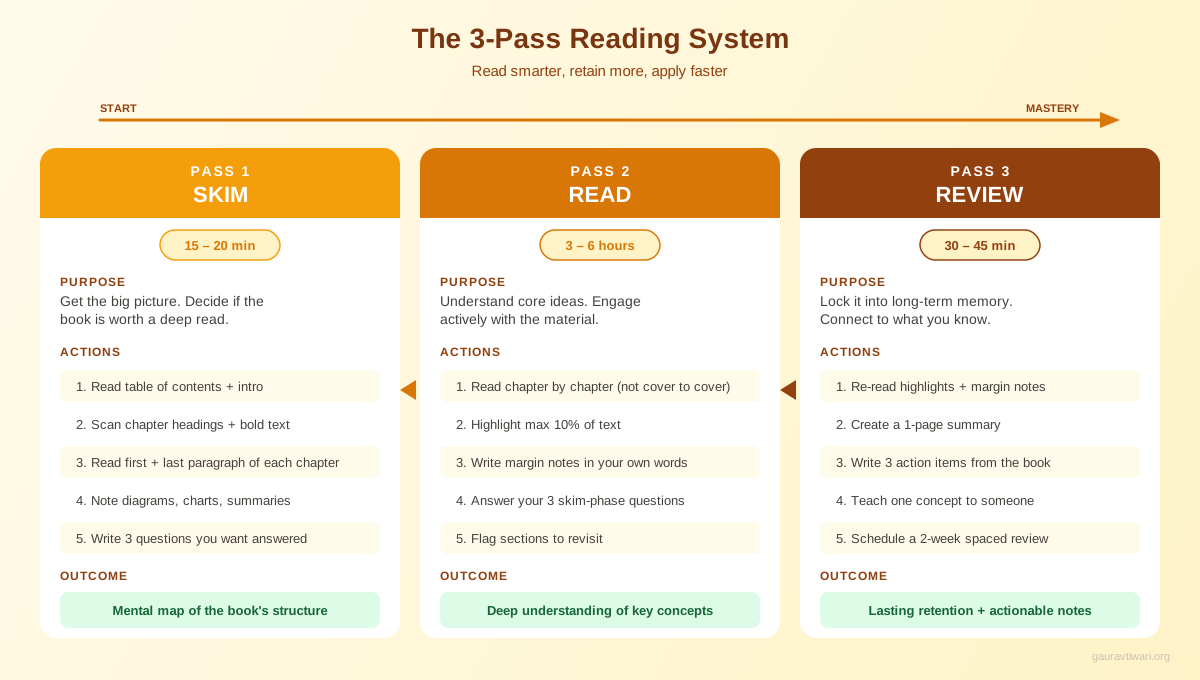
Pass 1: Skim for Structure (15 Minutes)
Before you read a single chapter, spend 15 minutes mapping the book’s structure. Read the table of contents carefully. Scan the introduction and conclusion. Flip through and notice how chapters connect to each other. This isn’t speed reading. It’s reconnaissance.
Why does this matter? Because your brain learns better when it has a framework to attach new information to. Think of it like looking at a map before driving somewhere new. You won’t memorize every turn, but you’ll know the general direction and recognize landmarks when you see them.
During this pass, I write down 3-5 questions I expect the book to answer. For example, when I skimmed “Building a StoryBrand” by Donald Miller, my questions were: What’s the StoryBrand framework? How do I apply it to a services business? What’s the one-liner formula? Having these questions in mind before reading turned every chapter into a treasure hunt instead of a passive scroll.
Pass 2: Read for Insight (2-3 Hours)
Now you read the book properly, but with a pen in hand. Physical or digital, it doesn’t matter. What matters is that you’re not just consuming. You’re having a conversation with the author.
Here’s my annotation system. I’ve used it on 200+ books and it takes maybe 10 extra seconds per page:
- Underline key arguments and surprising claims
- Star (*) ideas you want to implement
- Question mark (?) things you disagree with or want to verify
- Arrow (->) connections to other books or your own experience
- “T” in the margin for ideas worth teaching someone else
The last symbol is the most powerful. When you flag something as “worth teaching,” you’re already beginning the process of internalizing it. Your brain treats “I need to explain this” differently than “I should remember this.”
Pass 3: Review for Action Items (30 Minutes)
This is the pass most readers skip entirely, and it’s the one that produces 80% of the value. Within 48 hours of finishing the book, sit down with your highlights and annotations. Go through every starred item and every “T” in the margin.
Your goal in this session is simple: extract exactly 3 implementable ideas. Not 10. Not 7. Three. Why three? Because you’ll actually do three things. You won’t do ten. I’ve tested this with different numbers over years of reading, and 3 is the sweet spot where ambition meets execution.
For each action item, write down:
- What specifically you’ll do (not vague “be more strategic” stuff)
- When you’ll start (put it on your calendar right now)
- How you’ll know it worked (measurable outcome)
After reading “Atomic Habits” by James Clear, my 3 action items were: (1) stack my writing habit onto my morning coffee routine starting Monday, (2) use a habit tracker app for 30 days, and (3) redesign my workspace to make distractions harder. All three stuck. That’s a $15 book producing thousands of dollars in productivity gains.
Active Reading Tools That Make Retention Automatic
The 3-pass system works on its own. But pairing it with the right tools turns occasional insights into a compounding knowledge base that grows with every book you read. Here’s my current stack, refined over several years of experimentation.
Kindle Highlights + Readwise for Spaced Repetition
I do most of my reading on Kindle because highlights sync automatically. But highlights alone are useless if you never see them again. That’s where Readwise comes in. It resurfaces your highlights daily using spaced repetition, the same technique medical students use to memorize thousands of terms.
Every morning, Readwise sends me 5 highlights from books I’ve read in the past. It takes 2 minutes to review them. After 6 months of this habit, I noticed something wild: I could recall specific ideas from books I’d read years ago. The forgetting curve doesn’t stand a chance against spaced repetition.
A Notion Book Database for Long-Term Reference
For every book I finish, I create an entry in my Notion book database. Each entry includes the book title, author, date finished, my 1-paragraph summary, the 3 action items I extracted, and a link to my full highlights. This database has 150+ entries now, and I search it constantly when I need to reference an idea.
The 1-paragraph summary is key. It forces you to distill an entire book into its core argument. If you can’t do this, you didn’t understand the book well enough. Go back and re-read your highlights.
Physical Margin Notes Still Win for Deep Reading
For books that demand deep thinking, I still buy physical copies. There’s something about writing in the margins with a pen that engages a different part of your brain. A study from Princeton University found that handwriting notes produces better conceptual understanding than typing, even though typing captures more content.
I use a simple system: pencil for first-read annotations, then colored sticky tabs to mark the pages I want to revisit during Pass 3. Blue tabs for action items, yellow for quotes worth saving, pink for ideas I disagree with (disagreement is powerful for learning).
The Feynman Technique Applied to Business Books
Richard Feynman, the Nobel Prize-winning physicist, had a learning method so effective that it became a foundational technique in accelerated learning. The core idea is brutally simple: if you can’t explain something to a 12-year-old, you don’t understand it.
Here’s how I apply the Feynman Technique to business books. After finishing a book and completing my 3 action items, I try to explain the book’s core argument to someone who hasn’t read it. No jargon. No author name-dropping. Just the idea in plain language.
“If you can’t explain it simply, you don’t understand it well enough.”
Often attributed to Albert Einstein
I do this in three ways:
- Verbal explanation: I tell my wife or a colleague about the book’s key idea over coffee. If I stumble or resort to vague language, I know I need to re-read that section.
- Written summary: I write a 300-word summary using only simple words. This goes into my Notion database and doubles as a reference I can search later.
- Teaching moment: If I manage a team or mentor anyone, I share the relevant idea in context. “I read something that applies to our situation” is way more powerful than a generic book recommendation.
The act of teaching forces your brain to organize information differently than passive recall. You have to identify the core concept, find the right analogy, anticipate questions, and simplify without losing accuracy. It’s the single most effective retention technique I’ve found in 16 years of continuous learning.
The Book-to-Action Framework
This is the framework I mentioned in the 3-pass system, expanded into a complete process. The goal is simple: every book you read produces measurable changes in how you work or think. No more “interesting read” that leads nowhere.
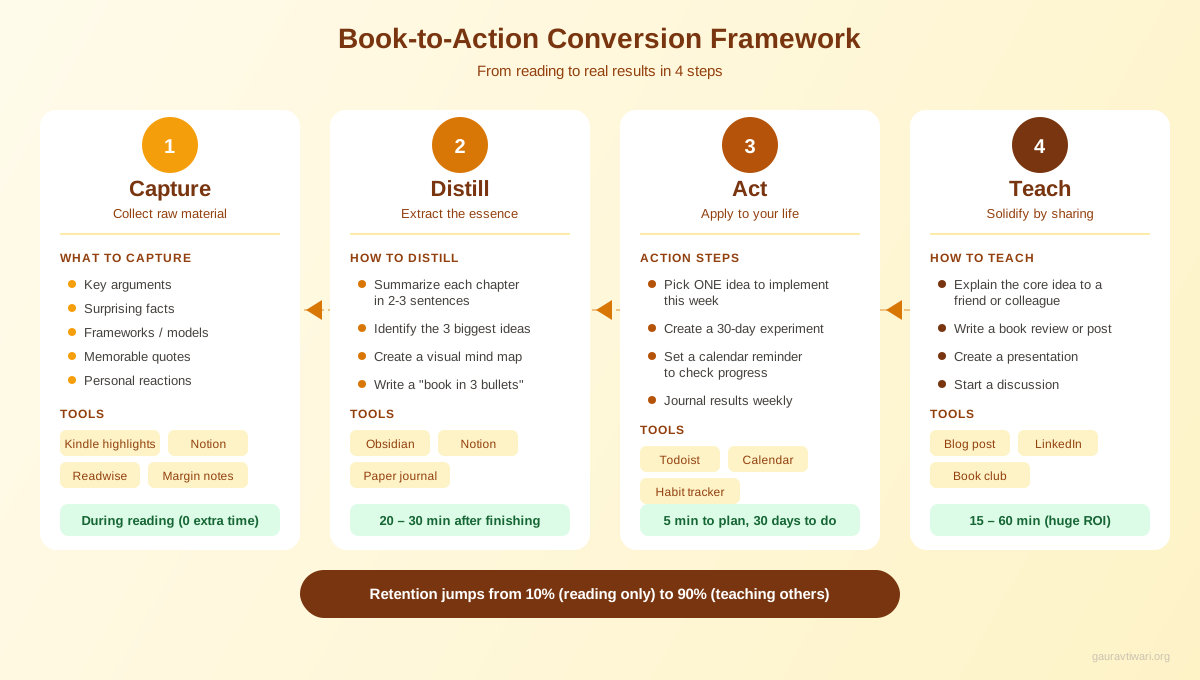
The framework has 4 stages: Capture, Distill, Act, Teach. You’ve already seen parts of it in the 3-pass system. Here’s the complete picture with the tools I use at each stage.
Stage 1: Capture (During Reading)
Highlight 15-20 key passages per book. Write margin reactions. Flag anything that triggers “I should try this.” Don’t filter too much at this stage. You want raw material to work with later. I use Kindle highlights for digital books and pencil annotations for physical ones.
Stage 2: Distill (30 Minutes After Finishing)
Group your highlights by theme. Write a 1-sentence summary of the book. Identify the 3 key principles that the entire book supports. Note what genuinely surprised you. This is where most of the learning happens, because you’re forcing your brain to synthesize instead of just recall.
I do this in Notion using a book database template. Each entry has fields for: title, author, date read, summary, key principles, action items, and a rating. The rating isn’t about how “good” the book was. It’s about how much it changed my behavior. A 5-star book is one where I’m still using ideas from it 6 months later.
Stage 3: Act (15 Minutes to Schedule)
Pick your 3 implementable ideas. Put them on your Google Calendar with specific start dates. Set a 30-day review reminder. This is the stage where books stop being entertainment and start being business tools.
Here’s a real example. After reading “Company of One” by Paul Jarvis, my 3 action items were: (1) audit my service packages and remove the lowest-margin offering by Friday, (2) create a “not-to-do” list for client requests I should decline, and (3) set a revenue-per-client metric and track it monthly. Item #1 increased my average project value by 22% within 2 months.
Stage 4: Teach (Ongoing)
Share what you learned. Write about it. Discuss it. The Feynman Technique in action. This stage isn’t just about retention. It positions you as someone who reads, thinks, and applies. That reputation compounds over time in ways that surprise you.
10 Books That Shaped How I Run My Business
These aren’t “best business books” lists you’ve seen a hundred times. These are the specific books that changed specific behaviors in how I work. For each one, I’ll share the exact takeaway I implemented, not just a summary of what the book says.
How many business/non-fiction books do you read per year?
- “Deep Work” by Cal Newport: I restructured my entire day around 3-hour deep work blocks. No email, no Slack, no meetings before noon. My output per hour roughly doubled. This single book paid for itself within the first week of implementation.
- “Atomic Habits” by James Clear: The “habit stacking” concept. I attached new behaviors to existing routines. Writing after morning coffee. Exercise after dropping kids at school. Client follow-ups right after lunch. The system stuck because it used existing triggers.
- “The One Thing” by Gary Keller: The focusing question, “What’s the one thing I can do such that by doing it everything else becomes easier or unnecessary?” I ask this every Monday morning. It cut my to-do list from 15 items to 3-4 that actually matter.
- “Building a StoryBrand” by Donald Miller: Rewrote all my service pages using the StoryBrand framework. The customer is the hero, not me. Conversion rates on my services page went up 35% after the rewrite. I now use this framework for every content marketing plan I build.
- “$100M Offers” by Alex Hormozi: Taught me to build offers so good that people feel stupid saying no. I restructured my pricing from hourly rates to value-based packages. Average project value increased 40% with the same client base.
- “The E-Myth Revisited” by Michael Gerber: The distinction between working IN your business vs. ON your business. I started documenting every repeatable process and delegating anything that didn’t require my specific expertise.
- “Thinking, Fast and Slow” by Daniel Kahneman: Understanding System 1 and System 2 thinking made me a better analyst. I now deliberately slow down for important decisions and recognize when I’m using mental shortcuts that lead to bad calls.
- “Company of One” by Paul Jarvis: Questioning growth for growth’s sake. Not every business needs to be bigger. Some need to be better. This book gave me permission to optimize for profit and lifestyle instead of headcount and revenue.
- “Show Your Work” by Austin Kleon: Started sharing my process publicly, not just results. Blog posts about what I’m learning, tools I’m testing, mistakes I’m making. This transparency built more trust with clients than any case study ever did.
- “Essentialism” by Greg McKeown: The disciplined pursuit of less. I said no to 3 potential projects in the month after reading this. Those “no”s freed up time for work that was 2x more impactful and 3x more enjoyable.
Notice something? Every book on this list produced a specific, measurable change. That’s not because I’m uniquely disciplined. It’s because the book-to-action framework forces extraction and implementation. Without the framework, these would’ve been “great reads” that collected dust.
“A reader lives a thousand lives before he dies. The man who never reads lives only one.”
George R.R. Martin, A Dance with Dragons
Speed Reading Myths: Why Reading Faster Doesn’t Mean Learning More
Let me save you $500 on that speed reading course. Speed reading, as commonly taught, is largely debunked by cognitive science. A 2016 study published in Psychological Science in the Public Interest concluded that there’s always a tradeoff between speed and comprehension. You can’t beat the fundamental processing limitations of your visual system.
The average person reads about 200-300 words per minute with good comprehension. “Speed readers” who claim 1,000+ WPM are actually skimming, which is useful (it’s literally Pass 1 of my system) but isn’t the same as reading. You skip details. You miss nuance. You lose the author’s reasoning.
Here’s what actually works instead of speed reading:
- Strategic skimming: Not every chapter deserves the same attention. Some chapters reiterate points you already know. Skim those. Go deep on the chapters that challenge you.
- Pre-reading: The 15-minute skim pass means your brain is primed. You’ll naturally read faster on Pass 2 because you already know the structure.
- Reading more: The fastest way to “read faster” is to read more books. Your vocabulary grows, pattern recognition improves, and you naturally process familiar concepts quicker.
- Eliminating subvocalization selectively: You don’t need to “hear” every word internally for familiar content. But for complex arguments, subvocalization actually helps comprehension.
The goal isn’t to read faster. It’s to learn more per hour invested. The 3-pass system achieves this by eliminating waste, not by rushing through pages.
Building a Reading Habit: The 20 Pages a Day System
The most common reason people don’t read enough isn’t lack of time. It’s lack of a system. “I’ll read when I have time” produces 2-3 books per year. “I’ll read 20 pages every morning” produces 30+ books per year. The math is simple: 20 pages per day x 365 days = 7,300 pages. At 200-250 pages per average nonfiction book, that’s 29-36 books annually.
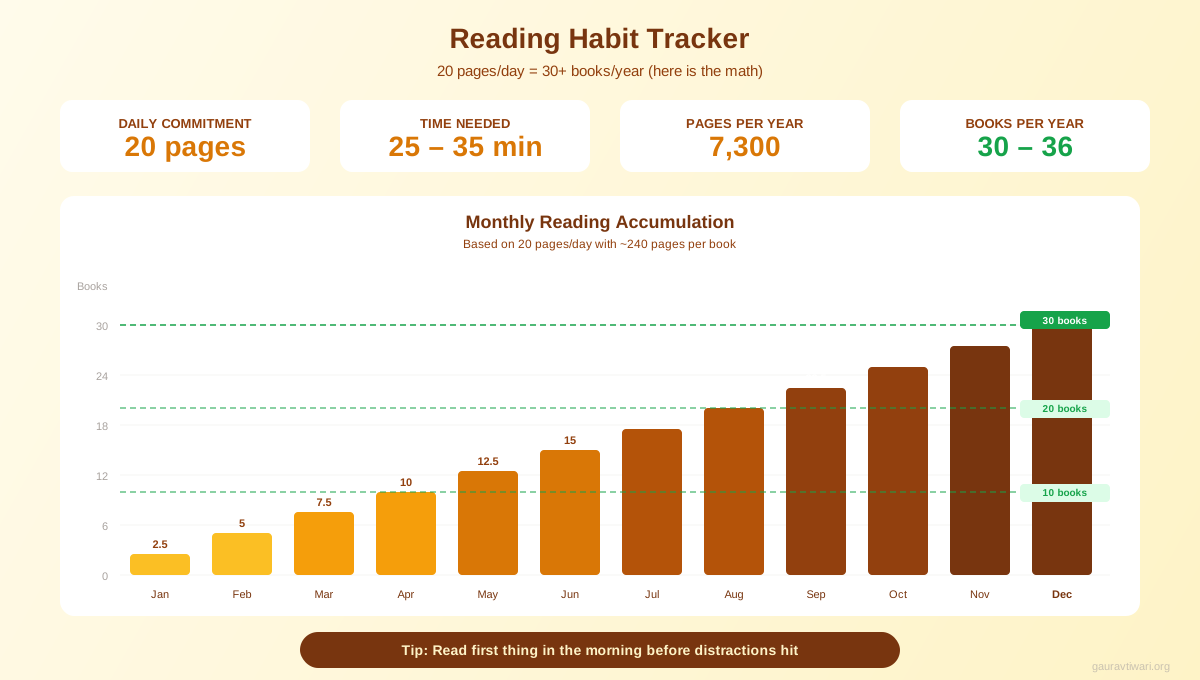
Twenty pages takes roughly 25-35 minutes of focused reading. That’s your morning coffee time. Or your commute. Or the 30 minutes before bed where you’d otherwise scroll social media. You’re not adding time to your day. You’re replacing low-value time with high-value reading.
Making the Habit Stick
I’ve been reading 20+ pages daily for over 5 years. Here’s what keeps the habit going:
- Same time, same place: I read at 6:30 AM in my home office with coffee. The environment itself triggers the habit now.
- Always have the next book ready: The moment I finish a book, the next one is already loaded on my Kindle or sitting on my desk. Zero friction between books.
- Mix formats: Physical books for deep reads, Kindle for travel, audiobooks during commutes and workouts. Different formats for different contexts means you always have access to a book.
- Quit books freely: Life’s too short for bad books. If a book doesn’t grab you by page 50, put it down. There are thousands more worth your time.
- Join a book club: Accountability matters. Knowing you’ll discuss a book with others adds urgency and depth to your reading. Even an informal monthly discussion with 2-3 friends works.
Audiobooks: The Commute Hack
I used to think audiobooks were “cheating.” They’re not. Research from the University of Virginia shows that listening and reading activate the same brain regions for language processing. Comprehension is nearly identical for narrative content.
That said, audiobooks work differently. They’re fantastic for narrative nonfiction, memoirs, and concept-based books. They’re less effective for dense, reference-heavy material where you need to flip back and forth. I use audiobooks at 1.25x speed during commutes, cooking, and gym sessions. That adds 1-2 extra books per month without any additional “reading” time.
AI-Assisted Reading: The New Frontier
AI tools have added a powerful new dimension to my reading system in 2026. I’m not talking about replacing reading. I’m talking about using AI to deepen understanding and accelerate the Distill and Teach stages of the framework.
Here’s how I use AI with my reading:
- ChatGPT as a discussion partner: After finishing a book, I paste my key highlights and ask ChatGPT to challenge my interpretations. “What am I missing?” and “How would a critic respond to this author’s argument?” are my go-to prompts. It’s like having a book club partner available 24/7.
- Blinkist for pre-screening: Before buying a book, I’ll check Blinkist for the 15-minute summary. If the summary doesn’t excite me, the full book won’t either. This has saved me from at least 10 mediocre books per year.
- AI-generated study questions: I feed chapter summaries to AI and ask it to generate study questions that test understanding, not just recall. “How would you apply Chapter 3’s framework to a SaaS business?” is more useful than “What did the author say in Chapter 3?”
One word of caution: AI summaries are not substitutes for reading. They’re supplements. An AI summary gives you the “what.” Reading gives you the “why” and the “how.” The nuance, the author’s reasoning, the stories that make concepts stick. That’s where the value lives.
Writing Better Book Summaries with the Right Tools
Your book summaries are only as good as the writing that captures them. I use Google Workspace for collaborative notes when I’m discussing books with colleagues, and Sapling to polish my written summaries before sharing them. Clear writing forces clear thinking, so the editing process itself becomes a learning tool.
When you write a book summary, aim for 300-500 words. Include: the book’s central argument in 1 sentence, the 3 key principles, your 3 action items, and who should read this book. Publish these summaries somewhere, even if it’s just a private blog or a Notion page you share with friends. The act of publishing raises your writing quality because you know someone might read it.
Tools I Recommend for Serious Readers
Here are the 3 tools that form the backbone of my reading system. Each one handles a different part of the capture-distill-act-teach framework.
- Custom database templates for book tracking
- Linked databases connect highlights to action items
- Free plan covers most reading needs
- Syncs across all devices for on-the-go notes
- AI features help summarize and organize notes
- Google Docs for shared book discussions
- Google Calendar for scheduling action items
- Google Keep for quick capture during reading
- Real-time collaboration for book clubs
- Seamless mobile + desktop experience

- AI-powered grammar and style corrections
- Works inside Google Docs and Notion
- Catches awkward phrasing in book summaries
- Faster and lighter than alternatives
- Free tier available for light use
Putting It All Together: Your Reading Action Plan
If you’ve made it this far, you already know more about effective reading than 95% of people who buy business books. But knowledge without action is just entertainment. So here’s your action plan for this week:
- Pick one book from your shelf or wish list. Start with something you’ve been meaning to read.
- Do the 15-minute skim. Read the table of contents, introduction, and conclusion. Write 3-5 questions you want answered.
- Commit to 20 pages per day. Set a specific time. Same time, same place.
- Set up your capture tool. Kindle + Readwise, or a physical notebook. Don’t overthink this.
- After finishing, extract 3 action items. Put them on your calendar with specific dates.
Reading isn’t a passive hobby. It’s one of the highest-ROI investments you can make in your career and your thinking. But only if you do it right. The 3-pass system, the book-to-action framework, and a consistent 20-page habit will transform you from someone who reads books into someone who learns from them.
Start today. Grab that book. And this time, read it like it matters.
Frequently Asked Questions
How long does the 3-pass reading system take per book?
The full 3-pass system takes about 4 hours total: 15 minutes for the skim pass, 2-3 hours for the reading pass, and 30 minutes for the review and action item extraction. This is roughly the same time as a single passive read-through, but you’ll retain 3-5x more information and walk away with concrete action items.
Should I read physical books or use a Kindle?
Both work well. I use Kindle for most reading because highlights sync automatically to Readwise for spaced repetition. But for books that require deep thinking or frequent page-flipping, physical copies with pencil annotations are better. The Princeton handwriting study supports this. Use whatever format reduces friction and keeps you reading consistently.
Is speed reading worth learning?
No. A 2016 study in Psychological Science in the Public Interest confirmed that speed reading always trades comprehension for speed. Instead of reading faster, focus on reading smarter. The 3-pass system, strategic skimming, and pre-reading are more effective than any speed reading technique. Your goal should be learning more per hour, not reading more words per minute.
How many books should I read per year?
Quality beats quantity. Reading 12 books well with the book-to-action framework (producing 36 action items) is far more valuable than reading 50 books passively. That said, the 20-pages-per-day system naturally produces 30+ books per year without forcing it. Start with one book per month and let the habit build naturally.
What if I start a book and don’t like it?
Put it down. Life is too short for books that don’t serve you. I use a “page 50 rule.” If a book hasn’t grabbed me or taught me something useful by page 50, I stop reading it. This isn’t quitting. It’s prioritizing. There are thousands of great books waiting. Don’t waste hours on one that isn’t clicking.
Can audiobooks replace traditional reading?
Audiobooks activate the same language processing brain regions as reading, according to research from the University of Virginia. They’re excellent for narrative nonfiction and concept-based books. However, they’re less effective for dense, reference-heavy material. I use audiobooks at 1.25x speed during commutes and gym sessions, adding 1-2 extra books per month to my reading habit.
How do I remember what I read long-term?
Three techniques work together: (1) Active annotation during reading, using symbols and margin notes, (2) Spaced repetition through tools like Readwise that resurface your highlights daily, and (3) Teaching what you’ve learned to others using the Feynman Technique. The combination of these three methods defeats the forgetting curve and keeps ideas accessible months or years after reading.
What’s the best tool for organizing book notes?
Notion is my top recommendation for building a book database. It lets you create custom templates with fields for summary, action items, key principles, and ratings. The free plan is generous enough for most readers. For collaborative notes and scheduling action items, Google Workspace handles that well with Docs and Calendar integration.
Related Reading
If you found this reading system useful, you’ll want to check out these related guides:
- How to Learn Faster and Better: The science behind accelerated learning and memory techniques
- SMART Analysis Guide: Apply the same structured thinking from your reading to business analysis
Disclaimer: This site is reader-supported. If you buy through some links, I may earn a small commission at no extra cost to you. I only recommend tools I trust and would use myself. Your support helps keep gauravtiwari.org free and focused on real-world advice. Thanks. - Gaurav Tiwari
Such an amazing article. Dear Gaurav, you have researched your content well and it truly show how master you are of your game. Splendind! I will let me students know about this. Cheers.
I can’t say the best way to read the book, but I will share my experiences about how I read the book. Before reading the book it is very essential to know about the author, contents and take aways from the book. Best way is to google about the book and know by yourself. It will definitely give you an intense motivation to read the book. Once you start to read,one may feel deviated from the topic and starts to think about something else connected to the book. It is then we have to look back about the things which inspired to read the book. And once your done with reading for that day, take some time to note down the important things about the content you have read(summarise it). It will not only help you in reading it effectively but will motivate you for further reading and completing the book.
An good article. Maybe it will help me in nearby future.
Book reading is an art and you have explained that beautifully.
Thank you Gaurav Tiwari.