
The Best Kneeling Chairs for 2026: Buying Guide and Top Deals
I spent 10+ years hunched over a desk before my lower back finally gave me an ultimatum. Regular ergonomic chairs helped, but they didn’t fix the root problem: my posture was terrible, and no lumbar support in the world could force me to sit straight for 8 hours. That’s when I tried a kneeling chair, and it changed how I think about sitting altogether.
A kneeling chair tilts your pelvis forward and opens up your hip angle, so your spine naturally falls into alignment. You don’t have to think about sitting up straight. The chair does the structural work for you. After testing several options over the past few years, I’ve narrowed it down to the best kneeling chairs you can buy in 2026.
Why buy a Kneeling Chair?

If you sit at a desk for 6+ hours a day, your body is paying a price. Lower back pain, tight hip flexors, rounded shoulders. I’ve dealt with all of it. Standing desks help, but you can’t stand for 8 hours straight either. And most ergonomic office chairs just mask the problem with expensive padding.
A kneeling chair works differently. It positions your thighs at a downward angle (usually around 60-70 degrees), which shifts your center of gravity forward and forces your spine into its natural S-curve. Your core muscles engage without you consciously thinking about it. Over weeks of consistent use, your posture actually improves even when you’re not sitting in the chair.
I won’t pretend kneeling chairs are perfect for everyone. They take getting used to, and your shins might feel sore for the first week or two. The smart move is to alternate between a kneeling chair and a regular office chair throughout the day. Start with 30-minute sessions and work your way up. Your back will thank you within a month.
The Best Kneeling Chairs to buy
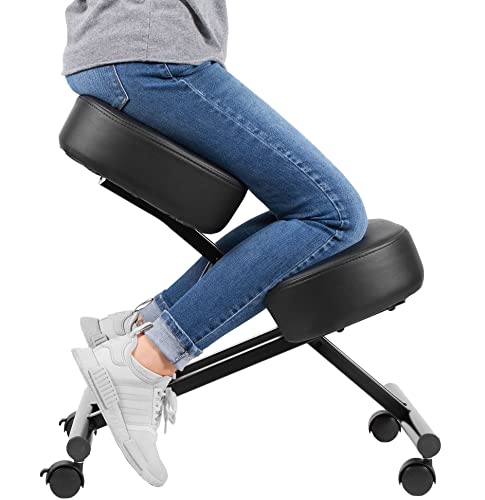
- 4-inch thick memory foam cushion for extended comfort
- Smooth-gliding lockable casters for stability
- Adjustable height range fits most desk setups
- Supports up to 250 lbs with durable steel frame
- Angled seat promotes natural spinal alignment
1. Dragonn Kneeling Chair
- 4-inch thick memory foam cushion for extended comfort
- Smooth-gliding lockable casters for stability
- Adjustable height range fits most desk setups
- Supports up to 250 lbs with durable steel frame
- Angled seat promotes natural spinal alignment
The Dragonn is my top pick for most people, and it’s the one I’d recommend if you’ve never tried a kneeling chair before. It hits the sweet spot between comfort, adjustability, and price. Best for: office workers who want their first kneeling chair without spending a fortune.
The 4-inch thick cushions are the standout feature here. Most kneeling chairs have thin padding that flattens out after a few weeks, leaving your knees and shins aching. The Dragonn’s faux leather cushions stay firm and supportive even after months of daily use. This matters more than you’d think, because knee discomfort is the #1 reason people abandon kneeling chairs.
Height adjustability is solid too. You can raise the base from 21 to 28 inches, which means it works with standard desks and even standing desks at the tallest setting. The steel frame supports up to 250 pounds. Four casters let you roll around, and two of them lock in place when you need to stay put.
The only real downside: the casters can feel stiff and occasionally lock up on their own. It’s a minor annoyance, not a dealbreaker. For the price, the Dragonn gives you more comfort and adjustability than anything else in its range.
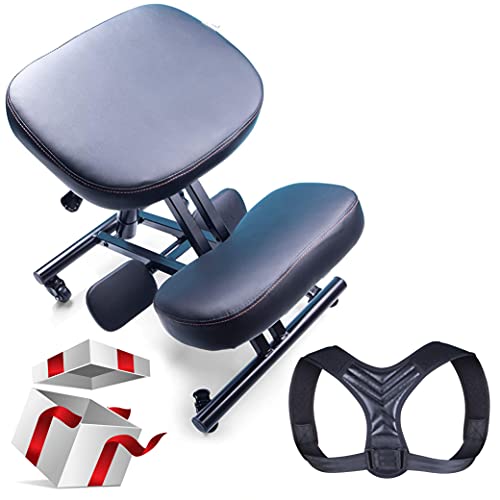
2. MediChair Kneeling Chair
- Cross-legged sitting option for flexibility
- Adjustable tilt angle for customized posture
- Thick padded knee cushions reduce pressure
- Compact design fits small home offices
- Supports multiple sitting positions beyond kneeling
The MediChair is the one I’d pick if you hate fiddling with knobs. Most kneeling chairs use a twist-knob for height adjustment, which gets old fast when you’re switching between sitting positions throughout the day. The MediChair has a lever, just like a regular office chair. One pull, and you’re at the right height. Best for: people transitioning from regular office chairs who want something familiar.
The seat is noticeably wider than most kneeling chairs, which makes it feel less intimidating for first-timers. It’s closer to what you’re used to on a standard office chair. The height range goes from 21.2″ to 25.1″, and the lever adjustment makes fine-tuning quick and painless.
Where the MediChair falls short: the height range is limited compared to the Dragonn (25.1″ max vs. 28″), and the padding isn’t as thick. If you’re tall or plan to pair it with a standing desk, the Dragonn is the better bet. But if quick height adjustment and a comfortable transition from regular chairs matter to you, the MediChair is hard to beat.
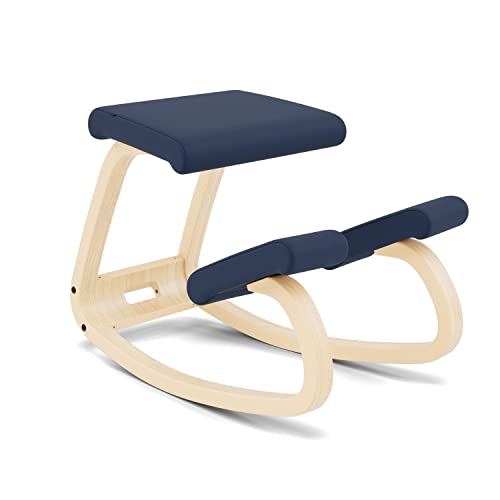
3. Varier Variable Balans
- Norwegian design by Peter Opsvik, built to last 10+ years
- Natural rocking motion keeps core muscles engaged
- Solid ashwood runners with premium fabric upholstery
- No height adjustment needed, rocks to adapt naturally
- Supports up to 300 lbs, professional-grade build
The Varier Variable Balans is the original kneeling chair, designed by Peter Opsvik back in 1979. It’s also the most expensive option on this list at around $349. But if you care about design and want a chair that looks good in your living room or home office, nothing else comes close. Best for: home offices, design-conscious buyers, and families with kids who also need posture correction.
What makes the Varier different from every other kneeling chair is the rocking motion. The curved base lets you shift your weight forward and backward while sitting, creating micro-movements that prevent the stiffness you get from sitting still for hours. It’s made from natural ash wood and polyester fabric from recycled plastics, so it’s an environmentally conscious choice too.
The two separate knee rests (instead of one wide pad) force your hips to open up naturally, engaging your lower back and abs without you thinking about it. This makes it popular with meditation practitioners and even kids. The Varier supports up to 240 pounds and works for a surprisingly wide range of body types.
The big tradeoff: zero adjustability. You can’t raise or lower the seat at all. There’s no height knob, no lever, nothing. It’s a fixed-height design. If you need a chair for a specific desk height or plan to share it between people of very different heights, this can be a problem. You can buy a separate backrest attachment, which helps for leaning back during breaks. But at this price, the lack of height adjustment is a tough pill to swallow.
If your budget allows it and you want a chair with Scandinavian design credentials that actually works, the Varier is worth the investment. It’s a piece of furniture you won’t want to hide.
4. Sleekform Austin Kneeling Chair
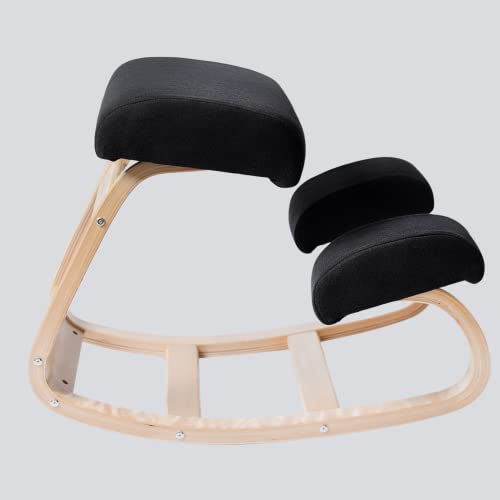
Sleekform Austin Kneeling Chair – Home Office Ergonomic Computer Desk Stool For Active Sitting
- 4 inches of high-density foam with breathable mesh
- Heavy-duty steel frame supports up to 265 lbs
- Extra-wide knee pad distributes weight evenly
- Pneumatic height adjustment with minimal wobble
- Tool-free assembly in under 10 minutes
Think of the Sleekform Austin as the Varier’s more affordable cousin. It borrows the same rocking Balans-style design but swaps natural ash for birchwood and comes in at a fraction of the price. Best for: people who want the Varier’s rocking design without the $349 price tag.
Like the Varier, the Sleekform Austin has two separate knee rests that push your knees apart and open your hips. The curved base gives you that same gentle rocking motion while sitting. And the cushions are where the Sleekform actually beats the Varier. At 4 inches thick with memory foam, they’re denser and more supportive than what you’d expect at this price point. They feel firm at first but hold up far better than thin pads that go flat in a month.
The frame uses three cross bars instead of one, and it supports up to 265 lbs, which is more than the Varier’s 240 lb limit. That’s a real advantage for larger users.
The downsides are real, though. Like the Varier, you can’t adjust the height. It sits fixed at 22 inches, which is a bit tall for standard desks. If you’re using a laptop, you’ll probably need a laptop riser to get the screen to eye level. And while birchwood keeps the cost down, it’s not as durable as the Varier’s ash frame over the long term. If budget is your main concern and you like the rocking design, the Sleekform Austin is the smarter buy.
5. Flash Furniture WL-SB-210-GG Mobile
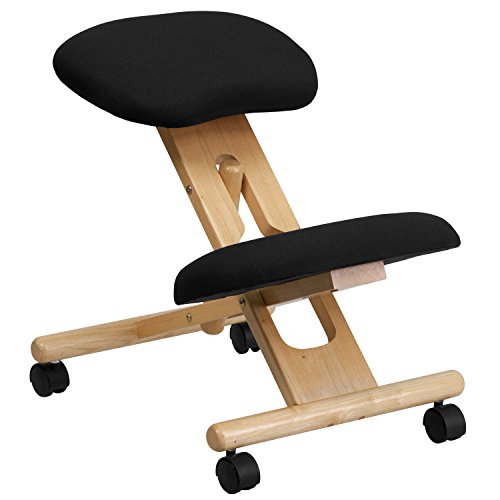
- Natural wood frame blends into home office decor
- Budget-friendly entry point under $80
- 2.5-inch padded seat and knee cushion
- Adjustable height via central ring mechanism
- Dual casters for easy mobility on hard floors
The Flash Furniture is the budget pick on this list, and it’s the one I’d suggest if you just want to try a kneeling chair without committing serious money. It won’t blow you away, but it gets the job done for the price. Best for: beginners testing out kneeling chairs, casual home use, and anyone on a tight budget.
The natural wooden frame looks surprisingly good in a home setting, next to your coffee table or in a casual workspace. Height is adjustable via a ring on the central post, so it works for different desk heights and body types. The padding is 2.5 inches thick, which is thinner than the Dragonn or Sleekform, but it’s comfortable enough for sessions of 2-3 hours. Dual casters give you decent mobility. Weight capacity tops out at 200 lbs.
I won’t sugarcoat the drawbacks. Some buyers report that assembly is a headache, and there have been cases of the wooden frame cracking after a few months. The cushion fabric and stitching aren’t built for years of heavy daily use either. You’re trading durability for affordability here.
If you want to test whether a kneeling chair works for your body before spending $200+, the Flash Furniture is a smart starting point. Just don’t expect it to last as long as the Dragonn or Varier.
Also see: The best orthopedic chairs Black Friday deals
What are the features of an ideal kneeling chair?
Before you pick a kneeling chair, you need to know what separates a good one from a waste of money. I’ve sat in plenty of both. Here’s what actually matters:
- Sturdy build. A wobbly frame defeats the purpose. Look for steel or solid hardwood frames that don’t creak when you shift weight.
- Adjustable height and angle. Your desk height dictates the chair height you need. Non-adjustable chairs only work if the dimensions happen to match your setup.
- High quality fabric and thick cushion. Anything under 3 inches of padding will flatten within weeks. Faux leather or memory foam holds up the longest.
- Presence of wheels. You’ll want to scoot back from your desk without standing up. Lockable casters are the ideal setup.
- Sitting mobility. Some rocking or swivel ability prevents your muscles from locking up during long sessions.
Keep in mind that kneeling chairs do have tradeoffs. They can reduce blood flow to your legs during long sessions, and your shins will need time to adjust. That’s why I keep a regular office chair at my desk too and rotate between them every couple of hours. The combination works better than either chair alone.
Frequently Asked Questions
What should I look for when buying a kneeling chair?
Focus on three things: cushion thickness (3+ inches minimum), height adjustability (so it matches your desk), and weight capacity. Check whether the chair has lockable casters, because a chair that rolls away when you sit down is useless. I’d also read recent buyer reviews specifically about durability, since that’s where cheaper chairs tend to fall apart.
Are expensive kneeling chairs worth the premium price?
If you’re using it 4+ hours a day for work, yes. A chair like the Varier Variable Balans at $349 will last years and hold its value. Budget options in the $60-80 range work fine for testing whether kneeling chairs suit you, but they won’t survive heavy daily use. Think of it like office shoes: cheap ones wear out fast, and your body pays the difference.
How often should I replace or upgrade my kneeling chair?
A well-made kneeling chair lasts 3-5 years with daily use. The first sign it needs replacing is when the cushions flatten out and you start feeling pressure on your knees or shins again. If the frame develops any wobble or creaking, that’s a safety concern, and it’s time for a new one. Budget models might only last 1-2 years.
Can I find a good kneeling chair on a tight budget?
You can. The Flash Furniture and Dragonn are both solid options under $100. Keep an eye on Amazon during Prime Day and Black Friday, because kneeling chairs regularly drop 20-30% during sales events. I’d avoid anything under $50 though. At that price point, the padding and frame quality aren’t worth your money.
Where is the best place to buy a kneeling chair?
Amazon is the easiest option, and their return policy is generous if the chair doesn’t work out for you. For the Varier specifically, check the manufacturer’s website too, because they sometimes offer bundle deals with accessories like the backrest attachment. Wherever you buy, make sure you can return it within 30 days. You won’t know if a kneeling chair works for you until you’ve used it for at least a week.
What warranty should I expect with a kneeling chair?
Most kneeling chairs come with a 1-year warranty at minimum. The Varier offers longer coverage, which is one reason I’m comfortable recommending it at the higher price. Always register your product after purchase and save your receipt. If the frame cracks or the cushion padding fails within warranty, you should be covered. Extended warranty plans from Amazon are usually not worth the extra cost for chairs in this price range.