
Circumcenter of a Triangle: Definition, Types and Examples
Every triangle has a special point where you can place a compass and draw a perfect circle through all three vertices. That point is called the circumcenter, and finding it is easier than you might think once you understand the geometry behind it.
What Is the Circumcenter?
The circumcenter is the center of a triangle’s circumscribed circle (called the circumcircle). This circle passes through all three vertices of the triangle, and the distance from the circumcenter to each vertex is exactly the same—that distance is called the circumradius.
Here’s the key insight: the circumcenter is where all three perpendicular bisectors of a triangle’s sides intersect. Since any point on a perpendicular bisector is equidistant from the segment’s endpoints, the intersection point is equidistant from all three vertices. That’s why the circumcircle works.
Important: Not every polygon has a circumcircle. The polygon must be cyclic—meaning all its vertices can lie on a single circle. Every triangle is cyclic, but not every quadrilateral or pentagon is.
Where Does the Circumcenter Lie?
The circumcenter’s position depends entirely on the triangle’s angles. This is one of those beautiful geometric facts that’s easy to remember once you see the pattern.
| Triangle Type | Circumcenter Location | Why? |
|---|---|---|
| Acute (all angles \( < 90° \)) | Inside the triangle | All perpendicular bisectors meet in the interior |
| Right (one angle \( = 90° \)) | On the hypotenuse (midpoint) | The right angle vertex lies on a semicircle |
| Obtuse (one angle \( > 90° \)) | Outside the triangle | Perpendicular bisectors meet beyond the obtuse angle |
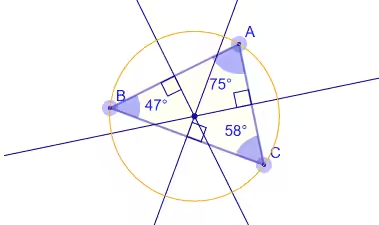
Acute Triangle: Circumcenter Inside
When all three angles are less than \( 90° \), the perpendicular bisectors intersect inside the triangle.
Right Triangle: Circumcenter on the Hypotenuse
This one’s elegant. For a right triangle, the circumcenter sits exactly at the midpoint of the hypotenuse. The circumradius is half the hypotenuse length.
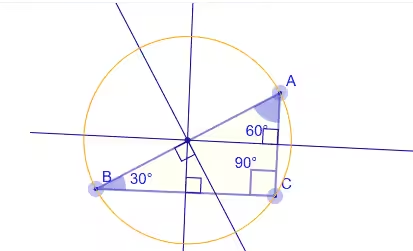
Why this works: Thales’ theorem states that any angle inscribed in a semicircle is a right angle. So if the hypotenuse is the diameter, the right-angle vertex must lie on the circle.
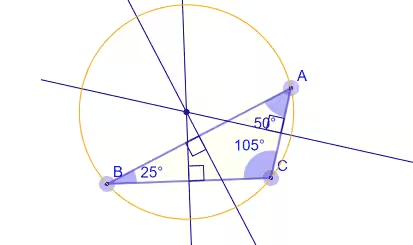
Obtuse Triangle: Circumcenter Outside
When one angle exceeds \( 90° \), the circumcenter moves outside the triangle, on the opposite side from the obtuse angle.
How to Construct the Circumcenter (Compass and Straightedge)
Here’s the geometric construction method:
- Draw the triangle with vertices \( A \), \( B \), and \( C \).
- Construct the perpendicular bisector of side \( AB \): Find the midpoint, then draw a line perpendicular to \( AB \) through that point.
- Construct the perpendicular bisector of side \( BC \): Same process.
- Mark the intersection: Where these two bisectors meet is the circumcenter.
- Draw the circumcircle: Place compass at the circumcenter, extend to any vertex, and draw.
You only need two perpendicular bisectors—the third will automatically pass through the same point.
Finding the Circumcenter Using Coordinates
When you have coordinate points, you can calculate the exact circumcenter algebraically. The method uses perpendicular bisectors, but with equations instead of constructions.
Formulas You’ll Need
| Formula | Expression | What It Does |
|---|---|---|
| Midpoint | \( \left( \dfrac{x_1 + x_2}{2}, \dfrac{y_1 + y_2}{2} \right) \) | Finds center of a segment |
| Slope | \( m = \dfrac{y_2 – y_1}{x_2 – x_1} \) | Measures steepness of a line |
| Perpendicular slope | \( m_{\perp} = -\dfrac{1}{m} \) | Slope of line at right angles |
| Point-slope form | \( y – y_1 = m(x – x_1) \) | Equation of line through point |
Worked Example
Problem: Find the circumcenter of the triangle with vertices \( A = (2, 4) \), \( B = (6, 2) \), and \( C = (3, -2) \).
Step 1: Find the midpoints of two sides.
Midpoint of \( AB \):
\( M_{AB} = \left( \dfrac{2+6}{2}, \dfrac{4+2}{2} \right) = (4, 3) \)
Midpoint of \( BC \):
\( M_{BC} = \left( \dfrac{6+3}{2}, \dfrac{2+(-2)}{2} \right) = (4.5, 0) \)
Step 2: Find the slopes of these sides.
Slope of \( AB \):
\( m_{AB} = \dfrac{2 – 4}{6 – 2} = \dfrac{-2}{4} = -0.5 \)
Slope of \( BC \):
\( m_{BC} = \dfrac{-2 – 2}{3 – 6} = \dfrac{-4}{-3} = \dfrac{4}{3} \)
Step 3: Find the perpendicular slopes.
Perpendicular to \( AB \): \( m_{\perp} = -\dfrac{1}{-0.5} = 2 \)
Perpendicular to \( BC \): \( m_{\perp} = -\dfrac{1}{4/3} = -\dfrac{3}{4} = -0.75 \)
Step 4: Write equations of the perpendicular bisectors.
Perpendicular bisector of \( AB \) passes through \( (4, 3) \) with slope \( 2 \):
\( y – 3 = 2(x – 4) \implies y = 2x – 5 \)
Perpendicular bisector of \( BC \) passes through \( (4.5, 0) \) with slope \( -0.75 \):
\( y – 0 = -0.75(x – 4.5) \implies y = -0.75x + 3.375 \)
Step 5: Solve the system to find the intersection.
Set the equations equal:
\( 2x – 5 = -0.75x + 3.375 \)
\( 2.75x = 8.375 \)
\( x \approx 3.05 \)
Substitute back: \( y = 2(3.05) – 5 = 1.09 \)
Circumcenter: \( (3.05, 1.09) \)
Direct Formula for Circumcenter
For vertices \( A = (x_1, y_1) \), \( B = (x_2, y_2) \), \( C = (x_3, y_3) \), there’s a direct formula:
$$ O_x = \frac{(x_1^2 + y_1^2)(y_2 – y_3) + (x_2^2 + y_2^2)(y_3 – y_1) + (x_3^2 + y_3^2)(y_1 – y_2)}{2[x_1(y_2 – y_3) + x_2(y_3 – y_1) + x_3(y_1 – y_2)]} $$
$$ O_y = \frac{(x_1^2 + y_1^2)(x_3 – x_2) + (x_2^2 + y_2^2)(x_1 – x_3) + (x_3^2 + y_3^2)(x_2 – x_1)}{2[x_1(y_2 – y_3) + x_2(y_3 – y_1) + x_3(y_1 – y_2)]} $$
This looks intimidating, but it’s just the algebraic result of solving the perpendicular bisector equations. The step-by-step method is usually clearer for learning.
Finding the Circumradius
Once you have the circumcenter \( O \), the circumradius \( R \) is simply the distance to any vertex:
\( R = \sqrt{(O_x – x_1)^2 + (O_y – y_1)^2} \)
There’s also a formula using only the side lengths \( a, b, c \) and the area \( K \):
$$ R = \frac{abc}{4K} $$
Real-Life Applications
The circumcenter solves a practical problem: finding the point equidistant from three locations.
Example: A school needs to set up bus pickup points for students in three villages. Where should they place a central pickup point so that students from all three villages travel the same distance?
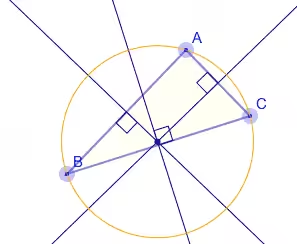
The answer is the circumcenter of the triangle formed by the three villages. Every student travels the circumradius distance to reach the pickup point.
Other applications:
- Cell tower placement: Positioning a tower equidistant from three areas
- Emergency services: Locating a facility to serve three zones equally
- Computer graphics: Delaunay triangulation uses circumcircles extensively
- Navigation: Triangulating position from three known points
Circumcenter vs. Other Triangle Centers
Triangles have several “centers.” Here’s how they differ:
| Center | Definition | Always Inside? |
|---|---|---|
| Circumcenter | Intersection of perpendicular bisectors | No (outside for obtuse) |
| Incenter | Intersection of angle bisectors | Yes, always |
| Centroid | Intersection of medians | Yes, always |
| Orthocenter | Intersection of altitudes | No (outside for obtuse) |
Fun fact: The circumcenter, centroid, and orthocenter are always collinear—they lie on a line called the Euler line. The centroid divides the segment from circumcenter to orthocenter in ratio \( 1:2 \).
Frequently Asked Questions
Can a circumcenter be outside the triangle?
Yes. For obtuse triangles (where one angle exceeds 90°), the circumcenter lies outside the triangle, on the opposite side from the obtuse angle. For acute triangles it’s inside, and for right triangles it’s exactly at the midpoint of the hypotenuse.
Why do perpendicular bisectors meet at one point?
Any point on a perpendicular bisector is equidistant from the segment’s two endpoints. So the intersection of bisectors of AB and BC is equidistant from A, B, and C. Since it’s equidistant from A and C, it must also lie on AC’s perpendicular bisector. All three bisectors meet at this unique point.
Do all polygons have circumcenters?
No. Only cyclic polygons—those whose vertices all lie on a single circle—have circumcenters. Every triangle is cyclic, but quadrilaterals and higher polygons may or may not be. A quadrilateral is cyclic if and only if its opposite angles sum to 180°.
What’s the relationship between circumcenter and circumradius?
The circumradius is the distance from the circumcenter to any vertex of the triangle. All three distances are equal by definition—that’s why the circumcircle passes through all vertices. You can calculate it as R = abc/(4K), where a, b, c are side lengths and K is the area.
How is the circumcenter different from the incenter?
The circumcenter is equidistant from the vertices (found via perpendicular bisectors), while the incenter is equidistant from the sides (found via angle bisectors). The incenter is always inside the triangle; the circumcenter may be outside. The incircle touches all three sides; the circumcircle passes through all three vertices.
Key Takeaways
- The circumcenter is where all three perpendicular bisectors of a triangle meet
- It’s equidistant from all three vertices—that distance is the circumradius
- Location depends on triangle type: inside (acute), on hypotenuse (right), outside (obtuse)
- Find it algebraically by solving two perpendicular bisector equations
- Practical use: finding points equidistant from three locations
For more on triangle geometry, see my article on Triangle Inequality.