
 by
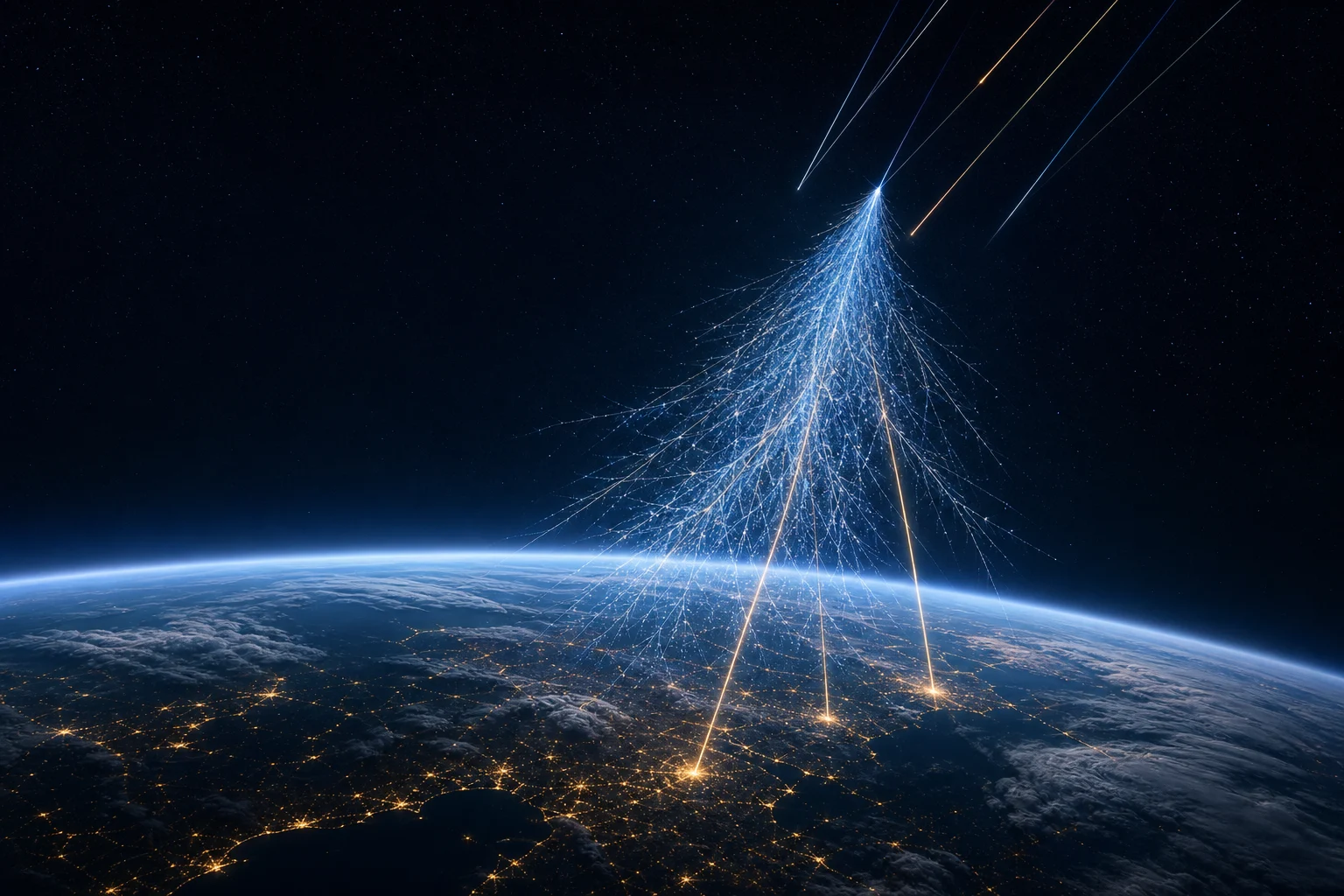
byCosmic radiation is the flow of high-energy particles arriving from space. Most primary cosmic rays are atomic nuclei, not electromagnetic rays: about 89% are protons, 10% are helium nuclei, and 1% are heavier nuclei. They strike Earth’s atmosphere at nearly the speed of light and produce cascades of secondary particles.
That distinction clears up most of the confusion around the subject. The particle that leaves an astrophysical accelerator is a primary cosmic ray. The muons, electrons, photons, and neutrons measured lower in the atmosphere are usually products of its collision with air. The atmosphere is not merely a shield. It is part of the detector.
What Is Cosmic Radiation?
Cosmic radiation is ionizing particle radiation from beyond Earth’s atmosphere. The older word “rays” survived from the period when physicists did not yet know what was causing the ionization. Today, the term normally refers to cosmic-ray particles and the secondary radiation they generate in matter.
| Component | Approximate share of primary nuclei | What it is |
|---|---|---|
| Protons | 89% | Hydrogen nuclei with one positive charge |
| Helium nuclei | 10% | Alpha particles containing two protons and two neutrons |
| Heavier nuclei | 1% | Nuclei from lithium through elements as heavy as uranium |
Electrons, positrons, and antiprotons are also measured in the primary flux, but the familiar 89:10:1 composition describes nuclei. Neutrinos and high-energy gamma rays are important cosmic messengers, yet they should not be folded into those nuclear percentages.
- Primary cosmic rays arrive at the top of the atmosphere from space.
- Secondary cosmic rays are produced when a primary collides with an atmospheric nucleus or detector material.
- Solar energetic particles are accelerated during energetic events associated with the Sun.
- Galactic cosmic rays arrive from sources within the Milky Way and are modulated by the heliosphere.
- Ultra-high-energy cosmic rays exceed \(10^{18}\) eV and are generally associated with extragalactic source populations, although their exact accelerators remain unsettled.
Where Do Cosmic Rays Come From?
Cosmic rays come from the Sun, the Milky Way, and sources beyond our galaxy. The lower-energy population includes a solar contribution. Many higher-energy galactic particles are consistent with acceleration in shocks associated with supernova remnants and other energetic objects. The rarest particles at the top of the spectrum are probably extragalactic, but no single source class explains every observation.
The hard part is direction. Charged particles curve in the magnetic fields between their source and Earth. Lower-energy particles can be deflected so thoroughly that their arrival direction is not a reliable line back to the accelerator. Neutral messengers such as gamma rays and neutrinos help identify candidate environments, but they are related evidence, not identical to the charged cosmic-ray sample.
The Knee, Ankle, and Highest-Energy Events
The cosmic-ray energy spectrum spans an extraordinary range. \(1\,\text{PeV}=10^{15}\,\text{eV}\) and \(1\,\text{EeV}=10^{18}\,\text{eV}\). Physicists describe changes in the spectrum rather than drawing hard source boundaries from those names alone.
- The knee, near a few \(10^{15}\) eV, is where the spectrum becomes steeper.
- The ankle, around a few \(10^{18}\) eV, is where the spectrum flattens again and the extragalactic population becomes increasingly important.
- The high-energy suppression, above roughly \(5\times10^{19}\) eV, is an observed fall in flux shaped by source limits, propagation losses, and particle composition.
A striking example is the Amaterasu particle detected by the Telescope Array on 27 May 2021. Its reconstructed energy was \(2.4\times10^{20}\) eV. That is macroscopic energy carried by one subatomic particle, yet its arrival direction did not reveal an obvious accelerator. The mystery is real, but it is not evidence that the measured high-energy suppression disappeared.
How Does a Cosmic Ray Shower Form?
A cosmic ray shower begins when a high-energy primary collides with a nitrogen or oxygen nucleus in the upper atmosphere. That first collision creates unstable particles and energetic fragments. They decay or collide again, multiplying the cascade until the energy per particle becomes too low to sustain further high-energy production.
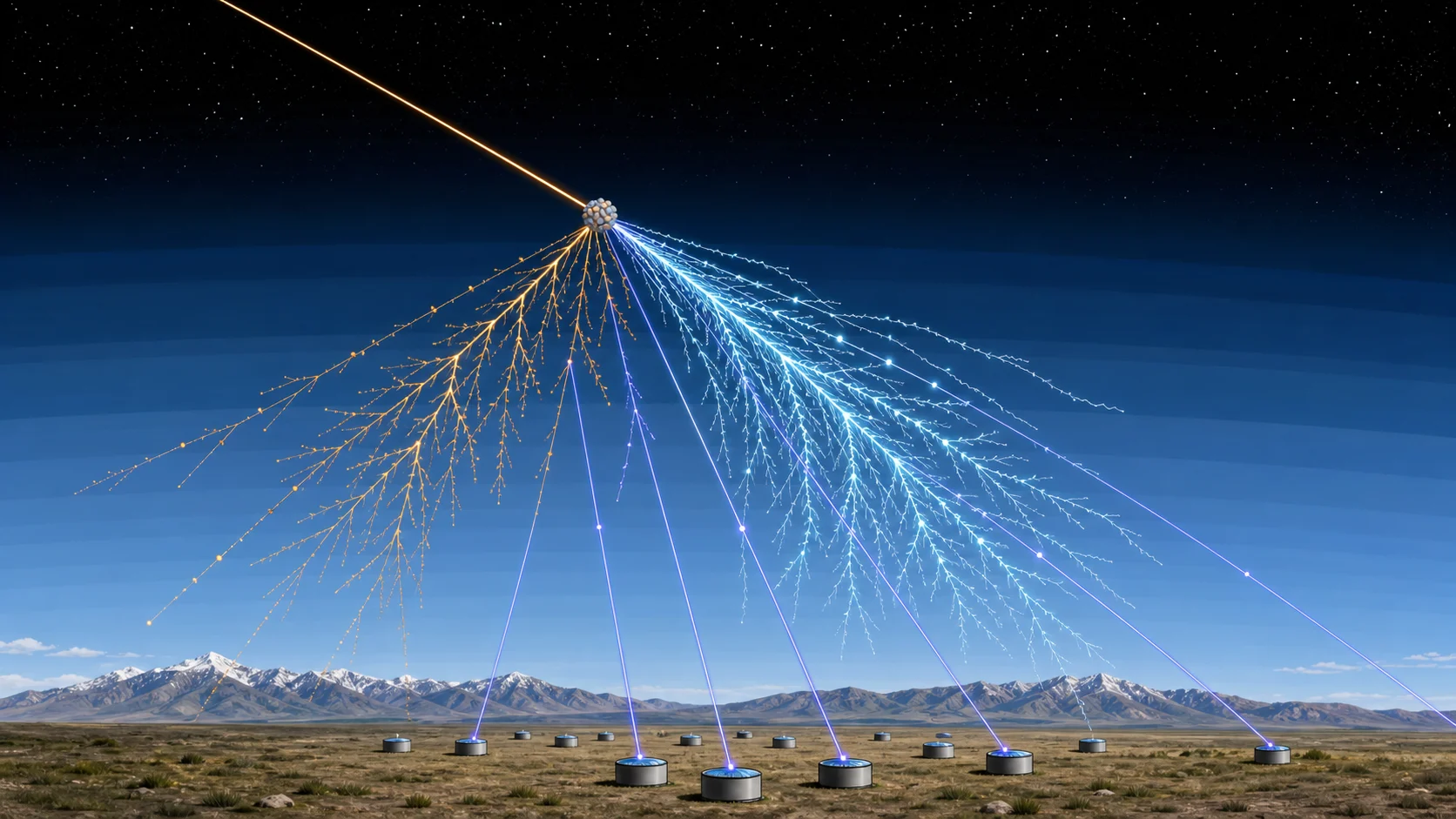
- First interaction: the primary nucleus collides with an atmospheric nucleus and produces hadrons, especially pions and kaons.
- Hadronic branch: energetic protons, neutrons, and mesons continue interacting and feeding the shower.
- Electromagnetic branch: neutral pions rapidly decay into gamma rays, which produce electron-positron pairs and more photons.
- Muon branch: charged pions and kaons can decay into muons and neutrinos. Many of the muons penetrate to the ground.
- Shower maximum and decline: the particle count rises, reaches a maximum, then falls as ionization and decay drain the remaining energy.
At the highest energies, one primary can produce billions of secondary particles over many square kilometres. That is why a sparse detector array can reconstruct a particle that never directly touched a detector: the array samples the footprint and timing of the shower it created.
What Cosmic-Ray Particles Reach the Ground?
Muons are the most familiar charged cosmic-ray secondaries at sea level. Electrons, positrons, photons, and neutrons also survive in smaller or more energy-dependent proportions. Atmospheric neutrinos pass through Earth with a very low interaction probability and require enormous detectors to measure.
Muon survival is a clean demonstration of relativity. A muon at rest has a mean lifetime near \(2.2\,\mu\text{s}\), corresponding to only about 660 m at the speed of light. Atmospheric muons are moving relativistically, so their lifetime in the laboratory frame is increased by the Lorentz factor: \(L\approx\gamma c\tau\). That time dilation lets many muons cross several kilometres of atmosphere and reach the surface.
The sea-level particles are not a miniature copy of the primary flux. They are the filtered remains of an evolving cascade. Altitude, geomagnetic latitude, atmospheric pressure, solar activity, detector threshold, and particle direction all affect what an instrument records.
How Cosmic Rays Changed Particle Physics
Before high-energy accelerators, the sky supplied the beam. Victor Hess established the extraterrestrial origin of the ionization in 1912 by carrying instruments to 5,300 m in balloon flights. The ionization rose strongly with altitude, and eclipse measurements argued against the Sun being the only source. Hess shared the 1936 Nobel Prize in Physics for the discovery.
- East-West effect: a directional asymmetry caused by Earth’s magnetic field showed that the dominant primaries carried positive charge.
- Positron: Carl Anderson identified the electron’s antiparticle in cosmic-ray cloud-chamber tracks in 1932.
- Muon: cosmic-ray tracks revealed a heavier electron-like particle in the 1930s.
- Pion and kaon: later cosmic-ray studies expanded the particle zoo before accelerators became the controlled source of choice.
This history also connects cosmic rays to broader ideas in the four fundamental forces. Electromagnetism bends charged primaries, the strong interaction drives the first atmospheric collisions, and the weak interaction appears in particle decays.
How Are Cosmic Rays Detected?
No single instrument covers the full cosmic-ray spectrum. Direct measurements work best where the flux is high enough to catch particles above the atmosphere. Indirect measurements become essential at extreme energies because those events are too rare for a small detector.
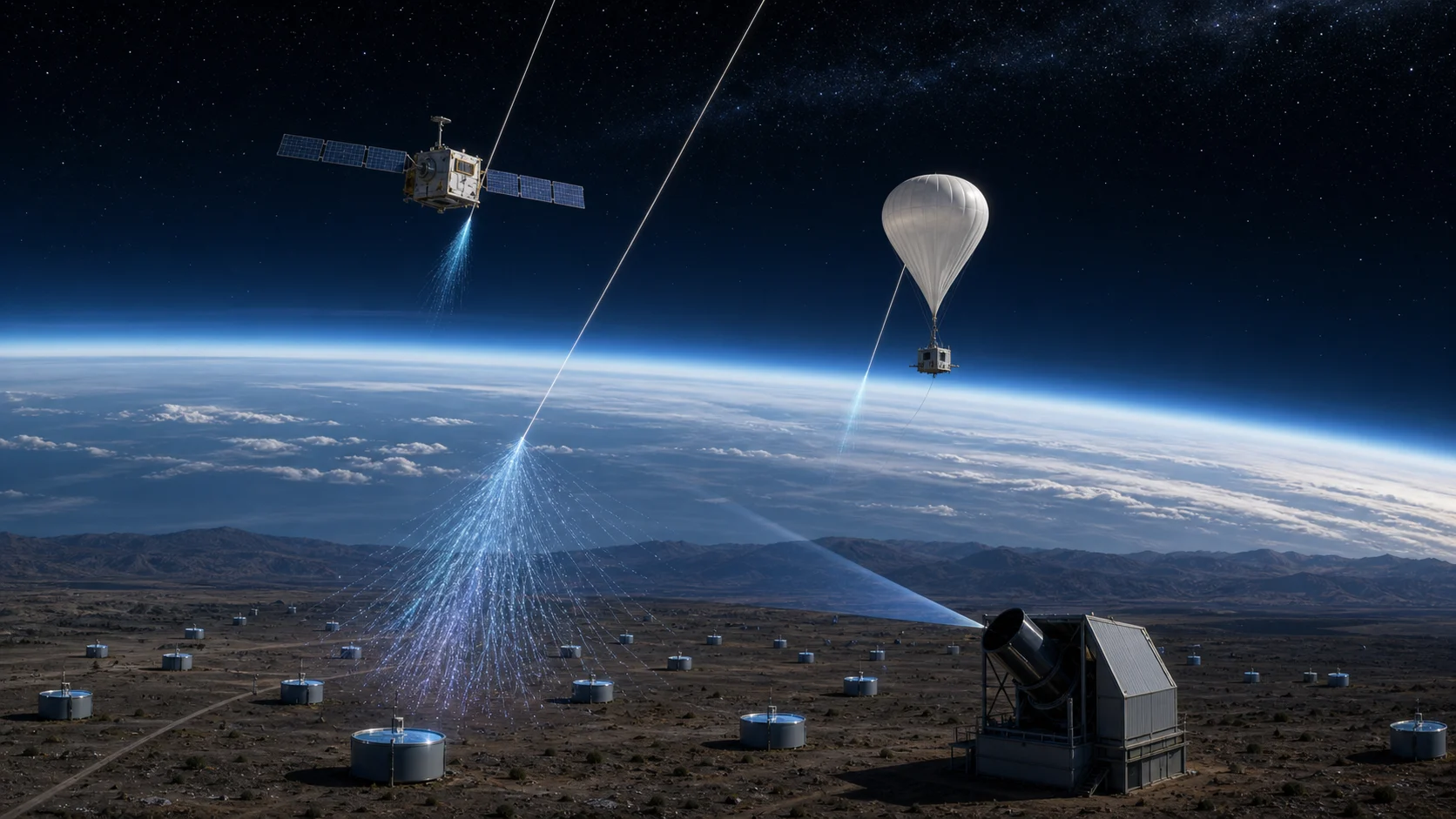
- Satellites and space-station instruments measure primary charge, energy, and antimatter before the atmosphere transforms the sample.
- Balloon experiments lift detectors above most of the atmosphere for long-duration direct measurements.
- Surface arrays record the timing and particle density of an air-shower footprint at the ground.
- Cherenkov detectors measure light produced when charged particles move faster than light travels through a medium such as water.
- Fluorescence telescopes observe faint ultraviolet light emitted by atmospheric nitrogen as a shower develops on clear, dark nights.
The Pierre Auger Observatory in Argentina shows why hybrid detection matters. Its 1,660 water-Cherenkov stations cover about 3,000 km², while 27 optical telescopes watch the atmosphere. The surface array runs continuously; the fluorescence system provides a complementary view of the shower’s longitudinal development.
What Are the Effects of Cosmic Radiation?
Cosmic radiation is part of the natural background radiation at ground level, but exposure and engineering risk rise with altitude and time outside Earth’s protection. The word “dangerous” is therefore incomplete without a location, dose, particle type, and exposure duration.
| Environment | Main effect | Useful scale or constraint |
|---|---|---|
| Ground level | Small contribution to natural ionizing-radiation exposure | Average US cosmic-radiation dose is about 0.33 mSv per year |
| Commercial aviation | Higher dose because there is less atmosphere above the aircraft | A cross-US flight is estimated near 0.035 mSv; duration, altitude, and latitude matter |
| Electronics | Energetic particles can cause single-event upsets or, more rarely, destructive effects | Fault tolerance, error correction, testing, and redundancy reduce system risk |
| Deep space and Mars | Galactic cosmic rays and solar particles raise biological and hardware risk | A NASA reference Mars mission was estimated near 1 Sv under its stated assumptions |
Ground and Aviation Exposure
Earth’s magnetic field and atmosphere remove or transform most incoming particles before they reach the surface. At aircraft altitude, the protective column of air is thinner. Polar routes can also receive more exposure because geomagnetic shielding is weaker at high latitudes. Flight time, altitude, latitude, and solar conditions all change the dose.
Electronics and Spaceflight
A single energetic particle can deposit enough charge in a sensitive circuit to change a stored bit or disrupt logic. Spacecraft engineers call these single-event effects. Error-correcting memory helps with some soft errors, but radiation-tolerant design also uses shielding, redundancy, watchdogs, component testing, and recovery procedures. The same physics is one reason putting computing hardware in space is more difficult than moving a terrestrial server rack into orbit.
For astronauts, galactic cosmic rays are difficult to stop because the most energetic nuclei penetrate ordinary spacecraft materials and can create secondary radiation inside the shielding. Mars adds limited atmospheric protection and no global magnetic field. NASA’s Curiosity rover measured a galactic-cosmic-ray absorbed dose near 210 micrograys per day on the surface during its first 10 months, while solar particle events remain a separate and variable hazard.
Why Are the Highest-Energy Cosmic Rays Still Unsolved?
The origin problem is hard for three independent reasons. Magnetic deflection weakens directional clues, the highest-energy events are exceptionally rare, and the primary mass must be inferred from a shower after many uncertain particle interactions. More collecting area helps, but it does not remove the modelling problem.
- Direction: the observed arrival direction may differ from the source direction because the particle is charged.
- Statistics: at the highest energies, observatories may wait a long time for a useful sample even across thousands of square kilometres.
- Composition: a proton and an iron nucleus produce different showers, and the inferred mass affects source and propagation conclusions.
- Propagation: interactions with background radiation reshape the spectrum over cosmic distances.
This is why I would not treat a single spectacular event as a solved-source announcement. The field advances by combining energy, composition, arrival direction, gamma-ray observations, neutrino observations, and better hadronic-interaction models. If you want the wider mathematical habits behind this kind of reasoning, the articles on symmetry in physics and the best physics textbooks for college are useful next steps.
Primary Sources and Further Reading
These are the official sources I would use to check the numbers or go deeper:
- CERN’s cosmic-ray overview, for composition, energy scale, showers, and particle discoveries.
- The Nobel Prize profile of Victor Hess, for the discovery history.
- The Pierre Auger hybrid-detector guide, for the surface-array and fluorescence methods.
- CDC guidance on air-travel radiation, for ground and flight dose comparisons.
- NASA’s space-radiation hazard guide, for human spaceflight risk.
Key Takeaways
- Cosmic radiation is mainly particle radiation, not a beam of electromagnetic light.
- Primary nuclei are approximately 89% protons, 10% helium, and 1% heavier elements.
- Atmospheric collisions create extensive cosmic ray showers with hadronic, electromagnetic, and muon components.
- Muons reach the ground in large numbers because relativistic time dilation extends their lifetime in Earth’s frame.
- Cosmic radiation contributes a small natural dose at ground level, a larger dose at flight altitude, and a serious design constraint in deep space.
- The sources of the rarest ultra-high-energy particles remain open because of magnetic deflection, low event rates, and composition uncertainty.
Frequently Asked Questions
What is cosmic radiation?
Cosmic radiation is ionizing particle radiation arriving from beyond Earth’s atmosphere. Most primary cosmic rays are atomic nuclei, especially protons and helium nuclei. Their collisions with the atmosphere create secondary particles such as muons, electrons, photons, and neutrons.
Are cosmic rays electromagnetic radiation?
Most cosmic rays are not electromagnetic radiation. They are charged particles and atomic nuclei. High-energy gamma rays are electromagnetic cosmic messengers, but they are a distinct component and are not included in the standard 89:10:1 primary-nuclei composition.
Where do cosmic rays come from?
Cosmic rays come from the Sun, energetic objects and shocks within the Milky Way, and extragalactic source populations. Charged particles are deflected by magnetic fields, so the source of an individual cosmic ray is often difficult to identify from its arrival direction.
What is a cosmic ray shower?
A cosmic ray shower is a cascade of secondary particles created when a high-energy primary cosmic ray strikes an atomic nucleus in the atmosphere. The shower develops through hadronic, electromagnetic, and muon branches before losing energy through decay and ionization.
Is cosmic radiation dangerous on Earth?
At ground level, cosmic radiation is a small part of natural background exposure. Dose rises with altitude and depends on latitude, duration, and solar conditions. It becomes a much larger concern for frequent high-altitude flight and for astronauts outside Earth’s atmospheric and magnetic protection.
Can cosmic rays pass through the human body?
Yes. Secondary particles, especially muons, pass through people and buildings at ground level. Individual interactions are normally unnoticed. Radiation risk depends on absorbed dose, particle type, exposure time, and the biological tissue affected.
My practical rule is to ask four questions whenever you see a claim about cosmic radiation: Which particle? At what energy? In which environment? Measured by what instrument? If a source cannot answer those, its conclusion is probably too broad.
Tell Google you want more of this.
Add Gaurav Tiwari as a preferred sourceOne tap, and this site shows up more often in your own Top Stories, AI Overviews and AI Mode. Remove it any time.