
Gaurav Tiwari · From the Workbench
The Best Free Performance Plugin for WordPress Is Here
Page caching, Cloudflare Free integration, on-server unused CSS removal, Redis and commerce safeguards. Every module on every website, no license fees.
A cache once served a stale receipt page on one of my stores, and I found out from the customer, not from a log. Nothing crashed. No error, no warning, just a checkout flow quietly showing yesterday’s state to today’s buyer.
That email is why GT Performance exists. I built it so I would never have to debug a cache blind again, and it has run my own stores every day since.
This week it ships to everyone. GT Performance 1.0.0 is free, for every website you run, personal or client, with every module included. Not freemium. I’ve sent it to the WordPress.org plugin directory, and until that listing goes live you can download it from my site or read every line of it on GitHub.
WordPress performance has settled into two camps. One pays for a polished paid plugin: FlyingPress Business runs $229 a year, WP Rocket’s multi-site plan $299, renewal after renewal.¹ The other stacks 4 or 5 free single-purpose plugins and spends weekends refereeing their fights over the same cache.
Neither camp is being silly. The paid camp is buying safety around carts and checkouts, and the free camp is right that a page cache is not worth a subscription. Both positions hold up; it is the trade between them that hurts.
So I built the third option and priced it at nothing.
What GT Performance Does
The short version: it makes WordPress fast the boring way and refuses to be clever near money.
-
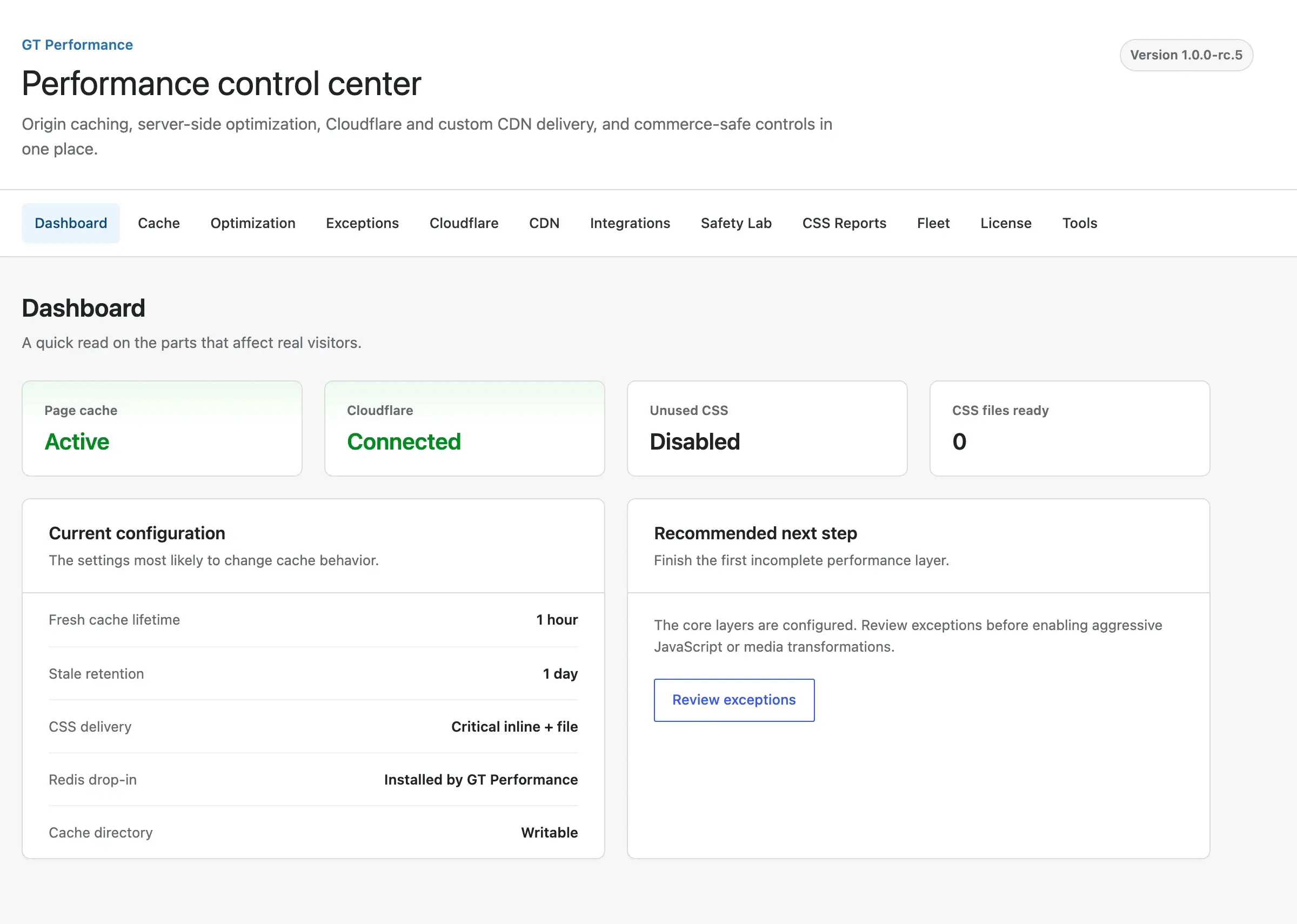
Page caching through a drop-in that serves finished HTML and steps aside the moment a request carries cart, login or checkout state
-
A Cloudflare integration designed for the free plan: 1 managed cache rule, exact-URL purges, no APO subscription required
-
Unused CSS removal that runs entirely on your server, so your stylesheets never travel to a third-party service
-
Redis object caching, WebP and AVIF image variants, lightweight YouTube embeds, local Google Fonts and scheduled database cleanup
-
Commerce safeguards for FluentCart, Easy Digital Downloads and WooCommerce, compiled into both the origin cache and the Cloudflare rule
-
Diagnostics that show receipts: Explain This Page tells you exactly why a URL was cached or skipped, and Verified Purge confirms a purge actually removed what you think it removed
That last bullet is the one I care about most. A caching plugin’s most important feature is not speed. It is being able to see what it refused to cache, and why.
76 modules across 12 groups, and there is no pro column in the table.² What lands on WordPress.org is the whole plugin.
It behaves carefully around the rest of your stack too. It won’t overwrite another plugin’s caching drop-in, because silently taking ownership is how two cache plugins ruin a site together. It detects Perfmatters, analytics plugins, Akismet and Jetpack and protects their dynamic pieces instead of fighting them. And the riskier frontend work ships switched off, because a default should never be the setting you regret.
Why Free
GT Performance was built for my own stores first. It runs on gauravtiwari.org and gatilab.com whether anyone else installs it or not, so charging for it was never the point. The choice was simpler: does this sit behind a checkout of its own, or on every site that needs it?
So there are no license keys, no activation server, no account and no upsell waiting inside the settings. Updates arrive the way core updates do, through the WordPress.org directory. The plugin never asks who you are.
And it is GPL in the full sense, not just the legal one. The source, the changelog and the test suite are public on GitHub. You can read the plugin before you run it, which is exactly the level of trust a plugin near your checkout should have to earn.
Few Notes
The public release history is 5 weeks old: 9 betas, 6 release candidates and now 1.0.0, which is 16 releases since 22 July³, however the plugin is around 6 months old in making.
-
Multisite is unverified. Treat this as a single-site plugin for now.
-
The aggressive optimizations, unused CSS removal and JavaScript delay, are opt-in for a reason.
-
The WordPress.org review is still in progress, so for a short while the download lives on my site instead of the directory.
Where This Leaves Things
Free WordPress plugins usually work as the demo, and the paid tier is the product. This one is just the product. There is no paid tier waiting behind it.
Whether it’s the best free performance plugin for WordPress is not my call to make. It’s yours, and the entry fee for checking is nothing.
Install it, point Explain This Page at your most fragile URL, and when the plugin refuses to cache something on your store, reply and tell me. The refusals are the part I read first.
Footnotes:
-
Prices from the FlyingPress and WP Rocket pricing pages, checked July 2026. Both are good plugins. Their prices were never the complaint; the renewal model was.
-
Including a Fleet Console that moves reviewed settings between your sites as signed bundles that expire in 5 minutes and work exactly once. Paranoia, as a feature.
-
There were 12 internal alphas before the public betas. The changelog from those 5 weeks is longer than this post.