
Sell in Multiple Currencies
A buyer in Germany sees your theme at $49, does the math in their head, and wonders what their bank will add on top. Some of them leave. Showing euros helps, but a straight conversion leaves odd cents, and you may want a fixed, round price for Europe whatever the rate does.
Multi-Currency Checkout lets shoppers browse and pay in the currencies you enable. Every cart and every order settles in exactly one currency. Prices convert from your store price with manual or automatic exchange rates, markup and rounding, and you can set exact prices per download or per price option that always win.
Turn It On
Switch on Multi-Currency Checkout from Stackless → Dashboard, then open Stackless → Settings and choose Multi-Currency Checkout under Currency.
The module pauses itself if the EDD Multi Currency extension is active. The dashboard then shows “Paused because EDD Multi Currency is active and does the same job.”
Choose Your Currencies
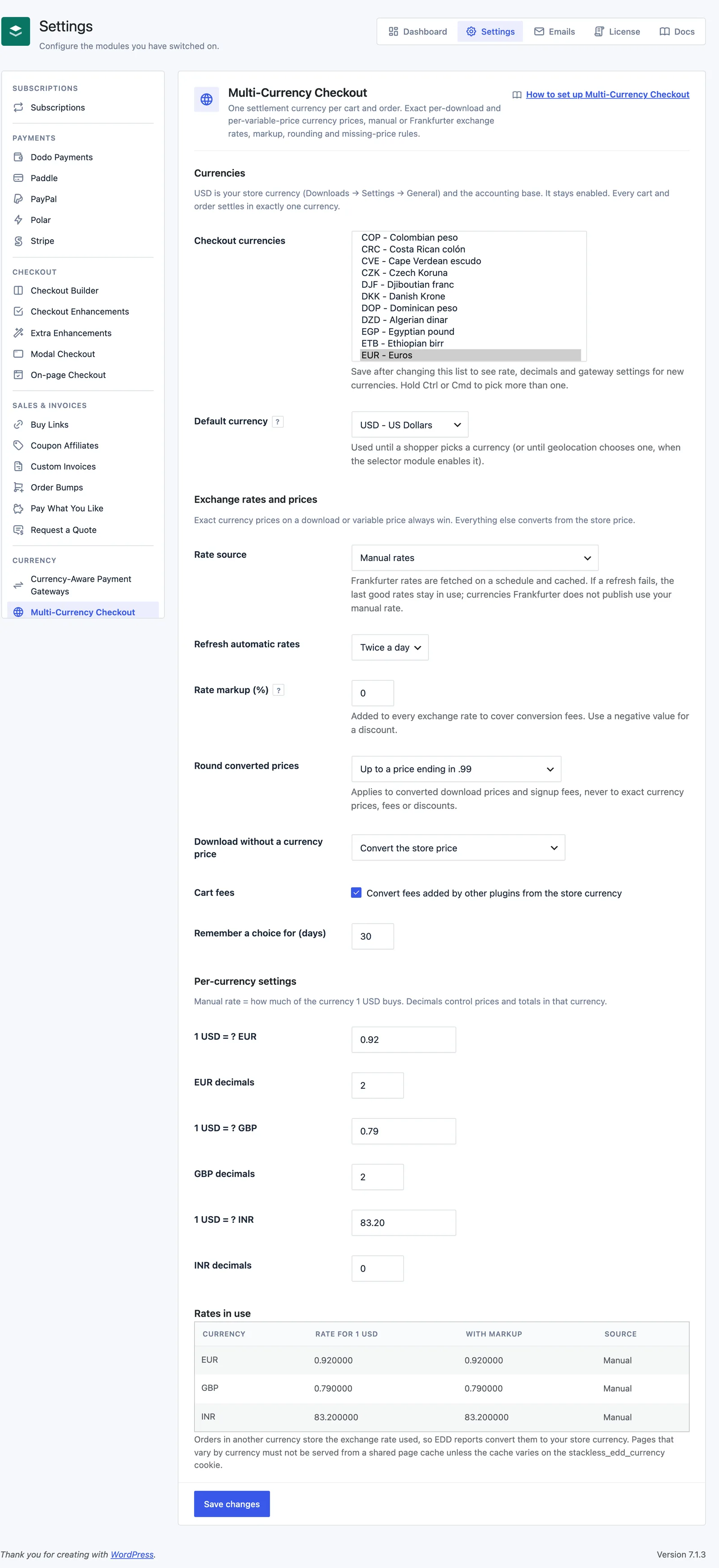
Under Currencies:
- Checkout currencies: every currency you want to sell in. Hold Ctrl or Cmd to pick more than one. The list has EDD’s currencies plus other ISO 4217 codes. Your store currency from Downloads → Settings → General is the accounting base and always stays enabled.
- Default currency: used until a shopper picks a currency, or until geolocation picks one when the selector module turns that on. Defaults to your store currency.
Save after changing the list. The rate and decimals fields for new currencies, and their gateway fields in Currency-Aware Payment Gateways, only appear after saving.
Set Exchange Rates
Under Exchange rates and prices:
- Rate source: Manual rates (default) or Frankfurter (European Central Bank reference rates).
- Refresh automatic rates: Every hour, Twice a day (default) or Once a day.
- Rate markup (%): added to every exchange rate to cover conversion fees. Defaults to 0, from -100 to 1000. Use a negative value for a discount.
Frankfurter rates come from https://api.frankfurter.app/latest on a schedule and are cached. If a refresh fails, the last good rates stay in use. Currencies Frankfurter doesn’t publish fall back to your manual rate. Saving the settings also fetches rates when a newly enabled currency has none yet.
Under Per-currency settings, each extra currency gets two fields:
- 1 USD = ? EUR (with your own codes): the manual rate, meaning how much of that currency one unit of your store currency buys.
- EUR decimals: decimals for prices and totals in that currency, from 0 to 4. Zero-decimal currencies such as JPY, KRW and CLP default to 0, and so do HUF and TWD, which EDD shows without decimals. Others default to 2.
Below the settings, Rates in use lists each currency with its rate, the rate with markup and its source: Frankfurter, Manual or “Missing: downloads convert to no price”. With Frankfurter selected, you also see the last successful refresh and a Refresh rates now button.
Round Converted Prices
Round converted prices has four options:
- No extra rounding (currency decimals only), the default
- Up to a price ending in .99
- Up to a price ending in .95
- Nearest whole number
Rounding applies to converted download prices and subscription signup fees. It never touches exact currency prices, fees or discounts. The .99 and .95 options always round up, so a converted price never drops below the exchange-rate value, and a price that already ends in .99 stays as it is. In a zero-decimal currency they round up to a whole number, and prices of 100 or more end in 99 or 95. A free download stays free.
Set Exact Prices per Download
Edit the download. Below the price field there’s a Currency prices group with a field for every enabled currency other than your store currency:
- EUR price (€), one per currency
- EUR signup fee (€), shown while the Subscriptions module is on
With variable pricing, every price option row gets its own Currency prices fields. Leave a field empty to convert the store price. An exact price wins over conversion. An empty signup fee converts the base signup fee.
EDD has no sale prices, so there’s no sale field. Amounts are saved with the currency’s decimals and read your EDD decimal separator. If an amount can’t be read, it isn’t saved and you see “Some currency prices are not valid amounts and were not saved” with the currency codes.
Turning a currency off keeps its saved prices, so they come back when you turn it on again. Deleting a price option deletes its currency prices. A variable download’s own price is its lowest option in the shopper’s currency.
Decide What Happens Without a Currency Price
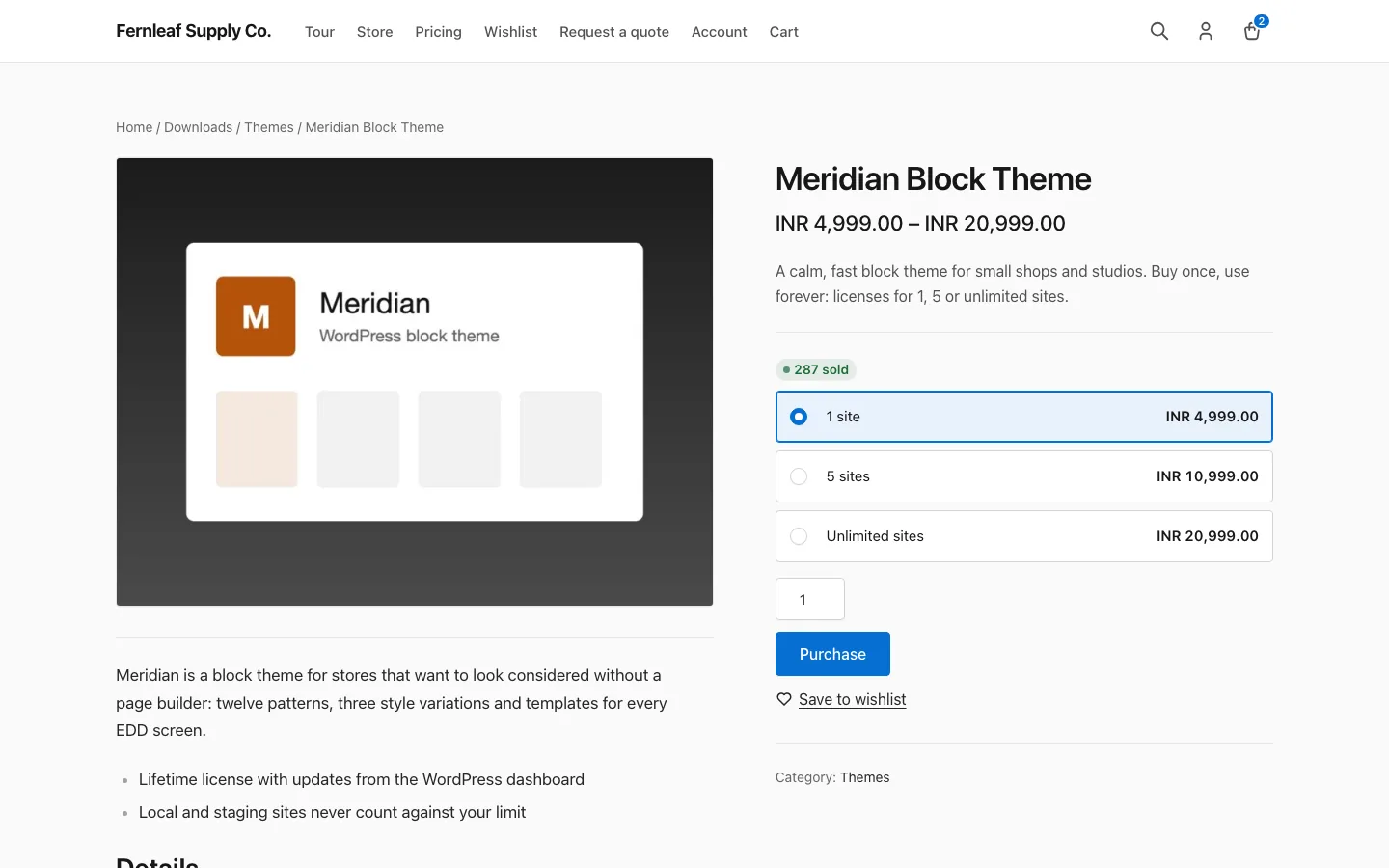
Download without a currency price controls downloads that have no exact price in the shopper’s currency:
- Convert the store price (default)
- Hide the download in that currency: the
[downloads]shortcode, the Downloads block and download archive, category and tag pages only list downloads with an exact price in that currency. - Show it, but block purchase in that currency
With hide or block, a download or price option without an exact price can’t be bought in that currency. Its price reads “Not available in EUR”, the purchase button is replaced by the same text, and price options without a price drop out of the list. Adding it to the cart is refused, and checkout stops with a notice to remove it or choose another currency.
The same happens under Convert the store price when a currency has no usable rate. If a shopper tries to switch currency while such items are in the cart, the switch is refused and the downloads are named.
Cart, Fees and Discounts
- Cart fees: “Convert fees added by other plugins from the store currency”. On by default. Subscription signup fees are added as cart fees and follow this setting, so leave it on when you sell subscriptions with signup fees.
- Flat-amount discount codes and every discount’s minimum order amount convert to the cart currency. Percentage discounts apply as usual.
- After a currency change, discount codes in the cart are checked again, because a converted minimum can make one invalid. Invalid codes are removed.
- Price changes other Stackless modules make to a cart line, such as Pay What You Like amounts, add-ons and order bump offers, are worked out in your store currency and converted once.
How the Currency Is Chosen
On a storefront request, Stackless picks the currency in this order:
- The currency of an order being paid through EDD’s payment recovery link, such as a renewal or invoice payment link. The cart keeps that order’s currency until the payment finishes or the cart is emptied.
- The shopper’s own choice, saved in the EDD session and a
stackless_edd_currencycookie. - The Default currency, or the shopper’s local currency when the selector’s location option is on.
Remember a choice for (days) sets how long the cookie lasts. Defaults to 30, from 1 to 365.
Shoppers change currency with the currency selector, or with any storefront link that ends in ?stackless_edd_currency=EUR.
Admin screens, cron, WP-CLI, Action Scheduler, payment listeners and REST routes other than EDD’s cart, Fastlane and unbranded card routes always use your store currency.
How Orders Are Stored
Each order keeps the currency it was placed in. Stackless writes the exchange rate used, markup included, to the order and to its items, adjustments and transactions. EDD’s reports, earnings and customer values divide by that rate, so they stay in your store currency.
Checkout orders also store the base currency, the rate and the rate source as order meta. Refunds use the rate of the order they refund. Orders created by code in another currency, such as renewals and invoices, get the current rate unless the code sets one.
The advanced filters on Downloads → Orders get a Currency filter with All currencies and every enabled currency.
Limits
- Pages that change by currency must not be served from a shared page cache unless the cache varies on the
stackless_edd_currencycookie. - Existing orders are never repriced. Stored amounts stay as they were placed.
- To control which gateways take each currency, see Match Payment Gateways to Currencies. To give shoppers a switcher, see Add a Currency Selector.
- Developers can read and convert amounts with
stackless_edd_current_currency(),stackless_edd_enabled_currencies(),stackless_edd_convert_amount(),stackless_edd_currency_rate()andstackless_edd_switch_currency(). See Hooks and Functions.