Home » Posts tagged 'Prime Numbers'

Tag Archives: Prime Numbers

Euler’s (Prime to) Prime Generating Equation

The greatest number theorist in mathematical universe, Leonhard Euler had discovered some formulas and relations in number theory, which were based on practices and were correct to limited extent. The prime generating equation by Euler is a binomial which is actually very specific and yields more primes than any other relations out there in number theory. Euler told that the equation f(x)=x^2+x+k yields many prime numbers with the values of x being input from x=0 to x=k-2; k being a prime.

Let’s see how many primes we can get by using different values of k and x:

Serial Number Value of k (prime) Value of x (from x=0 to x=k-2) Value of f(x)=(x^2+x)+k Not a Prime?
1 2 0 2
2 3 0 3
3 1 5
4 5 0 5
5 1 7
6 2 11
7 3 17
8 7 0 7
9 1 9 No
10 2 13
11 3 19
12 4 27 No
13 5 37
14 11 0 11
15 1 13
16 2 17
17 3 23
18 4 31
19 5 41
20 6 53
21 7 67
22 8 83
23 9 101
24 13 0 13
25 1 15 No
26 2 19
27 3 25 No
28 4 33 No
29 5 43
30 6 55 No
31 7 69 No
32 8 85 NO
33 9 103
34 10 123 No
35 11 145 No
36 17 0 17
37 1 19
38 2 23
39 3 29
40 4 37
41 5 47
42 6 59
43 7 73
44 8 89
45 9 107
46 10 127
47 11 149
48 12 173
49 13 199
50 14 227
51 15 257
52 19 0 19
53 1 21
54 2 25 No
55 3 31
56 4 39 No
57 5 49
58 6 61
59 7 75 No
60 8 91 No
61 9 109
62 10 129 No
63 11 151
64 12 175 No
65 13 201 No
66 14 229
67 15 259
68 16 291
69 17 325 No
70 23 0 23
71 1 25 No
72 2 29
73 3 35 No
74 4 43
75 5 53
76 6 65 No
77 7 79
78 8 95 No
79 9 113
80 10. 133
81 11 155 No
82 12 179
83 13 205 No
84 14 233
85 15 263
86
87 16 295  No
88 17 329
89 18 365  No
90 19 403
91 20 443
92 21 485  No

The above table yields many prime numbers, which again can be put at the place of k and so on the table can be progressed.

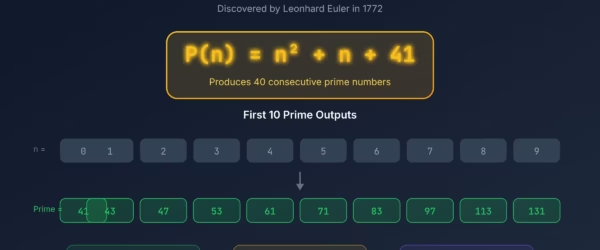
According to Euler, 41 was the most appropriate value of k yielding more prime numbers than any other k. In the list below, each value of f(x) is a prime for k=41:

k

41

x

0

f(x)

41

1 43
2 47
3 53
4 61
5 71
6 83
7 97
8 113
9 131
10 151
11 173
12 197
13 223
14 251
15 281
16 313
17 347
18 383
19 421
20 461
21 503
22 547
23 593
24 641
25 691
26 743
27 797
28 853
29 911
30 971
31 1033
32 1097
33 1163
34 1231
35 1301
36 1373
37 1447
38 1523
39 1601

So, the Euler’s Prime Generating Equation can be written as
f(x) = x^2+x+41 ; where x is an integer ranging from 0 to 39.

Wait. What if we increase the value of x beyond the limit of 39? What will we get?

The next values of f(x) in this series would be 1681, 1763, 1847, 1933, 2021, 2111, 2203, 2297, 2393, … .
Are all these prime numbers too? The answer is no. 1681 is not a prime number, neither are 1763 and 2021. Though all others are prime numbers.


A Trip to Mathematics: Part IV Numbers

Leopold Kronecker

If logic is the language of mathematics, Numbers are the alphabet. There are many kinds of number we use in mathematics, but at a broader aspect we may categorize them in two categories:
1. Countable Numbers
2. Uncountable Numbers
The names are enough to explain the properties of above numbers. The numbers which can be counted in nature are called Countable Numbers and the numbers which can not be counted are called Uncountable Numbers.

Well, this is not the correct way to classify the bunch of types of numbers. We have some formal names for special types of numbers, like Real numbers, Complex Numbers, Rational Numbers, Irrational Numbers etc.. We shall discuss these non-interesting numbers (let me say them non-interesting) at first and then some interesting numbers(those numbers are really interesting to learn). Although in this post I have concisely described the classification, I will rigorously discuss them later.
Let me start this discussion with the memorable quote by Leopold Kronecker:

“God created the natural numbers, and all the rest is the work of man.”

What does it mean? What did Kronecker think when he made this quote? Why is this quote true? —First part of this article is based on this discussion.
Actually, he meant to say that all numbers, like Real Numbers, Complex Numbers, Fractions, Integers, Non-integers etc. are made up of the numbers given by God to the human. These God Gifted numbers are actually called Natural Numbers. Natural Numbers are the numbers which are used to count things in nature.

Eight pens, Eighteen trees, Three Thousands people etc. are measure of natural things and thus ‘Eight’, ‘Eighteen’, ‘Three Thousands’ etc. are called natural numbers and we represent them numerically as ’8′, ’18′, ’3000′ respectively. So, if 8, 18, 3000 are used in counting natural things, are natural numbers. Similarly, 1, 2, 3, 4, and other numbers are also used in counting things —thus these are also Natural Numbers.

Let we try to form a set of Natural Numbers. What will we include in this set?

1?                    (yes!).
2?                    (yes).
3?                     (yes).
….
1785?                (yes)
…and          so on.

This way, after including all elements we get a set of natural numbers {1, 2, 3, 4, 5, …1785, …, 2011,….}. This set includes infinite number of elements. We represent this set by Borbouki’s capital letter N, which looks like \mathbb{N} or bold capital letter N (\mathbf{N} where N stands for NATURAL. We will define the set of all natural numbers as:

\mathbb{N} := \{ 1, 2, 3, 4, \ldots, n \ldots \}.

It is clear from above set-theoretic notation that n-th element of the set of natural numbers is n.
In general, if a number n is a natural number, we right that n \in \mathbb{N}.
Please note that some mathematicians (and Wolfram Research) treat ’0′ as a natural number and state the set as \mathbb{N} :=\{0, 1, 2, \ldots, n-1, \ldots \}, where n-1 is the nth element of the set of natural numbers; but we will use first notion since it is broadly accepted.

Now we shall try to define Integers in form of natural numbers, as Kronecker’s quote demands. Integers (or Whole numbers) are the numbers which may be either positives or negatives of natural numbers including 0.
Few examples are 1, -1, 8, 0, -37, 5943 etc.
The set of integers is denoted by \mathbb{Z} or \mathbf{Z} (here Z stands for ‘Zahlen‘, the German alternative of integers). It is defined by
\mathbb{Z} := \{ \pm n: n \in \mathbb{N} \} \cup \{0\}
i.e., \mathbb{Z} := \{\ldots -3, -2, -1, 0, 1, 2, 3 \ldots \}.

Now, if we again consider the statement of Kronecker, we might ask that how could we prepare the integer set \mathbb{Z} by the set \mathbb{N} of natural numbers? The construction of \mathbb{Z} from \mathbb{N} is motivated from the requirement that every integer can be expressed as difference of two positive integers (i.e., Natural Numbers). Let a,b,c,d \in \mathbb{N} and a relation ρ is defined on \mathbb{N} \times \mathbb{N} by (a,b) \rho (c,d) if and only if a+d = b+c. The relation ρ is an equivalence relation and the equivalence classes under ρ are called integers and defined as \mathbb{Z} := \mathbb{N} \times \mathbb{N} /\rho. Now we can define set of integers by an easier way, as \mathbb{Z}:= \{a-b; \ a,b \in \mathbb{N}\}. Thus an integer is a number which can be produced by difference of two or more natural numbers. And similarly as converse defintion, positive integers are called Natural Numbers.
After Integers, we head to rational numbers. Say it again– ‘ratio-nal numbers‘ –numbers of ratio.

diagonal argument by Cantor

Image via Wikipedia

A rational number \frac{p}{q} is defined as a ratio of an integer p and a non-zero integer q. (Well that is not a perfect definition, but as an introduction it is great for understanding.) The set of rational numbers is defined by \mathbb{Q}.
Once integers are formed, we can form Rational (and Irrational numbers: numbers which are not rational ) using integers.
We consider an ordered pair (p,q):=\mathbb{Z} \times (\mathbb{Z} \setminus \{0 \}) and another ordered pair (r,s):=\mathbb{Z} \times (\mathbb{Z} \setminus \{0\}) and define a relation ρ by (p,q) \rho (r,s) \iff ps=qr for p,q,r,s \in \mathbb{Z}, \ q, r \ne 0. Then ρ is an equivalence relation of rationality, class (p,q). The set \mathbb{Z} \times (\mathbb{Z} \setminus \{0\})/\rho is denoted by \mathbb{Q} (and the elements of this set are called rational numbers).
In practical understandings, the ratio of integers is a phrase which will always help you to define the rational numbers. Examples are \frac{6}{19}, \ \frac{-1}{2}=\frac{-7}{14}, \ 3\frac{2}{3}, \ 5=\frac{5}{1} \ldots. Set of rational numbers includes Natural Numbers and Integers as subsets.
Consequently, irrational numbers are those numbers which can not be represented as the ratio of two integers. For example \pi, \sqrt{3}, e, \sqrt{11} are irrationals.
The set of Real Numbers is a relatively larger set, including the sets of Rational and Irrational Numbers as subsets. Numbers which exist in real and thus can be represented on a number line are called real numbers. As we formed Integers from Natural Numbers; Rational Numbers from Integers, we’ll form the Real numbers by Rational numbers.
The construction of set \mathbb{R} of real numbers from \mathbb{Q} is motivated by the requirement that every real number is uniquely determined by the set of rational numbers less than it. A subset L of \mathbb{Q} is a real number if L is non-empty, bounded above, has no maximum element and has the property that for all x, y \in \mathbb{Q}, x < y and y \in L implies that x \in L. Real numbers are the base of Real Analysis and detail study about them is case of study of Real Anlaysis.
Examples of real numbers include both Rational (which also contains integers) and Irrational Numbers.

The square root of a negative number is undefined in one dimensional number line (which includes real numbers only) and is treated to be imaginary. The numbers containing or not containing an imaginary number are called complex numbers.
Some very familiar examples are 3+\sqrt{-1}, \sqrt{-1} =i, \ i^i etc. We should assume that every number (in lay approach) is an element of a complex number. The set of complex numbers is denoted by \mathbb{C}. In constructive approach, a complex number is defined as an ordered pair of real numbers, i.e., an element of \mathbb{R} \times \mathbb{R} [i.e., \mathbb{R}^2] and the set as \mathbb{C} :=\{a+ib; \ a,b \in \mathbb{R}. Complex numbers will be discussed in Complex Analysis more debately.
We verified Kronecker’s quote and shew that every number is sub-product of postive integers (natural numbers) as we formed Complex Numbers from Real Numbers; Real Numbers from Rational Numbers; Rational Numbers from Integers and Integers from Natural Numbers. //
Now we reach to explore some interesting kind of numbers. There are millions in name but few are the follow:
Even Numbers: Even numbers are those integers which are integral multiple of 2. 0, \pm 2, \pm 4, \pm 6 \ldots \pm 2n \ldots are even numbers.

Odd Numbers: Odd numbers are those integers which are not integrally divisible by 2. \pm 1, \pm 3, \pm 5 \ldots \pm (2n+1) \ldots are all odd numbers.

Prime Numbers: Any number p greater than 1 is called a prime number if and only if its positive factors are 1 and the number p itself.
In other words, numbers which are completely divisible by either 1 or themselves only are called prime numbers. 2, 3, 5, 7, 11, 13, 17, 19, 23, 29 \ldots etc. are prime numbers or Primes. The numbers greater than 1, which are not prime are called Composite numbers.
Twin Primes: Consecutive prime numbers differing by 2 are called twin primes. For example 5,7; 11,13; 17,19; 29,31; … are twin primes.

Pseudoprimes: Chinese mathematicians claimed thousands years ago that a number n is prime if and only if it divides 2^n -2. In fact this conjecture is true for n \le 340 and false for upper numbers because first successor to 340, 341 is not a prime (31 \times 11) but it divides 2^{341}-2. This kind of numbers are now called Pseudoprimes. Thus, if n is not a prime (composite) then it is pseudoprime \iff n | 2^n-2 (read as ‘n divides 2 powered n minus 2‘). There are infinitely many pseudoprimes including 341, 561, 645, 1105.

Carmichael Numbers or Absolute Pseudoprimes: There exists some pseudoprimes that are pseudoprime to every base a, i.e., n | a^n -a for all integers a. The first Carmichael number is 561. Others are 1105, 2821, 15841, 16046641 etc.

e-Primes: An even positive integer is called an e-prime if it is not the product of two other even integers. Thus 2, 6, 10, 14 …etc. are e-primes.

Germain Primes: An odd prime p such that 2p+1 is also a prime is called a Germain Prime. For example, 3 is a Germain Prime since 2\times 3 +1=7 is also a prime.
Relatively Prime: Two numbers are called relatively prime if and only their greatest common divisor is 1. In other words, if two numbers are such that no integer, except 1, is common between them when factorizing. For example: 7 and 9 are relatively primes and same are 15, 49.

Perfect Numbers: A positive integer n is said to be perfect if n equals to the sum of all its positive divisors, excluding n itself. For example 6 is a perfect number because its divisors are 1, 2, 3 and 6 and it is obvious that 1+2+3=6. Similarly 28 is a perfect number having 1, 2, 4, 7, 14 (and 28) as its divisors such that 1+2+4+7+14=28. Consecutive perfect numbers are 6, 28, 496, 8128, 33550336, 8589869056 etc.

Mersenne Numbers and Mersenne Primes: Numbers of type M_n=2^n-1; \ n \ge 1 are called Mersenne Numbers and those Mersenne Numbers which happen to be Prime are called Mersenne Primes. Consecutive Mersenne numbers are 1, 3 (prime), 7(prime), 15, 31(prime), 63, 127.. etc.

Catalan Numbers: The Catalan mumbers, defined by C_n = \dfrac{1}{n+1} \binom{2n}{n} = \dfrac{(2n)!}{n! (n+1)!} \ n =0, 1, 2, 3 \ldots form the sequence of numbers 1, 1, 2, 5, 14, 42, 132, 429, 1430, 4862, …

Triangular Number: A number of form \dfrac{n(n+1)}{2} \ n \in \mathbb{N} represents a number which is the sum of n consecutive integers, beginning with 1. This kind of number is called a Triangular number. Examples of triangular numbers are 1 (1), 3 (1+2), 6 (1+2+3), 10(1+2+3+4), 15(1+2+3+4+5) …etc.

Square Number: A number of form n^2 \ n \in \mathbb{N} is called a sqaure number.
For example 1 (1^2), 4 (2^2), 9(3^2), 16 (4^2)..etc are Square Numbers.

Palindrome: A palindrome or palindromic number is a number that reads the same backwards as forwards. For example, 121 is read same when read from left to right or right to left. Thus 121 is a palindrome. Other examples of palindromes are 343, 521125, 999999 etc.

//

Fermat Numbers

Fermat Number, a class of numbers, is an integer of the form F_n=2^{2^n} +1 \ \ n \ge 0.

For example: Putting n := 0,1,2 \ldots in F_n=2^{2^n} we get F_0=3, F_1=5, F_2=17, F_3=257 etc.

Fermat observed that all the integers F_0, F_1, F_2, F_3, \ldots were prime numbers and announced that F_n is a prime for each natural value of n.

In writing to Prof. Mersenne, Fermat confidently announced:

I have found that numbers of the form 2^{2^n}+1 are always prime numbers and have long since signified to analysts the truth of this theorem.

However, he also accepted that he was unable to prove it theoretically. Euler in 1732 negated Fermat’s fact and told that F_1 -F_4 are primes but F_5=2^{2^5} =4294967297 is not a prime since it is divisible by 641.
Euler also stated that all Fermat numbers are not necessarily primes and the Fermat number which is a prime, might be called a Fermat Prime. Euler used division to prove the fact that F_5 is not a prime. The elementary proof of Euler’s negation is due to G. Bennett.

Theorem:

The Fermat number F_5 is divisible by 641 i.e., 641|F_5.

Proof:

As defined F_5 :=2^{2^5}+1=2^{32}+1 \ \ldots (1)

Factorising 641 in such a way that 641=640+1 =5 \times 128+1 \\ =5 \times 2^7 +1
Assuming a=5 \bigwedge b=2^7 we have ab+1=641.

Subtracting a^4=5^4=625 from 641, we get ab+1-a^4=641-625=16=2^4 \ \ldots (2).

Now again, equation (1) could be written as
F_5=2^{32}+1 \\ \ =2^4 \times {(2^7)}^4+1 \\ \ =2^4 b^4 +1 \\ \ =(1+ab-a^4)b^4 +1 \\ \ =(1+ab)[a^4+(1-ab)(1+a^2b^2)] \\ \ =641 \times \mathrm{an \, Integer}
Which gives that 641|F_n.

Mathematics is on its progression and well developed now but it is yet not confirmed that whether there are infinitely many Fermat primes or, for that matter, whether there is at least one Fermat prime beyond F_4. The best guess is that all Fermat numbers F_n>F_4 are composite (non-prime).
A useful property of Fermat numbers is that they are relatively prime to each other; i.e., for Fermat numbers F_n, F_m \ m > n \ge 0, \mathrm{gcd}(F_m, F_n) =1.

Following two theorems are very useful in determining the primality of Fermat numbers:

Pepin Test:

For n \ge 1, the Fermat number F_n is prime \iff 3^{(F_n-1)/2} \equiv -1 \pmod {F_n}

Euler- Lucas Theorem

Any prime divisor p of F_n, where n \ge 2, is of form p=k \cdot 2^{n+2}+1.

Fermat numbers (F_n) with n=0, 1, 2, 3, 4 are prime; with n=5,6,7,8,9,10,11 have completely been factored; with n=12, 13, 15, 16, 18, 19, 25, 27, 30 have two or more prime factors known; with n=17, 21, 23, 26, 28, 29, 31, 32 have only one prime factor known; with n=14,20,22,24 have no factors known but proved composites. F_{33} has not yet been proved either prime or composite.

Related articles
Follow

Get every new post delivered to your Inbox.

Join 755 other followers

%d bloggers like this: