
On Ramanujan’s Nested Radicals

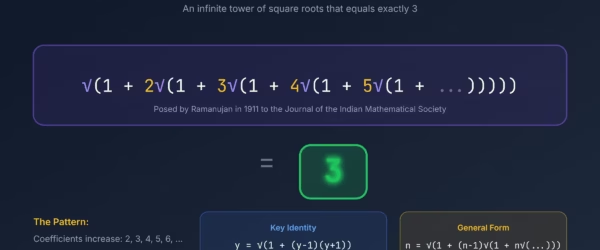
Ramanujan (1887-1920) discovered some formulas on algebraic nested radicals. This article is based on one of those formulas. The main aim of this article is to discuss and derive them intuitively. Nested radicals have many applications in Number Theory as well as in Numerical Methods.

A Problem on Ordinary Nested Radicals

Problem

Prove or disprove that
\sqrt {7+\sqrt{33}} + \sqrt {6+\sqrt{35} } = \sqrt {5+\sqrt{21}} + \sqrt {8+\sqrt{55}}

Solution

In order to simplify the radicals, the radicands should be forced to equal square numbers (e.g., 7+\sqrt{33} should be a square of some number). Numbers whose squares have a rational and radical part are usually in the form x+y .
So let \sqrt{7 +\sqrt{33}} = x+y = \sqrt{(x+y)^2} = \sqrt {x^2+y^2+2xy}
and set
x^2+y^2=7 and 2xy=\sqrt{33} \, , i.e., y=\sqrt{33}/2x
Thus x^2 + \left ( \frac {\sqrt{33}}{2x} \right )^2 =7
which on simplification yields x=\sqrt{22}/2
And also y=\sqrt{6}/2

Thus,
\mathbf {\sqrt{7+\sqrt{33}} = \frac {\sqrt{22}+\sqrt{6}}{2} }
Using the same process for other radicals:
\mathbf {\sqrt{6+\sqrt{35}} = \frac{\sqrt{10}+\sqrt{14}}{2} }
\mathbf {\sqrt{8+\sqrt{55}} = \frac{\sqrt{10}+\sqrt{22}}{2} }
\mathbf {\sqrt{5+\sqrt{21}} = \frac{\sqrt{6}+\sqrt{14}}{2} }
Thus, now we can easily prove (by addition) that

\sqrt {7+\sqrt{33}} + \sqrt {6+\sqrt{35}} =\sqrt {5+\sqrt{21}} + \sqrt {8+\sqrt{55}}