Home » Posts tagged 'light'

Tag Archives: light

Consequences of Light Absorption – The Jablonski Diagram

π-electronic energy levels of an organic molec...
Image via Wikipedia

According to the Grotthus – Draper Law of photo-chemistry, also called the principal of photo chemical activation, Only that light which is absorbed by a system can bring about a photochemical change. However it is not essential that the light which is absorbed must bring about a photochemical change. The absorption of light may result in a number of other phenomena as well. For instance, the light absorbed may cause only a decrease in the intensity of the incident radiation. This event is governed by the Beer-Lambert Law. Secondly, the light absorbed may be re-emitted almost instantaneously (within 10^{-8} second) in one or more steps. This phenomenon is known as fluorescence. The emission in fluorescence bearer with the removal of the source of light. Sometimes the light absorbed is given out slowly and even long after the removal of the source of light. This phenomenon is known as phosphorescence.
The phenomena of fluorescence and phosphorescence are best explained with the help of the Jablonski Diagram.
Jablonski Diagram

In order to understand this diagram, we need to define some terminology. Most molecules have an even number of electrons and thus in the ground state, all the electrons are spin paired. The quantity \mathbf {2S+1} , where S is the total electron spin, is known as the spin multiplicity of a state. When the spins are paired \uparrow \downarrow as shown in the figure, the upward orientation of the electron spin is cancelled by the downward orientation so that \mathbf {S=0} .

s_1= + \frac {1}{2} ; s_2= - \frac {1}{2} so that \mathbf{S}=s_1+s_2 =0.
Hence, \mathbf {2S+1}=1

Thus, the spin multiplicity of the molecule is 1. We express it by saying that the molecule is in the singlet ground state.

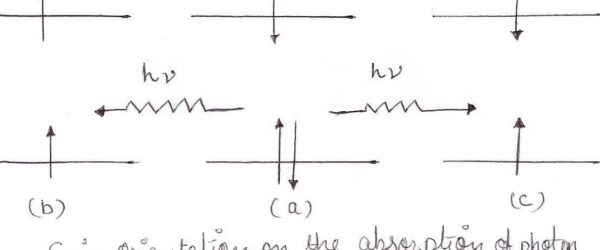
Spin Orientation on the absortion of a ligh photon

When by the absorption of a photon of a suitable energy h \nu , one of the paired electrons goes to a higher energy level (excited state), the spin orientations of the single electrons may be either parallel or antiparallel. [see image]

•If spins are parallel, \mathbf {S=1} or \mathbf {2S+1=3} i.e., the spin multiplicity is 3. This is expressed by saying that the molecule is in the triplet excited state.
• If the spins are anti-parallel, then
\mathbf{S=0} so that \mathbf {2S+1=1} i.e., the singlet excited state, as already mentioned.

Since the electron can jump to any of the higher electronic states depending upon the energy of the photon absorbed, we get a series of singlet excited states, \{S_n\} where n \ge 1 and a series of triplet excited state \{T_n\} where n \ge 1 . Thus S_1, \, S_2, \, S_3, .... etc are respectively known as first singlet excited state, second singlet excited state and so on. Similarly, in T_1, \, T_2,\, ..... are respectively known as first triplet excited state, second triplet excited state and so on.

Make sure, you are not confused in \mathbf{S} & S_n

Ultimate Speed of A Material Particle – Denying the Concept of Infinite mass – Photons and More

In classical mechanics, there being no upper limit to velocity it is possible that as a particle is given more and more acceleration, its speed may go on increasing progressively and may well become greater than c , –in fact, it may have any velocity whatever.

This is firmly denied by the theory of relativity. It may legitimately be asked, therefore, as to what will happen if the particle is continually accelerated. Certainly, its velocity v goes on increasing and hence also its mass in accordance with the mass-velocity relation m= \frac {m_0} { \sqrt {1- \frac {v^2} {c^2} } } = \gamma m_0 . But as v approaches c , \frac {v^2} {c^2} \longrightarrow 1 and therefore \sqrt {1- \frac {v^2} {c^2} } \longrightarrow 0 and hence the mass of the particle m \longrightarrow \infty , as shown graphically, from which it is clear that for velocities right up to 50% of c , the increase in mass from the value of the rest mass or inertial mass m_0 is quite inappreciable. (more…)

From Newton to Einstein – Search for a Fundamental Frame of Reference

This slideshow requires JavaScript.


It was on account on Newton’s insistence as to the existence of a fundamental or absolute frame of reference, called absolute space, that the search for it was carried on. This search resulted in the discovery, or rather the invention, of that monstrosity of a medium, Luminiferous Ether, as the following brief account will show:

Maxwell clearly demonstrated, in the year 1864, the inter-relationship between electricity, magnetism and light when, from the known properties of electricity and magnetism, he formulated his celebrated theory of electromagnetic radiation and have the well know equations of electromagnetic field which bear his name and are identical with those that represent a wave phenomenon. He thus established the presence of electromagnetic waves in space, travelling with the speed of light. In other words, he proved that light is an electromagnetic wave. (more…)

Raman Effect- Raman Spectroscopy- Raman Scattering

In constrast to other conventional brances of spectroscopy, Raman spectroscopy deals with the scattering of light & not with its absorption.


Raman Effect

Raman effect
Raman Effect: An Overview

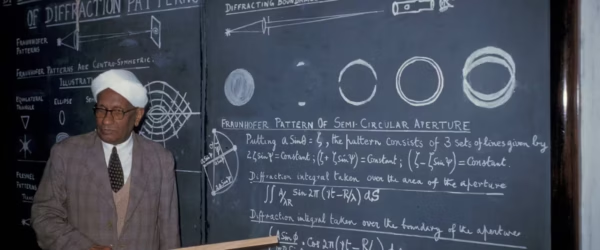
Chandrasekhar Venkat Raman discovered in 1928 that if light of a definite frequency is passed through any substance in gaseous, liquid or solid state, the light scattered at right angles contains radiations not only of the original frequency (Rayleigh Scattering)  but also of some other frequencies which are generally lower but occasionally higher than the frequency of the incident light.


The phenomenon of scattering of light by a substance when the frequencies of radiations scattered at right angles are different (generally lower and only occasionally higher) from the frequency of the incident light, is known as Raman Scattering or Raman effect.
The lines of lower frequencies as known as Stokes lines while those of higher frequencies are called anti-stokes lines.

If f  is the frequency of the incident light &  f’  that of a particular line in the scattered spectrum, then the difference   f-f’   is known as the Raman Frequency. This frequency is independent of the frequency of the incident light. It is constant and is characteristic of the substance exposed to the incident light.

A striking feature of Raman Scattering is that Raman Frequencies are identical, within the limits of experimental error, with those obtained from rotation-vibration (infrared) spectra of the substance.
Here is a home made video explaining the Raman Scattering of Yellow light:

And here is another video guide for Raman Scattering:

Advantage of Raman Effects

  •  Raman Spectroscopy can be used not only for gases but also for liquids & solids for which the infrared spectra are so diffuse as to be of little quantitative value.
  • Raman Effect is exhibited not only by polar molecules but also by non-polar molecules such as O2, N2, Cl2 etc.
  • The rotation-vibration changes in non-polar molecules can be observed only by Raman Spectroscopy.
  • The most important advantage of Raman Spectra is that it involves measurement of frequencies of scattered radiations, which are only slightly different from the frequencies of incident radiations. Thus, by appropriate choice of the incident radiations, the scattered spectral lines are brought into a convenient region of the spectrum, generally in the visible region where they are easily observed. The measurement of the corresponding infrared spectra is much more difficult.
  • It uses visible or ultraviolet radiation rather than infrared radiation.

Uses

  •  Investigation of biological systems such as the polypeptides and the proteins in aqueous solution.
  •  Determination of structures of molecules.

RAMAN was awarded the 1930 Physics Nobel Prize for this.

Classical Theory of Raman Effect

The classical theory of Raman effect, also called the polarizability theory, was developed by G. Placzek in 1934. I shall discuss it briefly here. It is known from electrostatics that the electric field E associated with the electromagnetic radiation induces a dipole moment \mu in the molecule, given by
\mu = \alpha E …….(1)
where \alpha is the polarizability of the molecule. The electric field vector E itself is given by
E = E_0 \sin \omega t = E_0 \sin 2\pi \nu t ……(2)
where E_0 is the amplitude of the vibrating electric field vector and \nu is the frequency of the incident light radiation.

Thus, from Eqs. (1) & (2),
\mu= \alpha E_0 \sin 2\pi \nu t …..(3)
Such an oscillating dipole emits radiation of its own oscillation with a frequency \nu , giving the Rayleigh scattered beam. If, however, the polarizability varies slightly with molecular vibration, we can write
\alpha =\alpha_0 + \frac {d\alpha} {dq} q …..(4)
where the coordinate q describes the molecular vibration. We can also write q as:
q=q_0 \sin 2\pi \nu_m t …..(5)
Where q_0 is the amplitude of the molecular vibration and \nu_m is its (molecular) frequency. From Eqs. 4 & 5, we have
\alpha =\alpha_0 + \frac {d\alpha} {dq} q_0 \sin 2\pi \nu_m t …..(6)
Substituting for \alpha   in (3), we have
\mu= \alpha_0 E_0 \sin 2\pi \nu t + \frac {d\alpha}{dq} q_0 E_0 \sin 2\pi \nu t \sin 2\pi \nu_m t …….(7)
Making use of the trigonometric relation \sin x \sin y = \frac{1}{2} [\cos (x-y) -\cos (x+y) ] this equation reduces to:
\mu= \alpha_0 E_0 \sin 2\pi \nu t + \frac {1}{2} \frac {d\alpha}{dq} q_0 E_0 [\cos 2\pi (\nu - \nu_m) t - \cos 2\pi (\nu+\nu_m) t] ……(8)
Thus, we find that the oscillating dipole has three distinct frequency components:

1• The exciting frequency \nu with amplitude \alpha_0 E_0
2• \nu - \nu_m
3• \nu + \nu_m (2 & 3 with very small amplitudes of \frac {1}{2} \frac {d\alpha}{dq} q_0 E_0 . Hence, the Raman spectrum of a vibrating molecule consists of a relatively intense band at the incident frequency and two very weak bands at frequencies slightly above and below that of the intense band.

If, however, the molecular vibration does not change the polarizability of the molecule then (d\alpha / dq )=0 so that the dipole oscillates only at the frequency of the incident (exciting) radiation. The same is true for the molecular rotation. We conclude that for a molecular vibration or rotation to be active in the Raman Spectrum, it must cause a change in the molecular polarizability, i.e., d\alpha/dq \ne 0 …….(9)

Homonuclear diatomic molecules such as \mathbf {H_2 \, N_2 \, O_2} which do not show IR Spectra since they don’t possess a permanent dipole moment, do show Raman spectra since their vibration is accompanied by a change in polarizability of the molecule. As a consequence of the change in polarizability, there occurs a change in the induced dipole moment at the vibrational frequency.

REFERENCE:-

Principles in Physical Chemistry
[7th edition]
Puri, Sharma & Pathania

Short Question: What is the reason that Doppler Effect in light is symmetric but asymmetric in sound?


Short Answer is summarised below:


In Sound, motion due to source affects the wavelength and the motion of the observer affects frequency. The relative velocity of the sound due to the motion of the observer is in the numerator. The relative velocity of sound due to motion of source is in denominator. The relative velocity of sound is not the same and constant.

In the case of doppler effect in light, first, the velocity of light is constant irrespective of the direction of motion of the observer or the source. There is no relative velocity.

Follow

Get every new post delivered to your Inbox.

Join 755 other followers

%d bloggers like this: