Home » Posts tagged 'Leonhard Euler'

Tag Archives: Leonhard Euler

Euler’s (Prime to) Prime Generating Equation

The greatest number theorist in mathematical universe, Leonhard Euler had discovered some formulas and relations in number theory, which were based on practices and were correct to limited extent. The prime generating equation by Euler is a binomial which is actually very specific and yields more primes than any other relations out there in number theory. Euler told that the equation f(x)=x^2+x+k yields many prime numbers with the values of x being input from x=0 to x=k-2; k being a prime.

Let’s see how many primes we can get by using different values of k and x:

Serial Number Value of k (prime) Value of x (from x=0 to x=k-2) Value of f(x)=(x^2+x)+k Not a Prime?
1 2 0 2
2 3 0 3
3 1 5
4 5 0 5
5 1 7
6 2 11
7 3 17
8 7 0 7
9 1 9 No
10 2 13
11 3 19
12 4 27 No
13 5 37
14 11 0 11
15 1 13
16 2 17
17 3 23
18 4 31
19 5 41
20 6 53
21 7 67
22 8 83
23 9 101
24 13 0 13
25 1 15 No
26 2 19
27 3 25 No
28 4 33 No
29 5 43
30 6 55 No
31 7 69 No
32 8 85 NO
33 9 103
34 10 123 No
35 11 145 No
36 17 0 17
37 1 19
38 2 23
39 3 29
40 4 37
41 5 47
42 6 59
43 7 73
44 8 89
45 9 107
46 10 127
47 11 149
48 12 173
49 13 199
50 14 227
51 15 257
52 19 0 19
53 1 21
54 2 25 No
55 3 31
56 4 39 No
57 5 49
58 6 61
59 7 75 No
60 8 91 No
61 9 109
62 10 129 No
63 11 151
64 12 175 No
65 13 201 No
66 14 229
67 15 259
68 16 291
69 17 325 No
70 23 0 23
71 1 25 No
72 2 29
73 3 35 No
74 4 43
75 5 53
76 6 65 No
77 7 79
78 8 95 No
79 9 113
80 10. 133
81 11 155 No
82 12 179
83 13 205 No
84 14 233
85 15 263
86
87 16 295  No
88 17 329
89 18 365  No
90 19 403
91 20 443
92 21 485  No

The above table yields many prime numbers, which again can be put at the place of k and so on the table can be progressed.

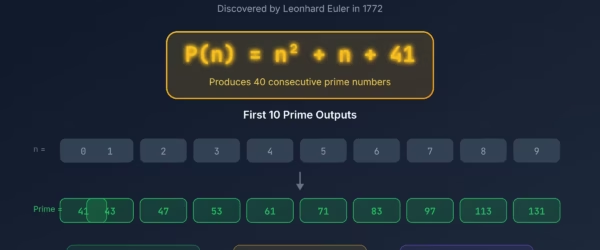
According to Euler, 41 was the most appropriate value of k yielding more prime numbers than any other k. In the list below, each value of f(x) is a prime for k=41:

k

41

x

0

f(x)

41

1 43
2 47
3 53
4 61
5 71
6 83
7 97
8 113
9 131
10 151
11 173
12 197
13 223
14 251
15 281
16 313
17 347
18 383
19 421
20 461
21 503
22 547
23 593
24 641
25 691
26 743
27 797
28 853
29 911
30 971
31 1033
32 1097
33 1163
34 1231
35 1301
36 1373
37 1447
38 1523
39 1601

So, the Euler’s Prime Generating Equation can be written as
f(x) = x^2+x+41 ; where x is an integer ranging from 0 to 39.

Wait. What if we increase the value of x beyond the limit of 39? What will we get?

The next values of f(x) in this series would be 1681, 1763, 1847, 1933, 2021, 2111, 2203, 2297, 2393, … .
Are all these prime numbers too? The answer is no. 1681 is not a prime number, neither are 1763 and 2021. Though all others are prime numbers.


Fermat Numbers

Fermat Number, a class of numbers, is an integer of the form F_n=2^{2^n} +1 \ \ n \ge 0.

For example: Putting n := 0,1,2 \ldots in F_n=2^{2^n} we get F_0=3, F_1=5, F_2=17, F_3=257 etc.

Fermat observed that all the integers F_0, F_1, F_2, F_3, \ldots were prime numbers and announced that F_n is a prime for each natural value of n.

In writing to Prof. Mersenne, Fermat confidently announced:

I have found that numbers of the form 2^{2^n}+1 are always prime numbers and have long since signified to analysts the truth of this theorem.

However, he also accepted that he was unable to prove it theoretically. Euler in 1732 negated Fermat’s fact and told that F_1 -F_4 are primes but F_5=2^{2^5} =4294967297 is not a prime since it is divisible by 641.
Euler also stated that all Fermat numbers are not necessarily primes and the Fermat number which is a prime, might be called a Fermat Prime. Euler used division to prove the fact that F_5 is not a prime. The elementary proof of Euler’s negation is due to G. Bennett.

Theorem:

The Fermat number F_5 is divisible by 641 i.e., 641|F_5.

Proof:

As defined F_5 :=2^{2^5}+1=2^{32}+1 \ \ldots (1)

Factorising 641 in such a way that 641=640+1 =5 \times 128+1 \\ =5 \times 2^7 +1
Assuming a=5 \bigwedge b=2^7 we have ab+1=641.

Subtracting a^4=5^4=625 from 641, we get ab+1-a^4=641-625=16=2^4 \ \ldots (2).

Now again, equation (1) could be written as
F_5=2^{32}+1 \\ \ =2^4 \times {(2^7)}^4+1 \\ \ =2^4 b^4 +1 \\ \ =(1+ab-a^4)b^4 +1 \\ \ =(1+ab)[a^4+(1-ab)(1+a^2b^2)] \\ \ =641 \times \mathrm{an \, Integer}
Which gives that 641|F_n.

Mathematics is on its progression and well developed now but it is yet not confirmed that whether there are infinitely many Fermat primes or, for that matter, whether there is at least one Fermat prime beyond F_4. The best guess is that all Fermat numbers F_n>F_4 are composite (non-prime).
A useful property of Fermat numbers is that they are relatively prime to each other; i.e., for Fermat numbers F_n, F_m \ m > n \ge 0, \mathrm{gcd}(F_m, F_n) =1.

Following two theorems are very useful in determining the primality of Fermat numbers:

Pepin Test:

For n \ge 1, the Fermat number F_n is prime \iff 3^{(F_n-1)/2} \equiv -1 \pmod {F_n}

Euler- Lucas Theorem

Any prime divisor p of F_n, where n \ge 2, is of form p=k \cdot 2^{n+2}+1.

Fermat numbers (F_n) with n=0, 1, 2, 3, 4 are prime; with n=5,6,7,8,9,10,11 have completely been factored; with n=12, 13, 15, 16, 18, 19, 25, 27, 30 have two or more prime factors known; with n=17, 21, 23, 26, 28, 29, 31, 32 have only one prime factor known; with n=14,20,22,24 have no factors known but proved composites. F_{33} has not yet been proved either prime or composite.

Related articles

Solving Ramanujan’s Puzzling Problem

Consider a sequence of functions as follows:-

f_1 (x) = \sqrt {1+\sqrt {x} }
f_2 (x) = \sqrt{1+ \sqrt {1+2\sqrt {x} } }

f_3 (x) = \sqrt {1+ \sqrt {1+2 \sqrt {1+3 \sqrt {x} } } }

……and so on to

f_n (x) = \sqrt {1+\sqrt{1+2 \sqrt {1+3 \sqrt {\ldots \sqrt {1+n \sqrt {x} } } } } }

Evaluate this function as n tends to infinity.

Or logically:

Find

\displaystyle{\lim_{n \to \infty}} f_n (x) .

(more…)

Follow

Get every new post delivered to your Inbox.

Join 755 other followers

%d bloggers like this: