Home » Posts tagged 'environment'

Tag Archives: environment

Environment Initiatives : Few Good Steps for a Happier Future

Our earth is in a very crusial stage. From this position, only we can make sure that where would our future go? Few Authorities and Initiatives are trying their most to save our earth & environment.

International Year of Forests 2011 logo

INTERNATIONAL YEAR OF FORESTS 2011

The United Nations declared the year 2011 as the International Year of Forests to raise awareness and strengthen the Sustainable forest management, conservation and developement of all types of trees for the benefit of current and future generations.

The UN’s Food & Agriculture Organization (FAO) estimates that every year about 130,000 km² of the world’s forests are lost due to deforestation.

GreenPeace

GreenPeace was founded in 1971, in Vancouver, Canada, by Jim Bohlem, Irving & Dorothy Stowe and Paul Cote. It stands for opposing environmental abuse, saving endangered species and increasing public awareness through direct action, lobbying, research and innovation.

Members: 3.1 millions in 45+ countries
Volunteers: 15000
HQ: Amsterdam, Netherlands

WORLD ENVIRONMENT DAY

World Environment Day

World Environment Day (WED) was started by the UN General Assembly in 1972 at the Stockholm Conference on the Human Environment. WED is commemorated each year on june 5, in a different city.

Through WED, the United Nations stimulates worldwide awareness of the environment and enhances political attention and action.

Earth Day

Earth Day

Earth Day is celebrated all across New World (America) , where communities honour the environmental holiday by highlighting green issues and commiting themselves to make a difference in their locale.

Earth Hour

Earth Hour

Earth Hour began in Sydney, Australia, in 2007 with about 2 million participants. The voluntary one hour blackout has since grown into an international event as a sign of action against.

Last year, for earth hour 2010, millions of businesses, homes and landmarks around the world switched off their lights on March 27th , between 8:30 to 9:30 on their local time. Thousands of cities in a record 121 countries participated in earth hour 2010.


Other Important International Initiatives and Conventions:

UN Framework Convention On Climate Change (UNFCCC)
• Kyoto Protocol to the UNFCCC
• Convention on the Laws of the Non-Navigational Uses of International Water Courses
• Rotterdam Convention on the Prior Informed Consent Procedure for Certain Hazardous Chemicals and Pesticides in International Trade
Stockholm Convention on Persistent Organic Pollutants
International Tropical Timber Agreement 2006
UN Convention on the Law of the Sea
• Agreement for the Implementation of the Provisions of the UN Convention on the Law of the Sea relating to the Conservation and Management of Straddling Fish Stocks and Highly Migratory Fish Stocks.

© Gaurav Happy Tiwari, 2011

Clean Technology – Why it is the time to be Green?

What is the ‘Need’ of this Clean Technology?

Why Not? There is a desperate need to meet the challenges caused by climate change and environmental degradation. In the past, it was the entrepreneurial spirit that contributed most to the innovations with far reaching benefits. Besides, scientists from outside the industry innovated technologies like steam power, the railways, telegraph, radios and telephone, petroleum, the automobile, computer, internet etc. etc. Yet the role of entrepreneurial innovation in addressing environmental problems has recieved relatively little attention. In this context, presently, the clean technologies have emerged.

Why is this Techology Clean?

Clean Technologies are technologies that use energy, water, raw materials and other inputs more efficiently and productively, create less waste or toxicity, deliver equal or superior performance, and improve customer profitability, through cost reduction and/or increased revenues. Such technologies are found in a broad range of industries, including energy, water, manufacturing, advanced materials and transportation.

As ?

A few examples of clean technologies are-
Wind Energy, Solar Energy, Water Filtration, Industrial Process Controls, Hybrid Electric Vehicles, etc.

Why We Should Use It?

With the decrease of available energy sources; like, petroleum, coal etc., demand for energy worldwide going through the roof and after poor effects of global warming, manufactures realise that alternatives are serious business.

Convergence of environmental, technological, economic and social factors will produce more resource-efficient technologies that will be less reliant on obsolete, polluting technologies.

Progress ?

Clean technology is an intrinsic part of a sustainable economy. Over the past few years, the importance of developing clean technologies has grown significantly and has driven the growth of what are now multi-billion dollar markets. Globally wind energy market was valued at $5 billion in the begining of 21st century, are expected to grow to $550 billion by next year, while solar energy is expected to note from $3.5 billion to $28 billion by the same timeperiod.

The measure share of the climate change in the outlook towards clean technologies has been due to the increasing realisation that this is not merely a social responsibility requirement, but also yield amazing profits.


The result of this awareness is steadily evolving into a sustainable new economy, which is based on premises of clean energy, transportation, water and materials that embody the emerging principles of industrial ecology, resource productivity and natural capitalism. Industrial houses, corporates, as well as goverments are now investing in research and developement on environment-friendly technologies.

Last Lines

There is a need in developing countries to have easy access to the technologies and cheaply. For any major change, changing political understanding on such issues, government support and prospects for business involvement is critical. For the advance of clean technologies require adequate and reliable R&D budgets, better incentive systems to promote and support clean-tech purchases by businesses and competitive price for consumers. A robust economy is as much required for encouraging clean tech investments. And That’s All. :)

Dedicated to Blogadda.com for their Blogger’s Social Responsibility Program & mother Earth. GO GREEN.

10 Most Endangered Rivers

Rio Grande River through Albuquerque, New Mexico

Image via Wikipedia


The Report from World Wild Fund For Nature lists following Rivers as the most endangered rivers.


1.Salween, Nujiang or Nu River

Location: Shared by China, Myanmar and Thailand. It flows from the Tibetian Plateau.

Major Threat: Dams made on it.

2. La Plata

Location: It crosses five countries in South America. Paraguay, Brazil, Argentina, Uruguay & Bolivia.

Major Threat: Dams and Navigation.

3. Danube

Location: 19 European Countries.
Major Threat: Navigation

4. Rio Grande

Location: Border of US & Mexico.
Major Threat: Water Over-extraction

5. Ganges

Location: India & Bangladesh
Major Threat: Water Over-extraction

6. Murray-Darling

Location: Australia
Major Threat: Invasive Species

7. Indus

Location: China, India, Afganistan and Pakistan
Major Threat: Climate Change

8. Nile

Location: 10 Countries in Africa.
Major Threats: Lowering of Water level

9. Yangtze

Location: Tibet-China
Major Threats: Pollution

10. Mekong

Location: China & Combodia
Major Threat: Over Fishing.

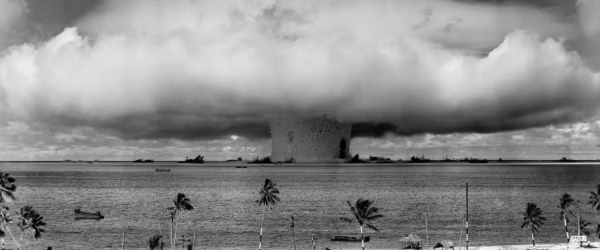
Radioactive Pollution

Early weapons models, such as the "Fat Ma...

Image via Wikipedia

What is Radioactive Polution?

Radioactive Substances and nuclear radiations (i.e., alpha, beta & gamma-particles) produced during nuclear reactions, affect our environment adversely and thus radioactive pollution is created.


Source of Radioactive Polutions & its effects

Source: Low level radioactive liquid wastes, radioactive gaseous wastes & dusts are released during nuclear explosions.

Effects:

I. The radiactive gaseous wastes are injected into the upper layer of atmosphere where, due to cooling they condense to fine-dust particles and thus Radioactive Cloud is formed. This cloud moves in the direction of the wind, settles down slowly to the surface of the earth & thus pollutes air,water & soil.
II. The radioactive substances produce energy which is so strong that the living cells are damaged or destroyed.
III. People working with radioactive elements develop tumours.
IV. Radioactive elements like strontium-90 affects our soil & through this human beings and animals are also affected adversely.
V. Nuclear explosions which are operated in sea, make sea water polluted. This affects the aquatic life.
VI. Among the radioactive radiations gamma-rays are the most dangerous, since they have high energy and high penerating power. These radiations can, therefore, pass freely in the human body, where they lose energy, which destroys the living cells by converting them into charged paticles i.e. ions. These ions are chemically very reactive & hence disrupt cell membranes, reduce the effectiveness of enzymes and even damage genes and chromosomes. All these results in diseases like Leakaemania & Cancer. A patient of Radioactive Pollution

VII. The radiations leaked from reactors damage the the health of human beings and animals.

Control Measures For Minimising Radioactive Polution:

The waste materials produced in the mining, enrichment and fission of U-235 inside the reactor are collective called Nuclear Wastes. At present most of the nuclear wastes are being stored in strong leak proof containers. These will be disposed off whenever a safe method of their disposal is found out in future.

Follow

Get every new post delivered to your Inbox.

Join 755 other followers

%d bloggers like this: