Home » Posts tagged 'Calculus'

Tag Archives: Calculus

Proofs of Irrationality

“Irrational numbers are those real numbers which are not rational numbers!”

Def.1: Rational Number

A rational number is a real number which can be expressed in the form of \frac{a}{b} where a and b are both integers relatively prime to each other and b being non-zero.
Following two statements are equivalent to the definition 1.
1. x=\frac{a}{b} is rational if and only if a and b are integers relatively prime to each other and b does not equal to zero.
2. x=\frac{a}{b} \in \mathbb{Q} \iff \mathrm{g.c.d.} (a,b) =1, \ a \in \mathbb{Z}, \ b \in \mathbb{Z} \setminus \{0\}.

(more…)

Gamma Function

If we consider the integral I =\displaystyle{\int_0^{\infty}} e^{-t} t^{a-1} \mathrm dt , it is once seen to be an infinite and improper integral. This integral is infinite because the upper limit of integration is infinite and it is improper because t=0 is a point of infinite discontinuity of the integrand, if a<1, where a is either real number or real part of a complex number. This integral is known as Euler’s Integral. This is of a great importance in mathematical analysis and calculus. The result, i.e., integral, is defined as a new function of real number a, as \Gamma (a) =\displaystyle{\int_0^{\infty}} e^{-t} t^{a-1} \mathrm dt .

(more…)

The Area of a Disk

[This post is under review.]

If you are aware of elementary facts of geometry, then you might know that the area of a disk with radius R is \pi R^2.

The radius is actually the measure(length) of a line joining the center of disk and any point on the circumference of the disk or any other circular lamina. Radius for a disk is always same, irrespective of the location of point at circumference to which you are joining the center of disk. The area of disk is defined as the ‘measure of surface‘ surrounded by the round edge (circumference) of the disk.

Radius and Area of a Disk

The area of a disk can be derived by breaking it into a number of identical parts of disk as units — calculating their areas and summing them up till disk is reformed. There are many ways to imagine a unit of disk. We can imagine the disk to be made up of several concentric very thin rings increasing in radius from zero to the radius of disc. In this method we can take an arbitrary ring, calculate its area and then in similar manner, induce areas of other rings -sum them till whole disk is obtained. (more…)

Triangle Inequality

Triangle inequality has its name on a geometrical fact that the length of one side of a triangle can never be greater than the sum of the lengths of other two sides of the triangle. If a, b and c be the three sides of a triangle, then neither a can be greater than b+c, norb can be greater than c+a, nor c can be than a+b.

A Triangle with sides a, b, c
Triangle

Consider the triangle in the image, side a shall be equal to the sum of other two sides b and c, only if the triangle behaves like a straight line. Thinking practically, one can say that one side is formed by joining the end points of two other sides.
In modulus form, |x+y| represents the side a if |x| represents side b and |y| represents side c. A modulus is nothing, but the distance of a point on the number line from point zero.

Visual representation of Triangle inequality

For example, the distance of 5 and -5 from 0 on the initial line is 5. So we may write that |5|=|-5|=5.

Triangle inequalities are not only valid for real numbers but also for complex numbers, vectors and in Euclidean spaces. In this article, I shall discuss them separately. (more…)

On Ramanujan’s Nested Radicals

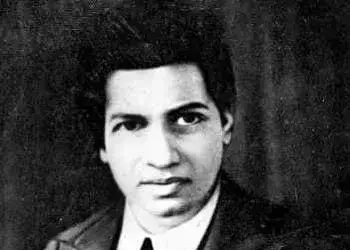
Ramanujan (1887-1920) discovered some formulas on algebraic nested radicals. This article is based on one of those formulas. The main aim of this article is to discuss and derive them intuitively. Nested radicals have many applications in Number Theory as well as in Numerical Methods.

Four Math Problems

  1. Solve the equation
    {(\dfrac{1}{10})}^{\log_{\frac{x}{4}} {\sqrt [4] {x} -1}} -4^{\log_{10} {\sqrt [4] {x} +5}} =6, \forall x \ge 1
  2. The function f: \mathbb{R} \to \mathbb{R} has n+1 derivatives. Show that if a < b and \log [f(b)+f'(b)+f"(b)+ \ldots +f^n(b)] - \log [f(a)+f'(a)+f"(a)+ \ldots +f^n(a)] =b-a then we can find c \in (a,b) such that f^{n+1} (c) = f (c).
  3. Let A = \{(x,y) : 0 \le < 1 \} .
    For (x,y) \in A , let \mathbf{S} (x,y)= \displaystyle{\sum_{\frac{1}{2} \le \frac{m}{n} \le 2}} x^m y^n where the sum ranges over all pairs (m,n) of positive integer satisfying the indicated inequalities. Evaluate:
    \displaystyle {\lim_{{(x,y) \to (1,1)}_{(x,y) \in A}}}  (1-xy^2)(1-x^2y) \mathbf{S} (x,y) .
  4. This problem deals to elementary functional analysis and is taken from very old paper of Putnam Competitions.

    f: [0, \mathbf{N}] \to \mathbf{R} has continuous second derivative and |f'(x)| < 1, f"(x) > 0 for all x.
    0 \le m_0 < m_1 < m_2 < \ldots < m_k \le \mathbf{N} are integers such that f(m_i) are all integers. Put a_i=m_i-m_{i-1} and b_i=f(m_i)-f(m_{i-1}).
    •Prove that
    -1 < \frac {b_1}{a_1} < \frac {b_2}{a_2} < \ldots < < \frac {b_k}{a_k} < 1.
    • Show that for A > 1 , there are atmost \dfrac{\mathbf{N}}{A} such indices i.
    • Show that there are atmost 3 {(\mathbf{N})}^{2/3} lattice points on the curve y=f(x).

Free Online Calculus Text Books

Once I listed books on Algebra and Related Mathematics in this article, Since then I was recieving emails for few more related articles. Here I’ve tried to list almost all freely available Calculus texts. Here we go:

  1. Elementary Calculus : An approach using infinitesimals by H. J. Keisler
  2. Multivariable Calculus by Jim Herod and George Cain
  3. Calculus by Gilbert Strang for MIT OPEN COURSE WARE
  4. Calculus Bible by G S Gill [I found this link broken.]
  5. Another Calculus Bible by Neveln
  6. Lecture Notes for Applied Calculus [pdf] by Karl Heinz Dovermann
  7. A Summary of Calculus [pdf] by Karl Heinz Dovermann
  8. First Year Calculus Notes by Paul Garrett
  9. The Calculus of Functions of Several Variables by Professor Dan Sloughter
  10. Difference Equations to Differential Equations : An Introduction to Calculus by Professor Dan Sloughter
  11. Visual Calculus by Lawrence S. Husch
  12. A Problem Text in Advanced Calculus by John Erdman
  13. Understanding Calculus by Faraz Hussain
  14. Advanced Calculus [pdf] by Lynn Loomio and Schlomo Sternberg
  15. The Calculus Wikibook [pdf] on Wiki Media
  16. Stewart ‘s Calculus by James Stewert.
    [Link removed due to copyright reasons.]
  17. Vector Calculus
  18. The Calculus for Engineers by John Perry
  19. Calculus Unlimited by J E Marsden & A Weinstein
  20. Advanced Calculus by E B Wilson
  21. Differential and Integral Calculus by Daniel A Murray
  22. Elements of the Differential and Integral Calculus[pdf] by W A Granville & P F Smith
  23. Calculus by Raja Almukkahal, Victor Cifarelli, Chun Tuk Fan & L Jarvis
Follow

Get every new post delivered to your Inbox.

Join 755 other followers

%d bloggers like this: