Home » Chemistry

Category Archives: Chemistry

Consequences of Light Absorption – The Jablonski Diagram

π-electronic energy levels of an organic molec...
Image via Wikipedia

According to the Grotthus – Draper Law of photo-chemistry, also called the principal of photo chemical activation, Only that light which is absorbed by a system can bring about a photochemical change. However it is not essential that the light which is absorbed must bring about a photochemical change. The absorption of light may result in a number of other phenomena as well. For instance, the light absorbed may cause only a decrease in the intensity of the incident radiation. This event is governed by the Beer-Lambert Law. Secondly, the light absorbed may be re-emitted almost instantaneously (within 10^{-8} second) in one or more steps. This phenomenon is known as fluorescence. The emission in fluorescence bearer with the removal of the source of light. Sometimes the light absorbed is given out slowly and even long after the removal of the source of light. This phenomenon is known as phosphorescence.
The phenomena of fluorescence and phosphorescence are best explained with the help of the Jablonski Diagram.
Jablonski Diagram

In order to understand this diagram, we need to define some terminology. Most molecules have an even number of electrons and thus in the ground state, all the electrons are spin paired. The quantity \mathbf {2S+1} , where S is the total electron spin, is known as the spin multiplicity of a state. When the spins are paired \uparrow \downarrow as shown in the figure, the upward orientation of the electron spin is cancelled by the downward orientation so that \mathbf {S=0} .

s_1= + \frac {1}{2} ; s_2= - \frac {1}{2} so that \mathbf{S}=s_1+s_2 =0.
Hence, \mathbf {2S+1}=1

Thus, the spin multiplicity of the molecule is 1. We express it by saying that the molecule is in the singlet ground state.

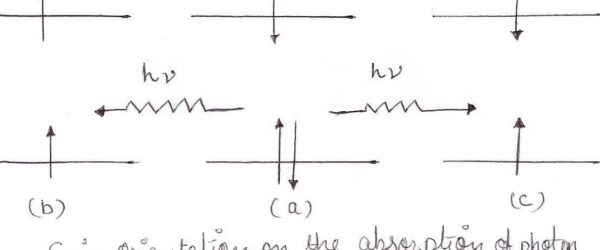
Spin Orientation on the absortion of a ligh photon

When by the absorption of a photon of a suitable energy h \nu , one of the paired electrons goes to a higher energy level (excited state), the spin orientations of the single electrons may be either parallel or antiparallel. [see image]

•If spins are parallel, \mathbf {S=1} or \mathbf {2S+1=3} i.e., the spin multiplicity is 3. This is expressed by saying that the molecule is in the triplet excited state.
• If the spins are anti-parallel, then
\mathbf{S=0} so that \mathbf {2S+1=1} i.e., the singlet excited state, as already mentioned.

Since the electron can jump to any of the higher electronic states depending upon the energy of the photon absorbed, we get a series of singlet excited states, \{S_n\} where n \ge 1 and a series of triplet excited state \{T_n\} where n \ge 1 . Thus S_1, \, S_2, \, S_3, .... etc are respectively known as first singlet excited state, second singlet excited state and so on. Similarly, in T_1, \, T_2,\, ..... are respectively known as first triplet excited state, second triplet excited state and so on.

Make sure, you are not confused in \mathbf{S} & S_n

Classical Theory of Raman Scattering

The classical theory of Raman effect, also called the polarizability theory, was developed by G. Placzek in 1934. I shall discuss it briefly here. It is known from electrostatics that the electric field E associated with the electromagnetic radiation induces a dipole moment \mu in the molecule, given by
\mu = \alpha E …….(1)
where \alpha is the polarizability of the molecule. The electric field vector E itself is given by
E = E_0 \sin \omega t = E_0 \sin 2\pi \nu t ……(2)
where E_0 is the amplitude of the vibrating electric field vector and \nu is the frequency of the incident light radiation.

Thus, from Eqs. (1) & (2),
\mu= \alpha E_0 \sin 2\pi \nu t …..(3)
Such an oscillating dipole emits radiation of its own oscillation with a frequency \nu , giving the Rayleigh scattered beam. If, however, the polarizability varies slightly with molecular vibration, we can write
\alpha =\alpha_0 + \frac {d\alpha} {dq} q …..(4)
where the coordinate q describes the molecular vibration. We can also write q as:
q=q_0 \sin 2\pi \nu_m t …..(5)
Where q_0 is the amplitude of the molecular vibration and \nu_m is its (molecular) frequency. From Eqs. 4 & 5, we have
\alpha =\alpha_0 + \frac {d\alpha} {dq} q_0 \sin 2\pi \nu_m t …..(6)
Substituting for \alpha   in (3), we have
\mu= \alpha_0 E_0 \sin 2\pi \nu t + \frac {d\alpha}{dq} q_0 E_0 \sin 2\pi \nu t \sin 2\pi \nu_m t …….(7)
Making use of the trigonometric relation \sin x \sin y = \frac{1}{2} [\cos (x-y) -\cos (x+y) ] this equation reduces to:
\mu= \alpha_0 E_0 \sin 2\pi \nu t + \frac {1}{2} \frac {d\alpha}{dq} q_0 E_0 [\cos 2\pi (\nu - \nu_m) t - \cos 2\pi (\nu+\nu_m) t] ……(8)
Thus, we find that the oscillating dipole has three distinct frequency components:

1• The exciting frequency \nu with amplitude \alpha_0 E_0
2• \nu - \nu_m
3• \nu + \nu_m (2 & 3 with very small amplitudes of \frac {1}{2} \frac {d\alpha}{dq} q_0 E_0 . Hence, the Raman spectrum of a vibrating molecule consists of a relatively intense band at the incident frequency and two very weak bands at frequencies slightly above and below that of the intense band.

If, however, the molecular vibration does not change the polarizability of the molecule then (d\alpha / dq )=0 so that the dipole oscillates only at the frequency of the incident (exciting) radiation. The same is true for the molecular rotation. We conclude that for a molecular vibration or rotation to be active in the Raman Spectrum, it must cause a change in the molecular polarizability, i.e., d\alpha/dq \ne 0 …….(9)

Homonuclear diatomic molecules such as \mathbf {H_2 \, N_2 \, O_2} which do not show IR Spectra since they don’t possess a permanent dipole moment, do show Raman spectra since their vibration is accompanied by a change in polarizability of the molecule. As a consequence of the change in polarizability, there occurs a change in the induced dipole moment at the vibrational frequency.

Related Articles

The Lindemann Theory of Unimolecular Reactions

It is easy to understand a bimolecular reaction on the basis of collision theory.

When two molecules A and B collide, their relative kinetic energy exceeds the threshold energy with the result that the collision results in the breaking of comes and the formation of new bonds.

But how can one account for a unimolecular reaction? If we assume that in such a reaction A \longrightarrow P , the molecule A acquires the necessary activation energy for colliding with another molecule, then the reaction should obey second-order kinetics and not the first-order kinetics which is actually observed in several unimolecular gaseous reactions. A satisfactory theory of these reactions was proposed by F. A. Lindemann in 1922. (more…)

Raman Effect- Raman Spectroscopy- Raman Scattering

In constrast to other conventional brances of spectroscopy, Raman spectroscopy deals with the scattering of light & not with its absorption.


Raman Effect

Raman effect
Raman Effect: An Overview

Chandrasekhar Venkat Raman discovered in 1928 that if light of a definite frequency is passed through any substance in gaseous, liquid or solid state, the light scattered at right angles contains radiations not only of the original frequency (Rayleigh Scattering)  but also of some other frequencies which are generally lower but occasionally higher than the frequency of the incident light.


The phenomenon of scattering of light by a substance when the frequencies of radiations scattered at right angles are different (generally lower and only occasionally higher) from the frequency of the incident light, is known as Raman Scattering or Raman effect.
The lines of lower frequencies as known as Stokes lines while those of higher frequencies are called anti-stokes lines.

If f  is the frequency of the incident light &  f’  that of a particular line in the scattered spectrum, then the difference   f-f’   is known as the Raman Frequency. This frequency is independent of the frequency of the incident light. It is constant and is characteristic of the substance exposed to the incident light.

A striking feature of Raman Scattering is that Raman Frequencies are identical, within the limits of experimental error, with those obtained from rotation-vibration (infrared) spectra of the substance.
Here is a home made video explaining the Raman Scattering of Yellow light:

And here is another video guide for Raman Scattering:

Advantage of Raman Effects

  •  Raman Spectroscopy can be used not only for gases but also for liquids & solids for which the infrared spectra are so diffuse as to be of little quantitative value.
  • Raman Effect is exhibited not only by polar molecules but also by non-polar molecules such as O2, N2, Cl2 etc.
  • The rotation-vibration changes in non-polar molecules can be observed only by Raman Spectroscopy.
  • The most important advantage of Raman Spectra is that it involves measurement of frequencies of scattered radiations, which are only slightly different from the frequencies of incident radiations. Thus, by appropriate choice of the incident radiations, the scattered spectral lines are brought into a convenient region of the spectrum, generally in the visible region where they are easily observed. The measurement of the corresponding infrared spectra is much more difficult.
  • It uses visible or ultraviolet radiation rather than infrared radiation.

Uses

  •  Investigation of biological systems such as the polypeptides and the proteins in aqueous solution.
  •  Determination of structures of molecules.

RAMAN was awarded the 1930 Physics Nobel Prize for this.

Classical Theory of Raman Effect

The classical theory of Raman effect, also called the polarizability theory, was developed by G. Placzek in 1934. I shall discuss it briefly here. It is known from electrostatics that the electric field E associated with the electromagnetic radiation induces a dipole moment \mu in the molecule, given by
\mu = \alpha E …….(1)
where \alpha is the polarizability of the molecule. The electric field vector E itself is given by
E = E_0 \sin \omega t = E_0 \sin 2\pi \nu t ……(2)
where E_0 is the amplitude of the vibrating electric field vector and \nu is the frequency of the incident light radiation.

Thus, from Eqs. (1) & (2),
\mu= \alpha E_0 \sin 2\pi \nu t …..(3)
Such an oscillating dipole emits radiation of its own oscillation with a frequency \nu , giving the Rayleigh scattered beam. If, however, the polarizability varies slightly with molecular vibration, we can write
\alpha =\alpha_0 + \frac {d\alpha} {dq} q …..(4)
where the coordinate q describes the molecular vibration. We can also write q as:
q=q_0 \sin 2\pi \nu_m t …..(5)
Where q_0 is the amplitude of the molecular vibration and \nu_m is its (molecular) frequency. From Eqs. 4 & 5, we have
\alpha =\alpha_0 + \frac {d\alpha} {dq} q_0 \sin 2\pi \nu_m t …..(6)
Substituting for \alpha   in (3), we have
\mu= \alpha_0 E_0 \sin 2\pi \nu t + \frac {d\alpha}{dq} q_0 E_0 \sin 2\pi \nu t \sin 2\pi \nu_m t …….(7)
Making use of the trigonometric relation \sin x \sin y = \frac{1}{2} [\cos (x-y) -\cos (x+y) ] this equation reduces to:
\mu= \alpha_0 E_0 \sin 2\pi \nu t + \frac {1}{2} \frac {d\alpha}{dq} q_0 E_0 [\cos 2\pi (\nu - \nu_m) t - \cos 2\pi (\nu+\nu_m) t] ……(8)
Thus, we find that the oscillating dipole has three distinct frequency components:

1• The exciting frequency \nu with amplitude \alpha_0 E_0
2• \nu - \nu_m
3• \nu + \nu_m (2 & 3 with very small amplitudes of \frac {1}{2} \frac {d\alpha}{dq} q_0 E_0 . Hence, the Raman spectrum of a vibrating molecule consists of a relatively intense band at the incident frequency and two very weak bands at frequencies slightly above and below that of the intense band.

If, however, the molecular vibration does not change the polarizability of the molecule then (d\alpha / dq )=0 so that the dipole oscillates only at the frequency of the incident (exciting) radiation. The same is true for the molecular rotation. We conclude that for a molecular vibration or rotation to be active in the Raman Spectrum, it must cause a change in the molecular polarizability, i.e., d\alpha/dq \ne 0 …….(9)

Homonuclear diatomic molecules such as \mathbf {H_2 \, N_2 \, O_2} which do not show IR Spectra since they don’t possess a permanent dipole moment, do show Raman spectra since their vibration is accompanied by a change in polarizability of the molecule. As a consequence of the change in polarizability, there occurs a change in the induced dipole moment at the vibrational frequency.

REFERENCE:-

Principles in Physical Chemistry
[7th edition]
Puri, Sharma & Pathania

Heterocyclic Compounds

What are Heterocyclic Compounds?

Heterocyclic compounds are cyclic compounds that contain atoms other than carbon in their ring. There are smaller and larger rings and there are also multiple ring heterocycles.

Heterocyclic compounds play a big role in organic chemistry and because they have different electron configurations from carbon, they react differently from carbon rings and differently from each other. For now, it’s simply important to know what a heterocyclic compound is.

Click here to download a file(.PDF)


Follow me on twitter

Introduction to the Universe: Part II: Systems of Stars: Solar System and Our Sun

What does “The Solar System” mean?

The Solar System means the system of the Sun. All bodies under the gravitational influence of our local star, the Sun, together with the Sun, form the Solar System.

Bodies? What kind of bodies?

•The largest bodies, orbiting the Sun, including Earth are called planets.
•Often smaller cool bodies called satellites or moons, orbit a planet.
•Bodies smaller than than the planets that orbit the sun are classed as
asteroids if they are rocky or metallic, comets if they are mostly ice and dust, and meteoroids if they are very small. Most comets release gases as they near the heat of sun, producing a luminous cloud called coma & often a long tail. A meteoroid that burns in Earth’s atmosphere is a meteor, while one that reaches Earth without burning completely becomes a meteorite.
• After the exclusion of Pluto from the planet category, a new category is formed: Dwarf Planet.

Elements of Solar System:

Stars: (1) The Sun
Planets: (8) Mercury, Venus, Earth, Mars, Jupiter, Saturn, Uranus, Neptune.
Dwarf Planets: (4) Pluto, Charon, Eris, Ceres- along with the numerous satellites that travels around most of planets.
Others:
Asteroids
Interplanetary Dust
Plasma etc.

What’s Next?

In this article, I shall discuss about the Sun only. Further bodies will be discussed in Part IV & V. While, next Part i.e. PART III, will bring you into the interior of Sun. I suggest you again to read Part I of this Series. :D :)

The Sun

SnapShots & facts about the Sun:

• Sun is one of more than 100 billion stars in the giant spiral galaxy called the Milky Way.

• Sun is the center of the solar system. Its mass is about 740 times as much as that of all the planets combined.

• It continuously gives off energy in several forms- visible light; invisible infrared, ultra-violet, X-rays and γ -rays, cosmic rays, radio waves and plasma.

•The Sun generally move in almost circular orbits around the galactic center at an average speed of about 250 km per second.

•It takes 250 million years to complete one revolution round the center. This period is called a Cosmic Year.

•It’s energy is generated by nuclear fusion in its interior. It is calculated that the Sun consumes about 4million tonnes of hydrogen every second. At this rate, it is expected to burn out its stock of hydrogen in about 5billion years and turn into a red giant.

Solar Statistics

Absolute Visual Magnitude: 4.75
Diameter: 1,384,000 km
Time of one Rotation as seen from the Earth: 25.38days (at equator) to 33days (at poles).
Chemical Composition:
Hydrogen 71%
Helium 26.5%
Other Elements 2.5%
Age: 4.5 billion years aprox.
Expected lifetime: 10 billion years aprox.
Mean distance from Earth 8.2 light seconds i.e. Aprox. 150 million km.

Introduction to Universe: PART I : Stars and their types

An artist's impression of the optical and X-ra...

Image via Wikipedia

What is it?

There are many millions of stars in the sky. In the whole heavens, fewer than 6000 stars are bright enough to be visible and at any one time, less than 2500 stars are visible above the horizon.

Stars account for 98% of the matter in a galaxy. The rest of 2% consists of interstellar or galactic gas & dust in a very attenuated form. The normal density of interstellar gas throughout the galaxy is about one tenth of a hydrogen atome per cm³ volume. Stars tend to form groups.

What I shall discuss here?

There are many types of stars in the universe having different name & definitions. I’ll discuss a few of them!

Major kinds of Stars according to numbers

• Lone Stars :These are alone and going on their own. Lone stars are exception in the Universe.

lone star

These donot follow up the condition to be in galaxy. And this is the difference between it & Single stars.

•Single Stars These are found in galaxy & are single (for example Our Sun). These do not number more than 25% of Stellar (Star) Population.

•Binary Stars or Double Stars These exist as couples of stars (e.g., Antares in Scorpio is actually two stars) and they are some 33% of stellar population.

The rest are •Multiple Stars (e.g., Capella & Alpha Centuri comprize 3 stars each, while Castor consists of 6 stars).

Note that, stars which appear single to the naked eyes are sometimes double stars. There are two stars revolving around a common center of gravity. They are also found in orbital motion round each other, in periods varying from about one year to many thousands of years.

Vivid types of Stars according to their nature


Red Giants

Red Giant

When the hydrogen, the main element in a star, is depleted, its outer regions swell and redden. This is the first sign of age. Such stars are called Red Giants.

Our Star, the Sun, is expected to turn into a red giant in another 5 billion years. Red giants are dying stars that has expanded greatly from its original size and gives off red light. They have gigantic dimensions.

Black Dwarf

black dwarf

It is the blackened corpse of a star. Ultimately it disappears into the blackness of the space.

White Dwarf

White Dwarf

It is a tiny, dense, hot star, representing a late stage in the life of a star. The matter in it is so incredibly dense that a single teaspoonful of it would weigh several tonnes.

Supergiants

These are huge stars, with all their hydrogen fuel used up in their core, but continue to expand hundred of times bigger than its original size before they finally die.

Novae & SuperNovae

These are kind of stars, whose brightness increases suddenly by 10 to 20 times are more and then fades gradually into normal brightness. The sudden increase in brightness is attributed to a partial or outright explosion. In Nova, it seems that only the outer shell explodes, whereas in SuperNova the entire star explodes.

Variable Stars

There are stars that show varying degrees of luminosity.

Quasars

These are variable stars and are powerful quasi stellar sources of radio radiations.

Pulsars

These are also variable stars which emit regular pulses of electro-magnetic waves of very short duration.

© Gaurav Happy Tiwari, 2011

Follow

Get every new post delivered to your Inbox.

Join 755 other followers

%d bloggers like this: