
Triangle Inequality
The triangle inequality — the statement that for any triangle, the length of any side is less than the sum of the other two — is one of those theorems that looks elementary but turns out to be everywhere in modern mathematics. In Euclidean geometry it’s a consequence of the parallel postulate. In metric-space theory it’s the defining axiom that separates “distance functions” from arbitrary similarity measures. In functional analysis it underwrites every theorem about norms. In computer science it’s the property that makes “approximately equal” a meaningful notion. This guide covers the geometric statement, the proofs (including a beautiful vector-algebra proof and a clean Cauchy-Schwarz-based proof), and the applications that make the inequality more than a high-school geometry fact.
The triangle inequality is one of those results that sounds obvious until you try to prove it rigorously. Here’s the geometric intuition: no side of a triangle can be longer than the other two sides combined. If it were, you couldn’t close the triangle. Simple enough. But this same principle extends to real numbers, complex numbers, vectors, and abstract spaces—and the proofs get increasingly elegant.
Where the Triangle Inequality Shows Up in Modern Math
The triangle inequality \( |a + b| \le |a| + |b| \) (or \( d(x, z) \le d(x, y) + d(y, z) \) in metric form) is the cornerstone of distance, and distance is the cornerstone of most of analysis. Metric spaces: a function \( d : X \times X \to \mathbb{R}_{\ge 0} \) is called a metric iff it’s non-negative, symmetric, vanishes only on identical points, and satisfies the triangle inequality. Remove the triangle inequality and you no longer have a metric — you have a “premetric,” which is much weaker. Norms on vector spaces: a function \( \|\cdot\| : V \to \mathbb{R}_{\ge 0} \) is a norm iff it’s positive-definite, homogeneous, and satisfies \( \|x + y\| \le \|x\| + \|y\| \). The triangle inequality is what lets you do calculus and analysis on infinite-dimensional spaces.
The most beautiful application is the reverse triangle inequality: \( |\,|a| – |b|\,| \le |a – b| \), which says that nearby points have nearby magnitudes — the foundation of continuity proofs for the absolute-value function and norm functions. In machine learning, the triangle inequality is what makes “nearest neighbor” a coherent notion and what underwrites the soundness of metric-based clustering algorithms. In information theory, the Kullback-Leibler divergence famously does NOT satisfy the triangle inequality, which is why we call it a “divergence” rather than a “distance” — that single missing axiom changes the entire mathematical theory built on top of it.
The Geometric Idea
Consider a triangle with sides \( a \), \( b \), and \( c \). The triangle inequality states:
- \( a < b + c \)
- \( b < a + c \)
- \( c < a + b \)
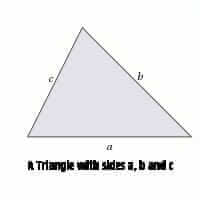
When does equality hold? Only in the degenerate case where the “triangle” collapses into a straight line. Think about it: side \( a \) equals \( b + c \) exactly when points \( B \) and \( C \) lie on the line segment from \( A \). Not really a triangle anymore.
Triangle Inequality for Real Numbers
The real-number version uses absolute values. For any real numbers \( x \) and \( y \):
$$ |x + y| \leq |x| + |y| $$
Here, \( |x| \) represents the distance from \( x \) to zero on the number line. So \( |5| = |-5| = 5 \).
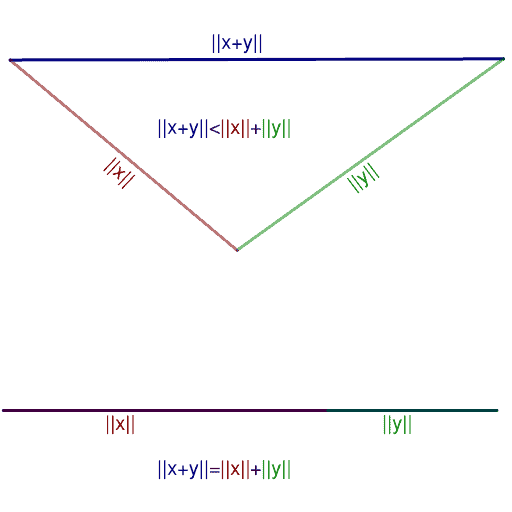
The proof requires a useful lemma first.
Key Lemma
Lemma: For \( a \geq 0 \), we have \( |x| \leq a \) if and only if \( -a \leq x \leq a \).
Proof:
Forward direction: Suppose \( |x| \leq a \). Then \( -|x| \geq -a \). Since \( |x| \) equals either \( x \) or \( -x \), we always have \( -|x| \leq x \leq |x| \). Combining these:
\( -a \leq -|x| \leq x \leq |x| \leq a \)
So \( -a \leq x \leq a \). ✓
Reverse direction: Assume \( -a \leq x \leq a \). If \( x \geq 0 \), then \( |x| = x \leq a \). If \( x < 0 \), then \( |x| = -x \leq a \) (since \( x \geq -a \) implies \( -x \leq a \)). Either way, \( |x| \leq a \). ✓
Main Proof
We know that \( -|x| \leq x \leq |x| \) and \( -|y| \leq y \leq |y| \).
Adding these inequalities:
\( -(|x| + |y|) \leq x + y \leq |x| + |y| \)
By the lemma (with \( a = |x| + |y| \)):
\( |x + y| \leq |x| + |y| \) ✓
Generalization to n Terms
The inequality extends to any finite sum:
$$ |x_1 + x_2 + \cdots + x_n| \leq |x_1| + |x_2| + \cdots + |x_n| $$
Or in sigma notation:
$$ \left| \sum_{k=1}^{n} x_k \right| \leq \sum_{k=1}^{n} |x_k| $$
This follows by induction, applying the two-variable case repeatedly.
Triangle Inequality for Vectors
For vectors \( \mathbf{A} \) and \( \mathbf{B} \) in a vector space \( V_n \):
$$ \|\mathbf{A} + \mathbf{B}\| \leq \|\mathbf{A}\| + \|\mathbf{B}\| $$
Here \( \|\mathbf{A}\| \) denotes the norm (length) of vector \( \mathbf{A} \), defined as:
\( \|\mathbf{A}\| = \sqrt{\mathbf{A} \cdot \mathbf{A}} \)
Proof
Starting from the definition:
$$ \|\mathbf{A} + \mathbf{B}\|^2 = (\mathbf{A} + \mathbf{B}) \cdot (\mathbf{A} + \mathbf{B}) $$
$$ = \mathbf{A} \cdot \mathbf{A} + 2(\mathbf{A} \cdot \mathbf{B}) + \mathbf{B} \cdot \mathbf{B} $$
$$ = \|\mathbf{A}\|^2 + 2(\mathbf{A} \cdot \mathbf{B}) + \|\mathbf{B}\|^2 \tag{1} $$
Meanwhile:
$$ (\|\mathbf{A}\| + \|\mathbf{B}\|)^2 = \|\mathbf{A}\|^2 + 2\|\mathbf{A}\|\|\mathbf{B}\| + \|\mathbf{B}\|^2 \tag{2} $$
The key insight: by the Cauchy-Schwarz inequality:
\( \mathbf{A} \cdot \mathbf{B} \leq \|\mathbf{A}\| \|\mathbf{B}\| \)
Comparing (1) and (2), we see that \( \|\mathbf{A} + \mathbf{B}\|^2 \leq (\|\mathbf{A}\| + \|\mathbf{B}\|)^2 \).
Taking square roots (both sides are non-negative):
\( \|\mathbf{A} + \mathbf{B}\| \leq \|\mathbf{A}\| + \|\mathbf{B}\| \) ✓
Triangle Inequality for Complex Numbers
For complex numbers \( z_1 \) and \( z_2 \):
$$ |z_1 + z_2| \leq |z_1| + |z_2| $$
The proof is essentially identical to the vector case. Complex numbers behave like 2D vectors under addition, and the modulus \( |z| \) corresponds to vector length. Just replace \( \mathbf{A} \) and \( \mathbf{B} \) with \( z_1 \) and \( z_2 \), and the argument carries through.
Triangle Inequality in Euclidean Space \( \mathbb{R}^n \)
Now for the most general setting. Let me build up the machinery we need.
The Set \( \mathbb{R}^n \)
The set \( \mathbb{R}^n \) consists of all ordered n-tuples of real numbers:
\( \mathbf{x} = (x_1, x_2, \ldots, x_n) \)
We define addition and scalar multiplication componentwise:
\( \mathbf{x} + \mathbf{y} = (x_1 + y_1, x_2 + y_2, \ldots, x_n + y_n) \)
\( c\mathbf{x} = (cx_1, cx_2, \ldots, cx_n) \)
The zero vector and negatives are defined naturally:
\( \mathbf{0} = (0, 0, \ldots, 0) \)
\( -\mathbf{x} = (-x_1, -x_2, \ldots, -x_n) \)
Distance in \( \mathbb{R}^n \)
The distance between points \( \mathbf{x} \) and \( \mathbf{y} \) is:
$$ d(\mathbf{x}, \mathbf{y}) = \sqrt{\sum_{i=1}^{n} (x_i – y_i)^2} $$
This is the familiar Euclidean distance, generalized to \( n \) dimensions.
The Norm
The norm of \( \mathbf{x} \) is its distance from the origin:
$$ \|\mathbf{x}\| = \sqrt{\sum_{i=1}^{n} x_i^2} $$
Note that \( d(\mathbf{x}, \mathbf{y}) = \|\mathbf{x} – \mathbf{y}\| \). The norm generalizes absolute value to higher dimensions.
Properties of Euclidean Space
The set \( \mathbb{R}^n \) with this distance function is called Euclidean n-space. The distance satisfies four key properties:
| Property | Statement | Name |
|---|---|---|
| A | \( d(\mathbf{x}, \mathbf{y}) \geq 0 \) for all \( \mathbf{x}, \mathbf{y} \) | Non-negativity |
| B | \( d(\mathbf{x}, \mathbf{y}) = 0 \Leftrightarrow \mathbf{x} = \mathbf{y} \) | Identity of indiscernibles |
| C | \( d(\mathbf{x}, \mathbf{y}) = d(\mathbf{y}, \mathbf{x}) \) | Symmetry |
| D | \( d(\mathbf{x}, \mathbf{y}) \leq d(\mathbf{x}, \mathbf{z}) + d(\mathbf{z}, \mathbf{y}) \) | Triangle inequality |
Properties A, B, and C follow directly from the definition. Property D is the triangle inequality—let’s prove it.
Proof of the Triangle Inequality in \( \mathbb{R}^n \)
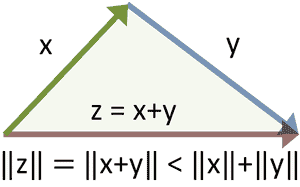
Theorem: For all \( \mathbf{x}, \mathbf{y}, \mathbf{z} \in \mathbb{R}^n \):
\( d(\mathbf{x}, \mathbf{y}) \leq d(\mathbf{x}, \mathbf{z}) + d(\mathbf{z}, \mathbf{y}) \)
Proof: First, we establish the norm inequality. From the definition:
$$ \|\mathbf{x} + \mathbf{y}\|^2 = \sum_{i=1}^{n} (x_i + y_i)^2 $$
$$ = \sum_{i=1}^{n} x_i^2 + 2\sum_{i=1}^{n} x_i y_i + \sum_{i=1}^{n} y_i^2 $$
By the Cauchy-Schwarz inequality:
$$ \sum_{i=1}^{n} x_i y_i \leq \sqrt{\sum_{i=1}^{n} x_i^2} \cdot \sqrt{\sum_{i=1}^{n} y_i^2} = \|\mathbf{x}\| \|\mathbf{y}\| $$
Substituting:
$$ \|\mathbf{x} + \mathbf{y}\|^2 \leq \|\mathbf{x}\|^2 + 2\|\mathbf{x}\|\|\mathbf{y}\| + \|\mathbf{y}\|^2 = (\|\mathbf{x}\| + \|\mathbf{y}\|)^2 $$
Taking square roots:
$$ \|\mathbf{x} + \mathbf{y}\| \leq \|\mathbf{x}\| + \|\mathbf{y}\| \tag{*} $$
Now here’s the clever step. Since (*) holds for all vectors, it holds when we substitute \( \mathbf{x} – \mathbf{z} \) for \( \mathbf{x} \) and \( \mathbf{z} – \mathbf{y} \) for \( \mathbf{y} \):
$$ \|(\mathbf{x} – \mathbf{z}) + (\mathbf{z} – \mathbf{y})\| \leq \|\mathbf{x} – \mathbf{z}\| + \|\mathbf{z} – \mathbf{y}\| $$
$$ \|\mathbf{x} – \mathbf{y}\| \leq \|\mathbf{x} – \mathbf{z}\| + \|\mathbf{z} – \mathbf{y}\| $$
Converting to distance notation:
$$ d(\mathbf{x}, \mathbf{y}) \leq d(\mathbf{x}, \mathbf{z}) + d(\mathbf{z}, \mathbf{y}) \quad \checkmark $$
Summary: Triangle Inequality Across Different Spaces
| Space | Triangle Inequality | Key Tool in Proof |
|---|---|---|
| Real numbers | \( |x + y| \leq |x| + |y| \) | Properties of absolute value |
| Complex numbers | \( |z_1 + z_2| \leq |z_1| + |z_2| \) | Cauchy-Schwarz inequality |
| Vectors in \( V_n \) | \( \|\mathbf{A} + \mathbf{B}\| \leq \|\mathbf{A}\| + \|\mathbf{B}\| \) | Cauchy-Schwarz inequality |
| Euclidean \( \mathbb{R}^n \) | \( d(\mathbf{x}, \mathbf{y}) \leq d(\mathbf{x}, \mathbf{z}) + d(\mathbf{z}, \mathbf{y}) \) | Cauchy-Schwarz inequality |
Why the Triangle Inequality Matters
The triangle inequality isn’t just a curiosity. It’s foundational for:
- Metric spaces: Any function satisfying properties A-D above is called a “metric.” The triangle inequality is what makes distance behave sensibly.
- Analysis: Proofs about convergence, continuity, and limits constantly use this inequality to bound errors.
- Optimization: Many algorithms depend on the fact that the direct path is never longer than a detour.
- Machine learning: Distance-based algorithms (k-nearest neighbors, clustering) rely on triangle inequality for efficient search structures.
Bonus: The Reverse Triangle Inequality
There’s also a lower bound. For real numbers:
$$ ||x| – |y|| \leq |x + y| $$
And for vectors/norms:
$$ |\|\mathbf{A}\| – \|\mathbf{B}\|| \leq \|\mathbf{A} + \mathbf{B}\| $$
This follows directly from the standard triangle inequality by clever substitution. Together, these give you both upper and lower bounds on the length of a sum.
Key Takeaways
- The triangle inequality says the direct path is never longer than a detour
- It holds for real numbers, complex numbers, vectors, and Euclidean space
- The Cauchy-Schwarz inequality is the key tool for proving it in higher dimensions
- It’s one of three properties (with non-negativity and symmetry) that define a metric
- The reverse triangle inequality provides a corresponding lower bound

Hi Gaurav. Nice post, I will include this in the next Math and Multimedia Carnival. By the way, if you can lower the level of your posts to high school level, I can invite to as a guest blogger.
Thanks Guillermo for the compliment! I usually write on basic topics in mathematics —however this is not the one. :)
I am greatly surprised, that how could you do this? Great post. I could only get that the longest side of a triangle is always less than the sum of other two sides
very interesting post.