
Solving Ramanujan’s Puzzling Problem
Here’s a problem that looks impossible at first glance. You’ve got infinitely many nested square roots, each level multiplied by an increasing integer. How do you even begin to evaluate something like that? Turns out, Ramanujan already solved this – and the answer is surprisingly clean.
The Problem: An Infinite Sequence of Nested Radicals
Consider this sequence of functions:
\( f_1(x) = \sqrt{1 + \sqrt{x}} \)
\( f_2(x) = \sqrt{1 + \sqrt{1 + 2\sqrt{x}}} \)
\( f_3(x) = \sqrt{1 + \sqrt{1 + 2\sqrt{1 + 3\sqrt{x}}}} \)
See the pattern? Each function adds another layer of nesting, and the coefficient in front of the innermost radical increases: 1, 2, 3, 4, …
The general form is:
$$ f_n(x) = \sqrt{1 + \sqrt{1 + 2\sqrt{1 + 3\sqrt{\cdots\sqrt{1 + n\sqrt{x}}}}}} $$
The question: What happens as \( n \to \infty \)?
$$ \lim_{n \to \infty} f_n(x) = \, ? $$
At first, this seems hopeless. You can’t “start from the inside” because there’s always another layer. And unlike simple recursive sequences, each level has a different coefficient.
But Ramanujan cracked this over a century ago.
The Key Insight: Ramanujan’s Nested Radical Formula
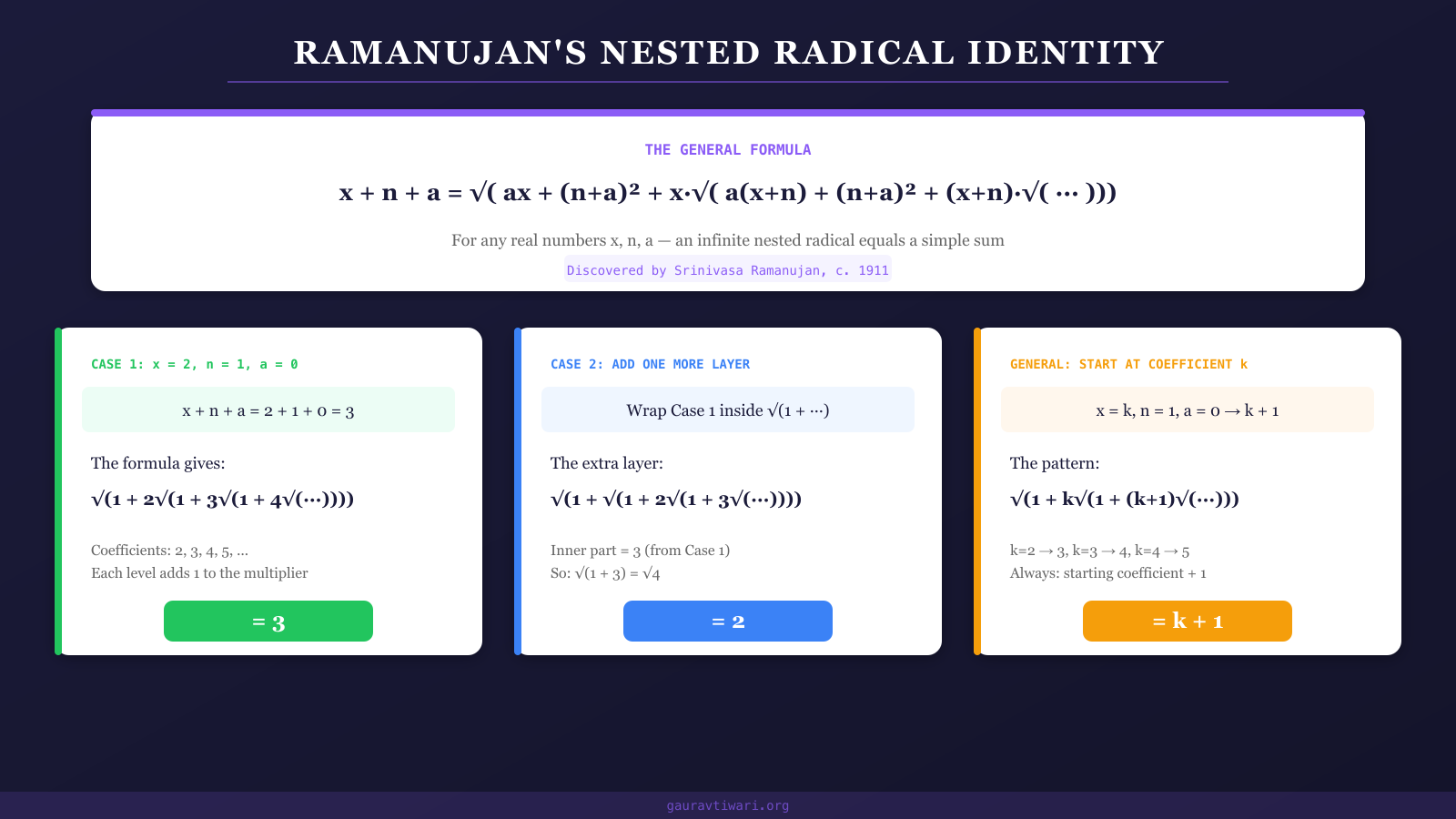
In my article on Ramanujan’s Nested Radicals, I derived his general formula:
Ramanujan’s Nested Radical Identity
For real numbers \( x, n, a \):
$$ x + n + a = \sqrt{ax + (n+a)^2 + x\sqrt{a(x+n) + (n+a)^2 + (x+n)\sqrt{\cdots}}} $$
This formula tells us that certain infinite nested radicals have clean, closed-form values. The trick is matching our problem to this template.
Step 1: Derive a Useful Special Case
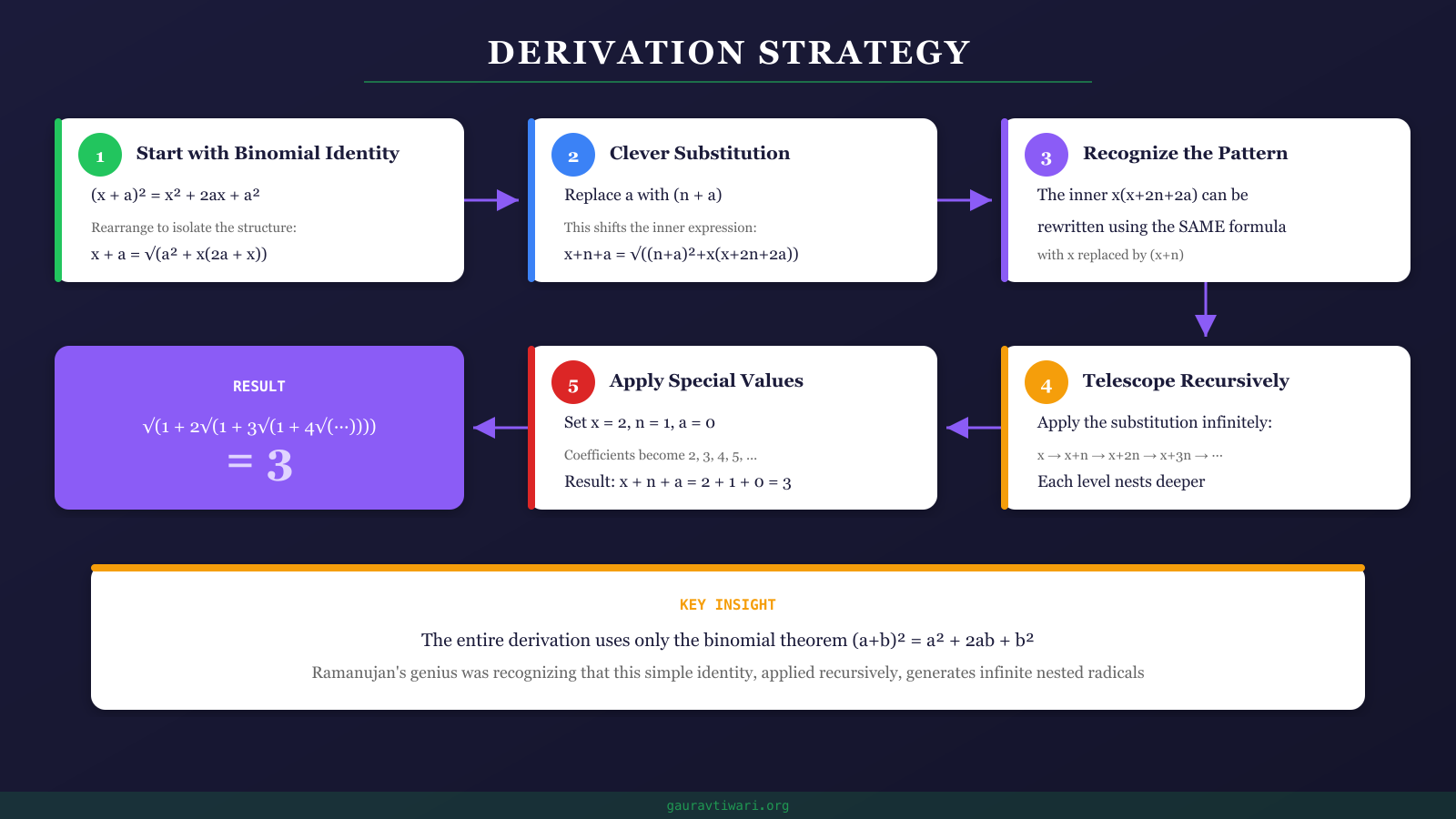
Let’s set \( n = 1 \) and \( a = 0 \) in Ramanujan’s formula:
$$ x + 1 = \sqrt{1 + x\sqrt{1 + (x+1)\sqrt{1 + (x+2)\sqrt{1 + (x+3)\sqrt{\cdots}}}}} $$
Now here’s the key move. Set \( x = 2 \):
$$ 2 + 1 = \sqrt{1 + 2\sqrt{1 + 3\sqrt{1 + 4\sqrt{1 + 5\sqrt{\cdots}}}}} $$
Which simplifies to:
Ramanujan’s Famous Result
$$ 3 = \sqrt{1 + 2\sqrt{1 + 3\sqrt{1 + 4\sqrt{1 + 5\sqrt{\cdots}}}}} $$
This is one of Ramanujan’s most celebrated identities. He posed it as a challenge in 1911, and it took months before anyone could prove it.
Step 2: Connect to Our Problem
Now look at our original sequence again. As \( n \to \infty \), what does \( f_n(x) \) approach?
$$ \lim_{n \to \infty} f_n(x) = \sqrt{1 + \sqrt{1 + 2\sqrt{1 + 3\sqrt{1 + 4\sqrt{\cdots}}}}} $$
Notice anything? The inner part is exactly Ramanujan’s result!
Let me define:
\( X = \sqrt{1 + 2\sqrt{1 + 3\sqrt{1 + 4\sqrt{1 + 5\sqrt{\cdots}}}}} = 3 \)
Then our limit becomes:
$$ \lim_{n \to \infty} f_n(x) = \sqrt{1 + X} = \sqrt{1 + 3} = \sqrt{4} = 2 $$
The Answer
Final Result
$$ \lim_{n \to \infty} f_n(x) = 2 $$
$$ \sqrt{1 + \sqrt{1 + 2\sqrt{1 + 3\sqrt{1 + 4\sqrt{\cdots}}}}} = 2 $$
That’s it. An infinitely nested structure with ever-increasing coefficients collapses to the simple integer 2.
Wait, Does This Actually Work? Let’s Verify

I don’t blame you for being skeptical. Let’s compute the first few values of \( f_n(x) \) and see if they converge toward 2.
For simplicity, let’s evaluate with \( x = 1 \) (the limit doesn’t actually depend on \( x \), as the innermost term becomes negligible):
| \( n \) | Expression | Approximate Value |
|---|---|---|
| 1 | \( \sqrt{1 + \sqrt{1}} \) | 1.4142 |
| 2 | \( \sqrt{1 + \sqrt{1 + 2\sqrt{1}}} \) | 1.6529 |
| 3 | \( \sqrt{1 + \sqrt{1 + 2\sqrt{1 + 3\sqrt{1}}}} \) | 1.8174 |
| 4 | \( \sqrt{1 + \sqrt{1 + 2\sqrt{1 + 3\sqrt{1 + 4\sqrt{1}}}}} \) | 1.9035 |
| 5 | (5 levels deep) | 1.9486 |
| 10 | (10 levels deep) | 1.9937 |
| 20 | (20 levels deep) | 1.9997 |
| \( \infty \) | Limit | 2.0000 |
The convergence is clear. Each additional layer brings us closer to 2.
Pro Tip: You can verify this yourself with a simple recursive program. Start with some value, apply \( \sqrt{1 + n \cdot (\text{previous})} \) working outward, and watch it converge.
Why Does \( x \) Disappear?
You might wonder: the original function \( f_n(x) \) depends on \( x \), but our answer is just 2. What happened?
Here’s the intuition: as \( n \to \infty \), the innermost term \( n\sqrt{x} \) gets wrapped in so many layers of square roots that its influence becomes negligible.
Think about it this way:
- The innermost term is \( n\sqrt{x} \)
- After one square root: \( \sqrt{1 + n\sqrt{x}} \approx \sqrt{n\sqrt{x}} \) for large \( n \)
- Each subsequent layer dampens the effect further
- By the time you reach the outermost layer, the initial \( x \) has been “washed out”
Mathematically, Ramanujan’s formula shows that the infinite structure has a definite value regardless of how it terminates—the pattern of coefficients (1, 2, 3, 4, …) determines the limit completely.
Understanding the Nested Structure
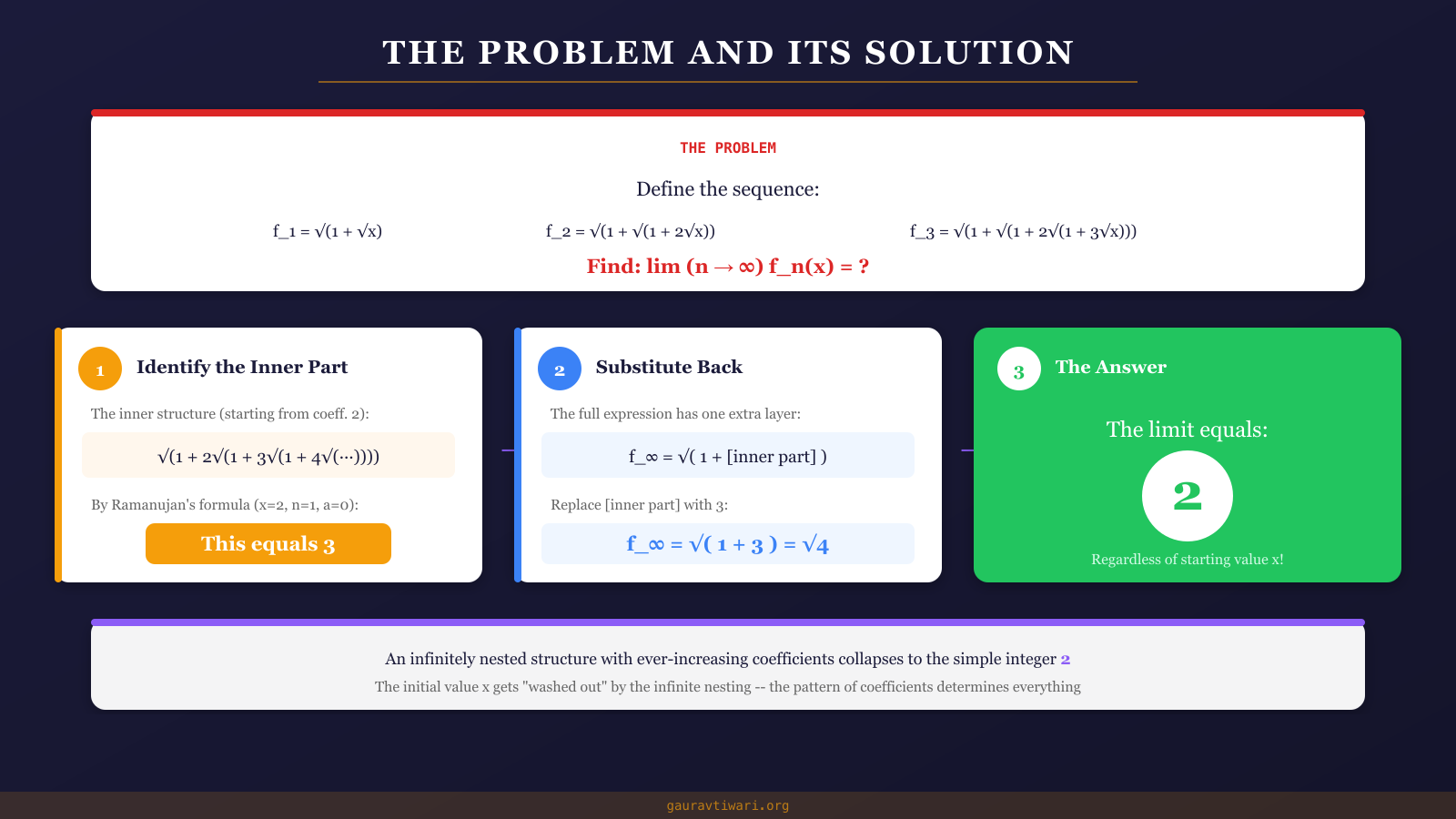
Let me break down exactly how our problem maps to Ramanujan’s formula:
| Our Problem | Ramanujan’s Formula (\( x=2, n=1, a=0 \)) |
|---|---|
| Outermost: \( \sqrt{1 + \cdots} \) | One extra layer wrapping \( x + 1 = 3 \) |
| Coefficient 2 | Corresponds to \( x = 2 \) |
| Coefficient 3 | Corresponds to \( x + 1 = 3 \) |
| Coefficient 4 | Corresponds to \( x + 2 = 4 \) |
| Coefficient \( k \) | Corresponds to \( x + (k-2) = k \) |
The coefficients 2, 3, 4, 5, … in our nested radical match the sequence \( x, x+1, x+2, x+3, … \) in Ramanujan’s formula when \( x = 2 \).
Related Results You Might Find Interesting
Once you understand this technique, you can evaluate an entire family of nested radicals:
Variation 1: Different Starting Coefficient
What if the coefficients started at 3 instead of 2?
$$ \sqrt{1 + 3\sqrt{1 + 4\sqrt{1 + 5\sqrt{\cdots}}}} = \, ? $$
Using Ramanujan’s formula with \( x = 3 \):
\( x + 1 = 3 + 1 = 4 \)
So this nested radical equals 4.
Variation 2: The Classic Ramanujan Problem
Ramanujan’s original 1911 challenge:
$$ \sqrt{1 + 2\sqrt{1 + 3\sqrt{1 + 4\sqrt{\cdots}}}} = 3 $$
This is the inner part of our problem—we just added one more layer on top.
Variation 3: General Formula
For coefficients starting at \( k \):
$$ \sqrt{1 + k\sqrt{1 + (k+1)\sqrt{1 + (k+2)\sqrt{\cdots}}}} = k + 1 $$
So the pattern is beautifully simple: starting coefficient plus one.
Frequently Asked Questions
How did Ramanujan discover these formulas?
Ramanujan worked largely by intuition and pattern recognition. He started with the binomial expansion (x + a)² and made clever substitutions, replacing a with (n + a), then recognizing that the resulting expressions could be nested recursively. He had an extraordinary ability to see patterns that others missed—often arriving at correct results before rigorous proofs existed.
Does this work for any sequence of coefficients?
No. Ramanujan’s formula specifically handles arithmetic progressions (like 2, 3, 4, 5, …). Other coefficient patterns require different techniques or may not have closed-form solutions at all. The special structure of consecutive integers is what makes the formula work.
Why is the answer an integer?
It’s not always an integer—that’s a special feature of specific parameter choices. Ramanujan’s formula gives x + n + a, which can be any real number. For our problem (x = 2, n = 1, a = 0), this happens to be 3, and adding one more √(1 + …) layer gives √4 = 2. Different parameters yield different results, often irrational.
How do I prove convergence rigorously?
The rigorous proof involves showing that: (1) the sequence f_n(x) is monotonically increasing for each fixed x, (2) the sequence is bounded above (by 2), and (3) by the Monotone Convergence Theorem, the limit exists. Then Ramanujan’s identity establishes what that limit equals. The full proof requires careful analysis of the recursive structure.
Are nested radicals useful in practice?
Yes! They appear in: (1) expressing roots of certain polynomials, (2) computing trigonometric values for special angles (like cos(π/17)), (3) continued fraction theory, (4) numerical algorithms for computing square roots, and (5) certain problems in algebraic number theory. They’re also popular in mathematical competitions.
Key Takeaways
- The limit equals 2 — regardless of the starting value \( x \)
- The inner radical equals 3 — Ramanujan’s 1911 result
- One extra layer — wrapping 3 in \( \sqrt{1 + \cdot} \) gives \( \sqrt{4} = 2 \)
- General pattern — coefficients starting at \( k \) give result \( k + 1 \)
- Convergence is fast — even 10 levels gets you within 0.01 of the limit
Further Reading
Want to go deeper? Check out my detailed derivation of the general formula in On Ramanujan’s Nested Radicals, where I walk through the complete proof starting from the binomial theorem.
These problems showcase what made Ramanujan special: the ability to see elegant patterns in seemingly chaotic mathematical structures—and to prove that infinity, properly tamed, gives finite answers.

I’m not entirely sure, but using C++ (with n = 1,000,000) I numerically evaluated it to the function f(x) = 2. But as I said, not quite sure!
You’re right..! After using google, I got this Link , which was also saying the same. But I wasn’t satisfied.
Answer is 3 according to formulation 27 at http://mathworld.wolfram.com/NestedRadical.html .
There are two slightly different versions of this nested radical, so you need to be careful.
The version posed by Ramanujan was
sqrt(1 + 2*sqrt(1 + 3*sqrt(1 + 4*sqrt(1 + … = 3
Your version is almost the same:
sqrt(1 + 1*sqrt(1 + 2*sqrt(1 + 3*sqrt(1 + … = sqrt(1 + 3) = 2.
Hi there,
Just a small typo — I think you meant to write the limit as n tends to infinity. On all of the limits you wrote in that article, you unfortunately said that x goes to infinity.
x_x
x_x Corrected Now. Thanks.
wow – wouldnt have a clue where to start!
I think you might be one of the best bloggers in India today. We are having a TEDx conference, and it would be great to have you as a Speaker. I am sure you can come up with a very interesting talk. Let me know however I can contact you.
Ramanujan always the best
second equation is wrong x+1=sq(1+xsq(1+(x+1))sq(1+(x+2)sq(1+(x+3))))
thank you , this is one of my try out question in my school.
quiet confused since i saw this crazy square root .lol
thank you , this is one of my try out question in my school.
quiet confused since i saw this crazy square root .lol